Over the past few weeks, Beyond Frame has focused heavily on proving that the core technical idea can work.
We can detect a visitor, place them inside a painting, allow them to move between visual layers, trigger environmental reactions, capture an image, and bring the experience to an end.
This week, the question began to change.
Instead of asking:
“Can someone enter the painting?”
we are now asking:
“What makes the visitor feel like they are actually inside its world?”
As Halves approaches, our focus is shifting from individual technical experiments toward building a stable, installed, playable experience in our new project room.
Building a Complete Playable Loop
Our current prototype has grown significantly.
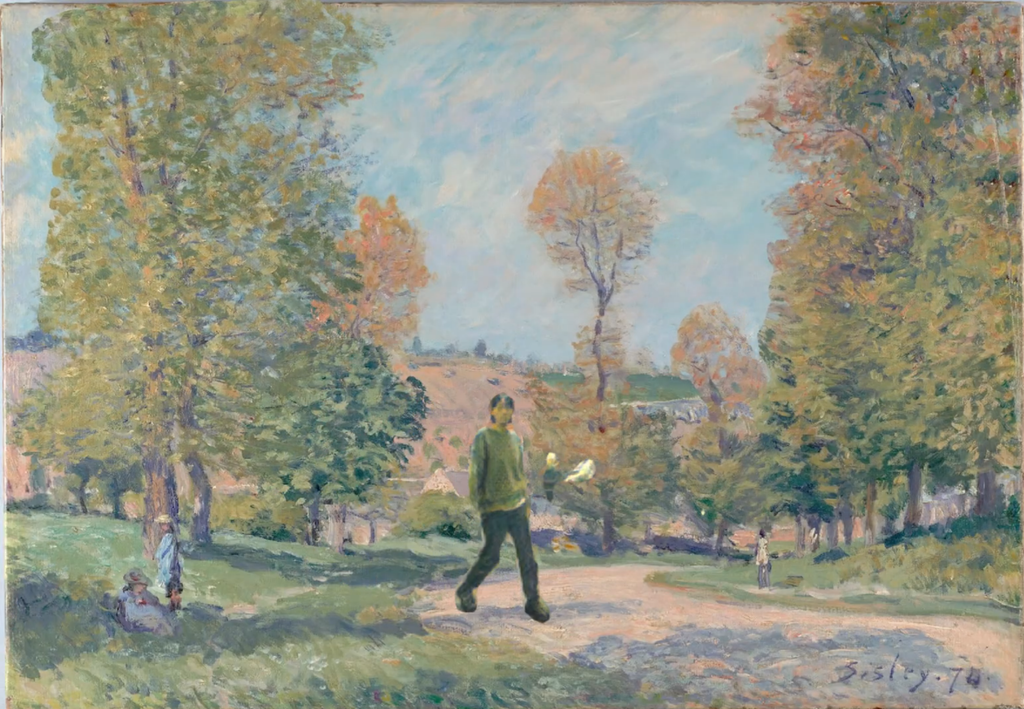
The experience now includes visitor segmentation and filtering, arm movements that trigger falling leaves, trees that respond to the visitor’s horizontal position, gesture-controlled sky movement, depth-based hiding behind trees, fade in/out, and a print + freeze-frame sequence.
These systems give us the basic structure of the experience:
Enter → appear in painting → explore → interact → capture → freeze → print → fade out
For Halves, our goal is no longer to demonstrate these features separately.
They need to work together as one continuous visitor journey.
Moving Beyond Individual Gestures
Our consultant, Ralph, responded positively to the progress of the prototype, but encouraged us to think about layers of interaction rather than continuing to add variations of the same gesture.
The current tree movement, falling leaves, and depth interaction are a strong foundation, but they still largely belong to the same type of visual response.
The next step is to create interactions that feel more distinct from one another.
During the discussion, possibilities included interacting with water, kicking or moving an object, responding to different regions of a painting, or creating other actions that make the visitor feel physically connected to the environment.
The goal is not simply to add more effects.
It is to make the visitor feel that the painting has multiple systems they can discover.
This also affects how we select paintings.
A painting with stronger spatial depth, water, or more distinct environmental regions may naturally support a richer range of behaviors. Ralph specifically encouraged us to consider whether our paintings provide enough opportunities for interaction.
For Halves, however, we do not want to change direction too dramatically. We will continue developing the paintings already in progress while using these questions to guide future selection.
Extending the Painting Into the Room
One of the most important ideas to emerge this week is that interaction does not have to happen only on the screen.
The physical room itself can become part of the painting.
We are beginning to think about the experience as several overlapping environmental layers:
digital image → sound → lighting → visitor movement
For example, the forest painting could be accompanied by soft environmental ambience, footsteps, leaves, distant voices, or wind.
Lighting could then reflect the visual atmosphere of the artwork itself—such as sunlight filtering through trees—rather than functioning only as a technical light source.
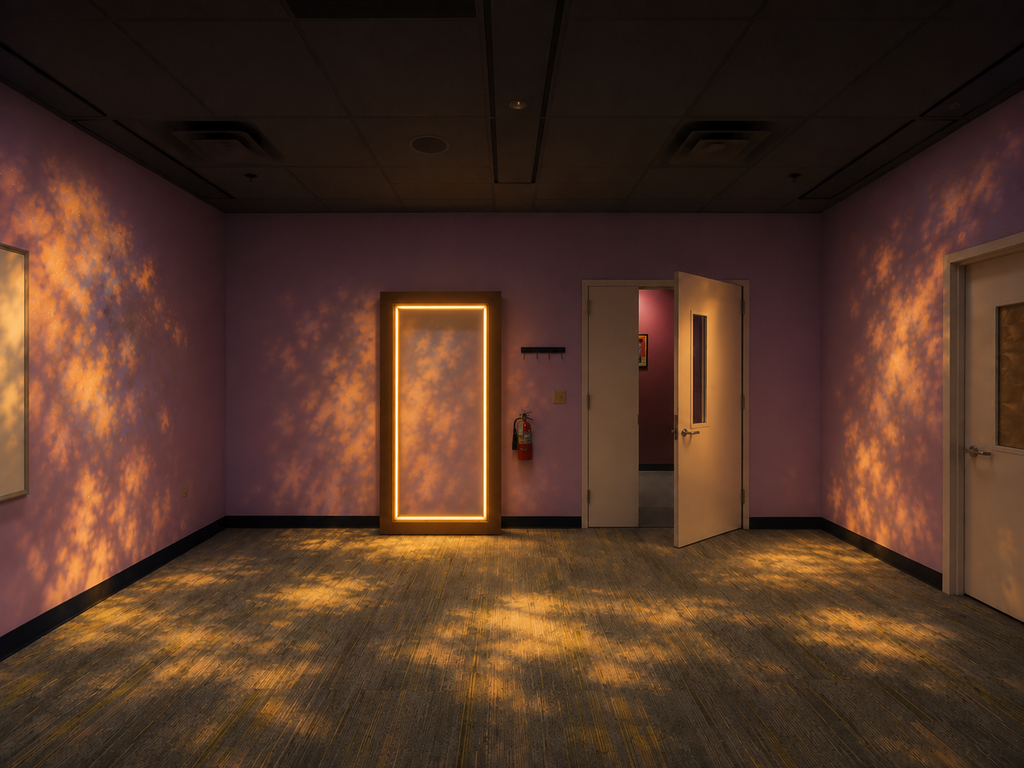
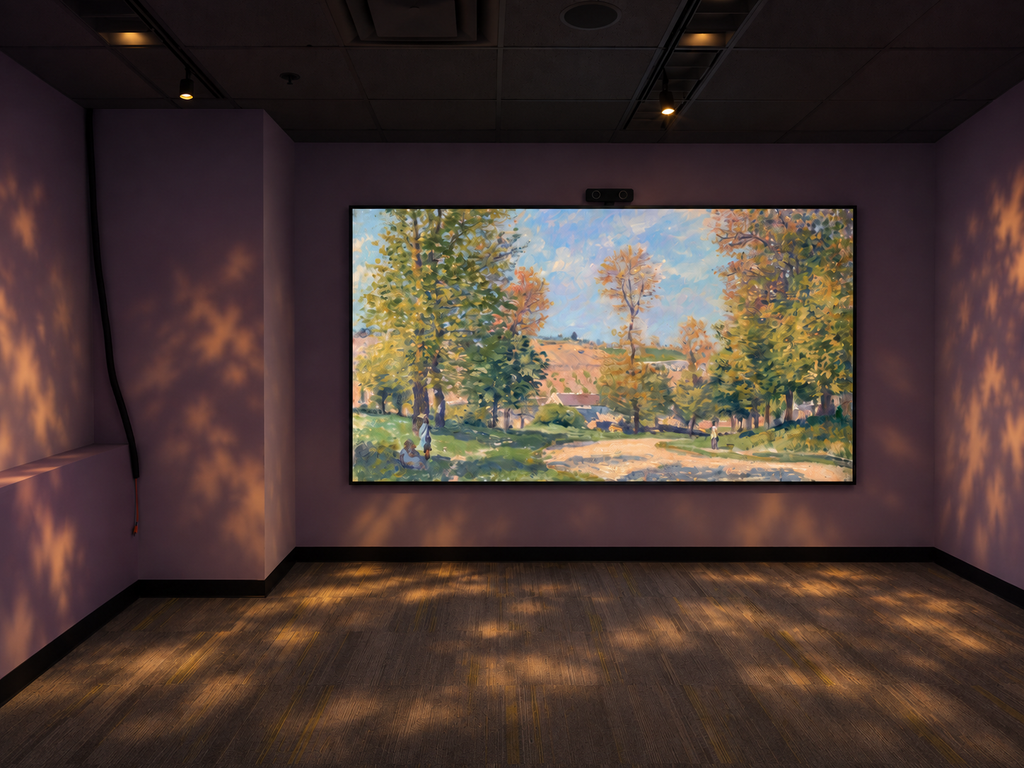
Our current lighting studies explore exactly this idea: allowing the color, brightness, and shadow patterns of the painting to extend beyond the screen into the surrounding space.
The lighting and sound direction presented during our September 23 meetings already begins to visualize this transition from a screen-based experience to an environmental one.
For now, we are intentionally keeping the sound implementation simple.
Rather than trying to complete a sophisticated spatial-audio system before Halves, we are preparing environmental layers such as background ambience, leaves, footsteps, and distant human voices.
The priority is to make sound support the painting first.
Designing the Installation Space
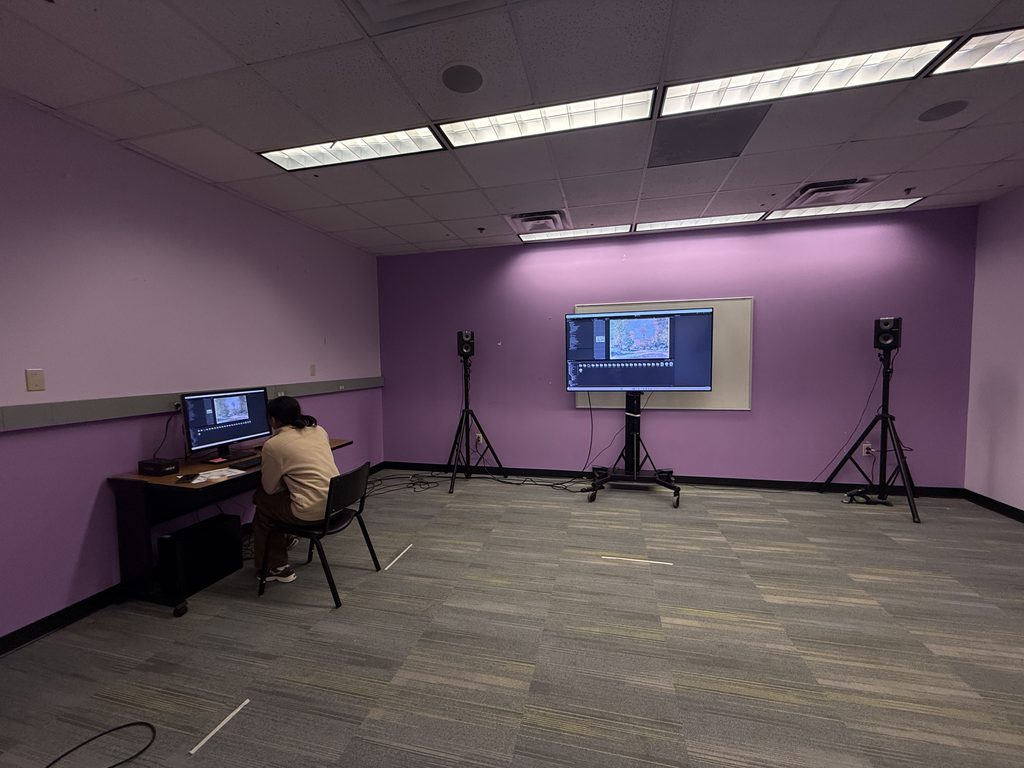
This week, the physical room also became a major part of our development process.
From this point forward, the project room will become our primary testing environment.
Our current room plan includes the screen, camera, physical frame, development computer, four speaker positions, visitor tracking area, and an external printer location.
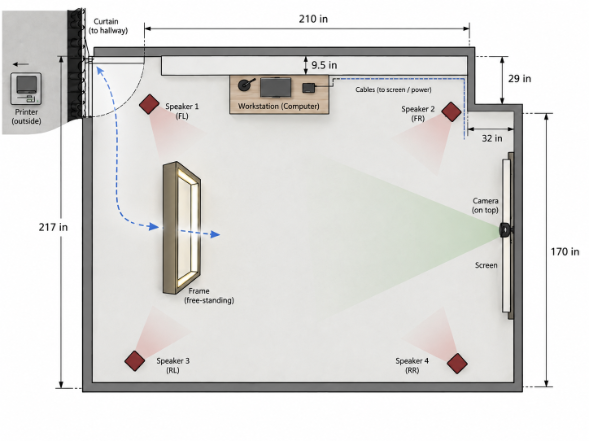
Moving into the actual room changes the type of questions we can ask.
On a development computer, we can test whether a gesture technically works.
In the room, we can test whether the visitor understands where to walk, whether the frame feels appropriately placed, whether the screen is large enough, how long the experience feels, whether sound comes from the right place, and whether the beginning and ending are understandable.
These spatial questions are becoming just as important as the software itself.
We are also testing display size before committing to a larger screen. During the instructor meeting, the plan was to begin with an available 55-inch display before deciding whether a larger screen is necessary.
Designing for a Shorter Experience
Another important consideration this week was experience length.
Ralph suggested that two minutes may be longer than necessary, especially when other visitors may be waiting.
A target closer to one minute could be more appropriate—as long as that minute contains enough meaningful interaction.
This changes how we think about richness.
A richer experience does not necessarily need to be a longer experience.
Instead, we want visitors to quickly understand that the environment responds to them, discover several different types of reaction, and reach the capture moment before the experience begins to feel repetitive.
Refining the Capture Moment
The capture and ending sequence is now technically part of the prototype.
The current system connects the photo capture to a shutter/frame effect, freezes the captured moment, and then transitions toward the end of the experience.
We are still asking whether that is enough.
The visitor needs to understand that a photograph has been captured without the installation suddenly feeling like a conventional photo booth.
Sound may be useful here.
A subtle audio cue, visual freeze, and environmental transition could work together to communicate the moment without introducing a visible interface.
The physical print remains an important final outcome.
We are currently also working through practical questions such as printer size, paper format, and how different painting aspect ratios translate into a physical print. The client meeting specifically raised the issue of a 4×6 printer versus paintings with different proportions, along with possible printer options and paper considerations.
Bringing the Visual Identity Together
The design side of the project has also become much more cohesive this week.
Our identity, logo, poster, half sheet, website, and team imagery are now beginning to share a consistent visual direction built around the idea of entering through the frame into another space.
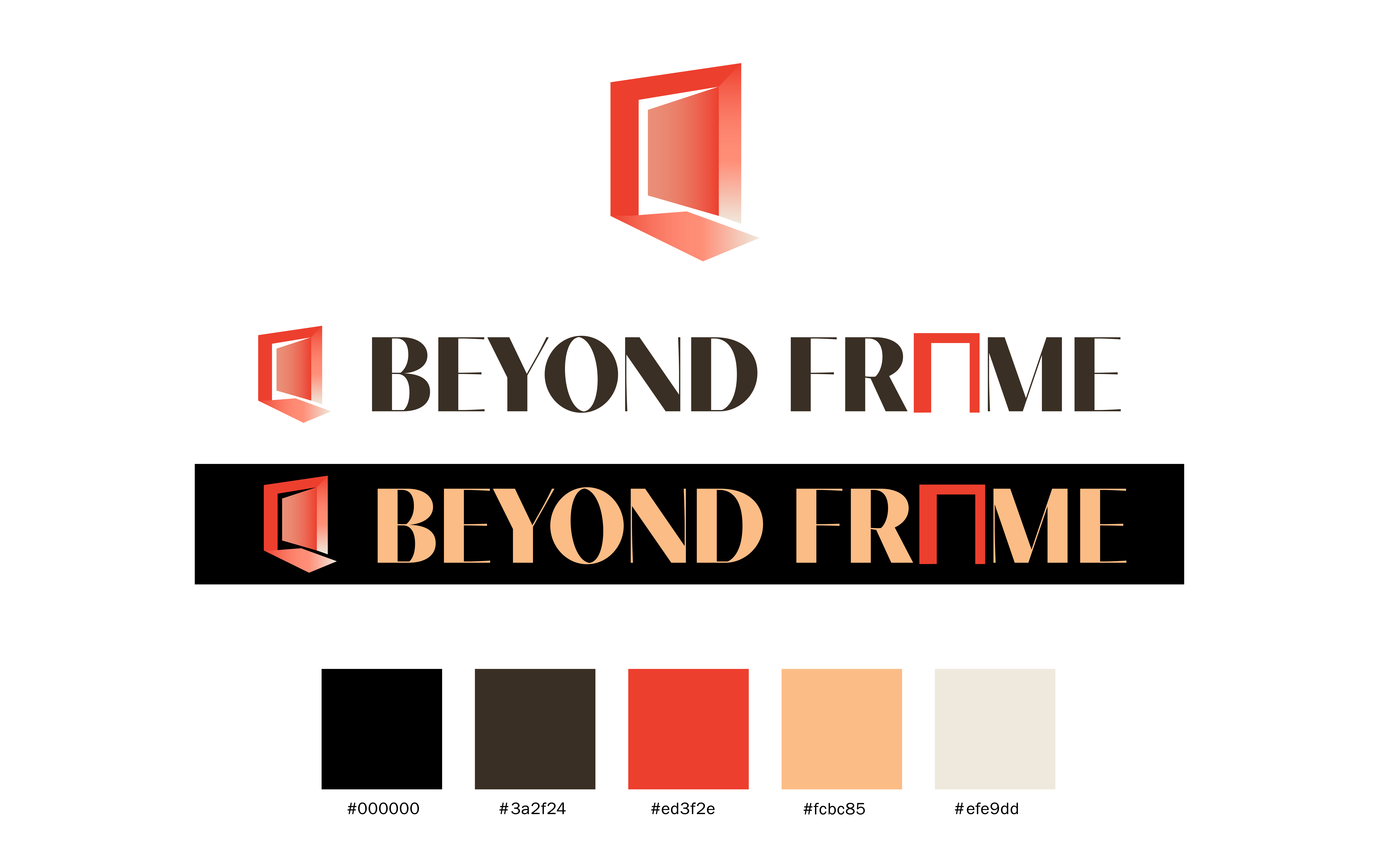
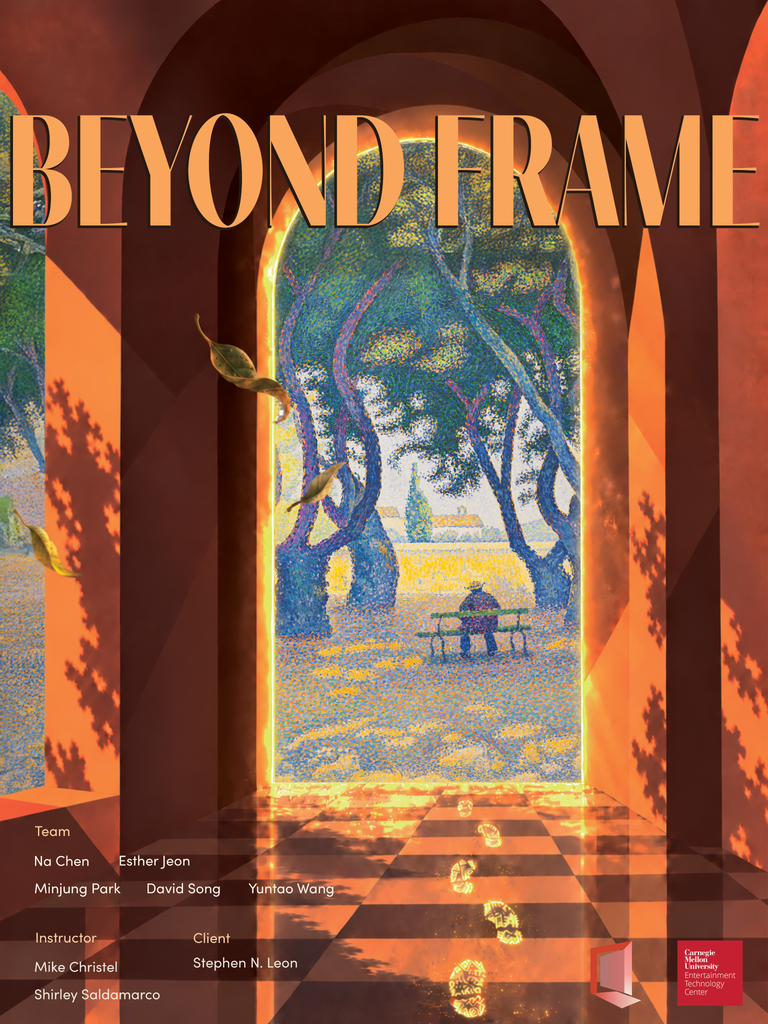
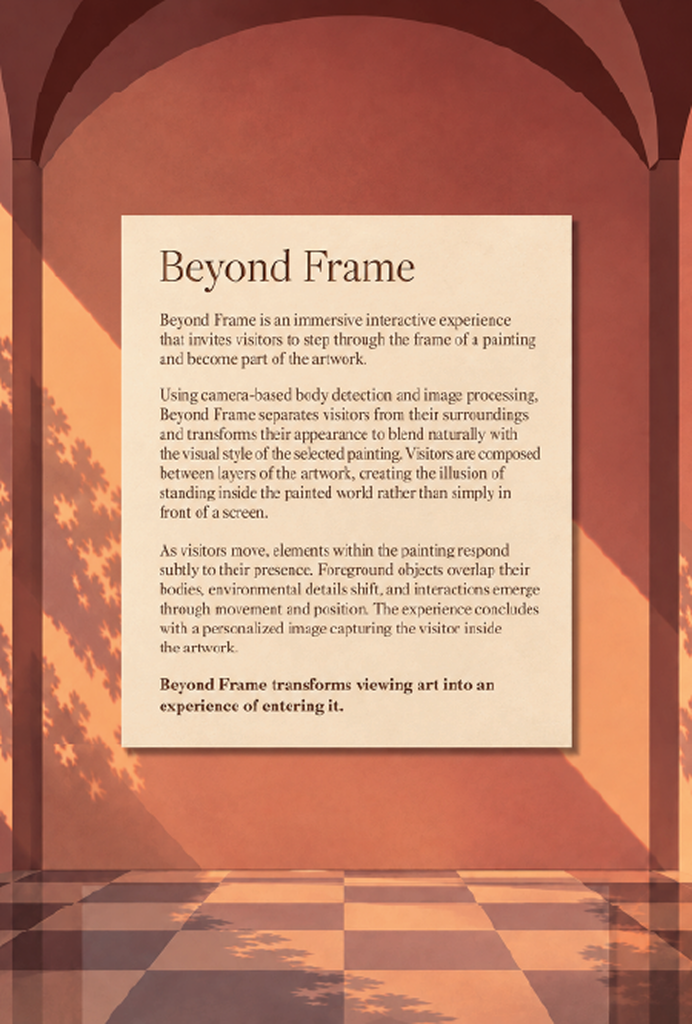
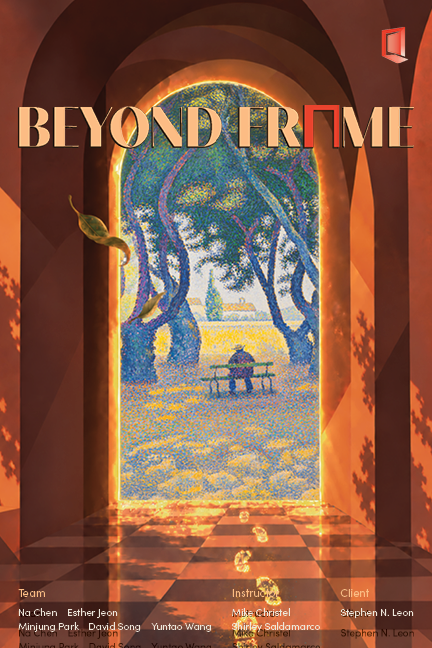
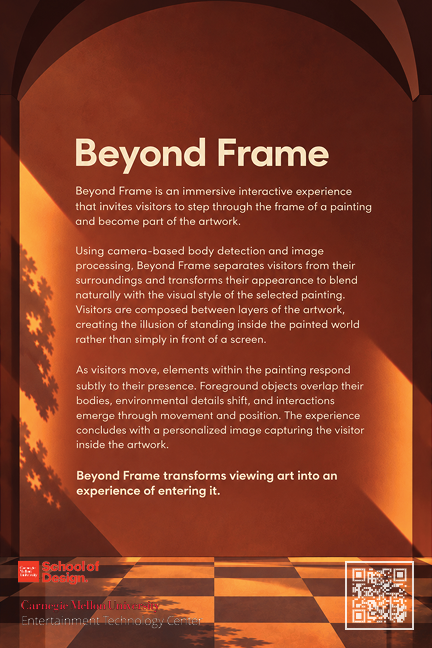
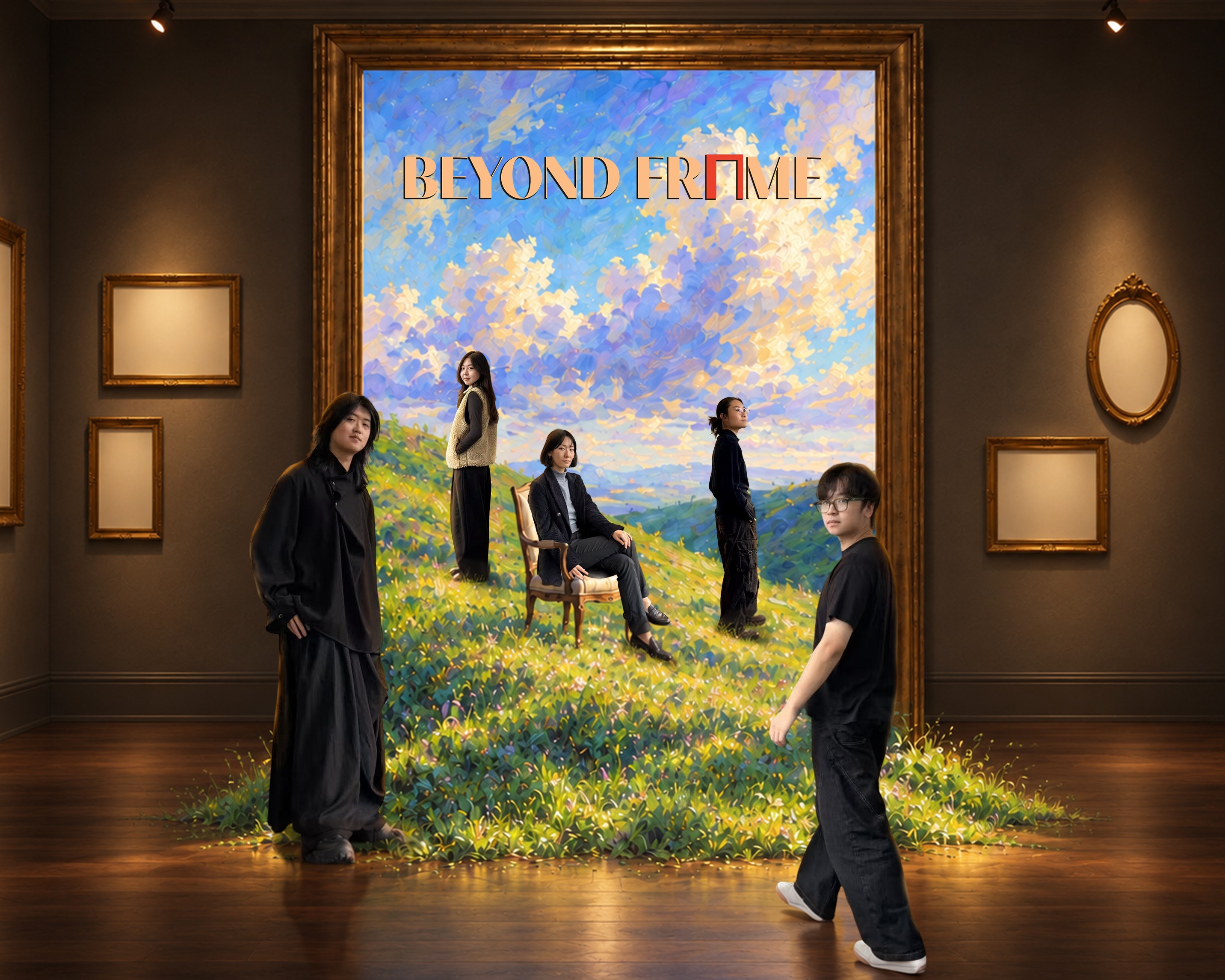
The current design work uses the frame as an opening rather than something broken or destructive, which better reflects the tone of the experience itself.
The poster and team image now communicate the transition from a museum environment into an artwork much more directly. The September 23 instructor presentation shows the current logo, poster, half-sheet, and team-image direction together.
This visual language will also influence the physical frame we eventually build for the room.
Preparing for Our First Full Playtest
Our most immediate milestone is now an internal playtest.
Before then, we want the experience installed enough that the entire team can walk through it from beginning to end.
That means testing not only individual interactions, but also:
the entrance, tracking reliability, visitor boundaries, timing, lighting, sound, capture, printing, fade-out, and the physical room setup as one system.
The instructor milestone for next week is similarly concrete: a full first playable draft in the new room, basic sound, completed painting assets, a basic physical-frame draft, and continued installation preparation.
As Halves gets closer, the project is becoming less about adding isolated features and more about making different parts of the experience support one another.
A tree moving on screen is one interaction.
But the tree moving while leaves fall, sound shifts, light changes across the room, and the visitor physically moves deeper into the composition begins to feel like something else.
That is the direction we want to explore next:
not simply interacting with a painting, but temporarily inhabiting its environment.