As Beyond Frame approaches its soft opening and Fall Festival, our development is moving toward a new goal: creating an experience that visitors can understand and enjoy with minimal assistance from our team.
Over the past few weeks, playtesting has helped us identify what makes the installation engaging and where visitors still encounter confusion.
This week, we focused on testing our latest improvements, refining the interaction language, and preparing the physical installation for public exhibition.
One question has become especially important:
Can the experience communicate how it works without someone standing beside the visitor to explain it?
Learning to Guide Without Explaining
One of our main priorities this week was improving the onboarding experience.
Previously, visitors often needed verbal instructions to understand how to move and interact inside the paintings.
We have now been experimenting with a pictogram-based onboarding system that uses simple visuals and minimal text to communicate that visitors are free to move, gesture, reach, and explore.
Rather than explaining every interaction in advance, we want to introduce the basic language of the experience while preserving the enjoyment of discovery.

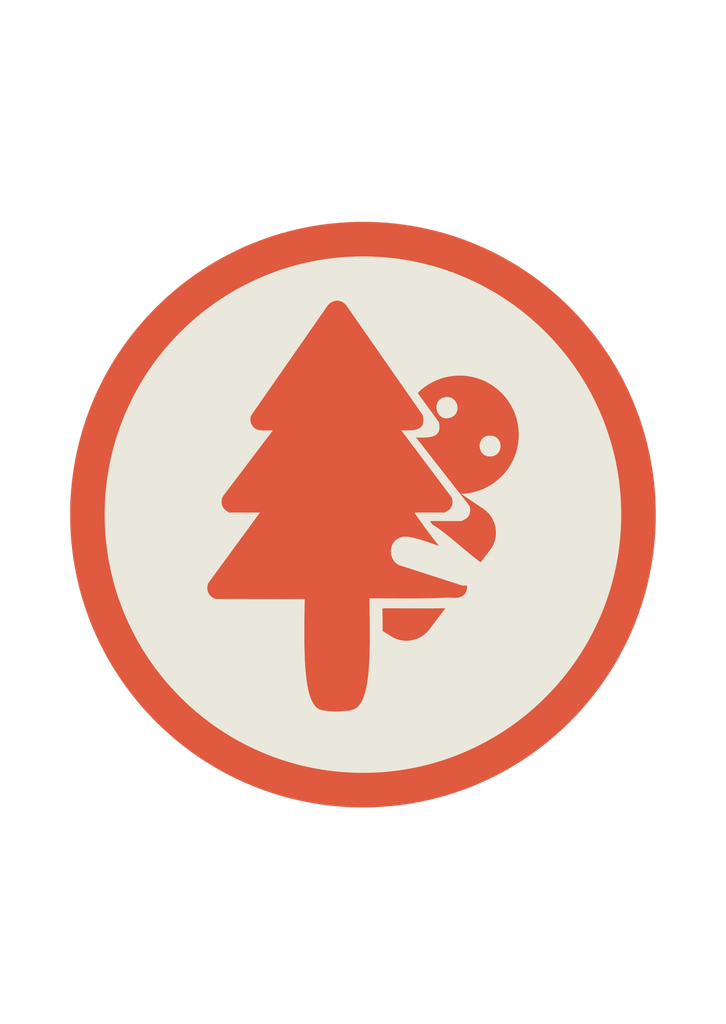
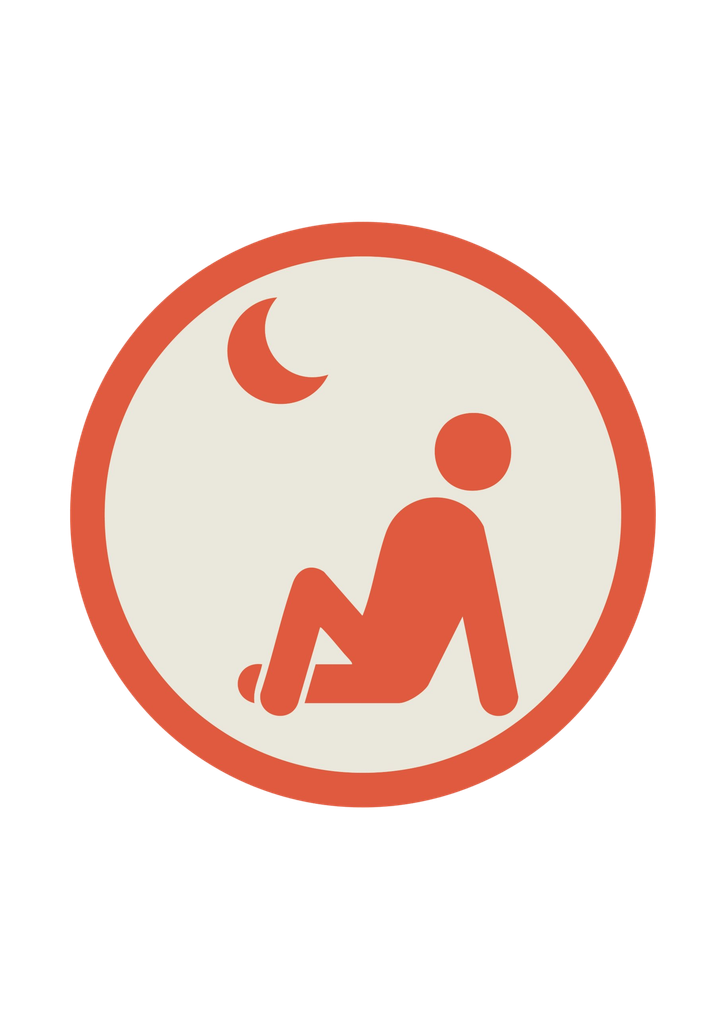
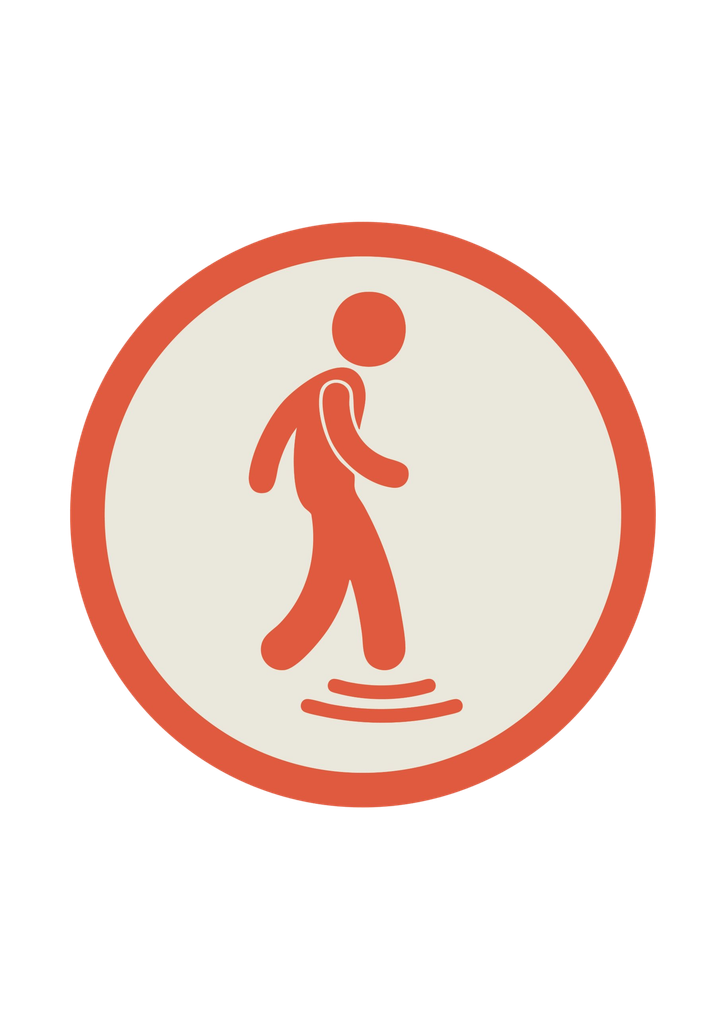
Early testing has been encouraging. Visitors showed improved understanding even when we significantly reduced the amount of verbal explanation.
However, we are also reconsidering where these instructions should appear.
While floor graphics may work during smaller tests, they could easily become hidden by visitors during a crowded event such as Fall Festival.
We are therefore exploring ways to integrate the visual guidance into the entrance or surrounding walls.
Making Interactions Easier to Discover
We also continued refining interactions in both paintings.
For the first painting, we have been developing a new leaf-pile interaction. We compared several visual treatments to find a balance between making the leaves noticeable enough to invite interaction and keeping them consistent with the original artwork.

Other improvements include clearer feedback around the visitor’s hands, stronger environmental reactions, updated character animation, and more immediate interaction cues when visitors enter each painting.
Our latest playtest revealed an important relationship between discovery and enjoyment.
Visitors who discovered several interactions generally responded more positively to the experience, while those who discovered fewer interactions were more likely to feel that they had missed something.
This suggests that the challenge is not simply making more interactions available.
We need to help visitors discover enough of what already exists, without removing the pleasure of exploration.
One direction we are now considering is delayed guidance.
Instead of immediately telling visitors what to do, subtle visual or sound cues could appear after a period of inactivity, helping those who need additional guidance while allowing others to explore independently.
Rethinking the Experience Duration
Another interesting finding from recent playtesting is that some visitors wanted more time inside the paintings.
Our experience currently follows a relatively fixed duration, but different visitors explore at different speeds.
Someone who quickly discovers the major interactions may feel ready to finish earlier, while another visitor may need more time to understand the environment before they can fully enjoy it.
This has led us to consider a more flexible experience structure, where duration could respond to visitor behavior rather than remaining entirely predetermined.
For now, this remains a design direction we want to investigate further.
Finding the Strength of Each Painting
During our client meeting, we also compared the two paintings more directly.
Both have produced engaging results, but they offer different strengths.
One painting currently creates a stronger sense of spatial immersion through its perspective, environmental layers, lighting, and interaction structure.
The other has generated particularly playful responses through its character-based interactions, although some challenges with perspective and interaction clarity remain.
This led to an important discussion about how to use our remaining development time.
Rather than dividing our efforts equally between two experiences that may remain partially polished, our client suggested bringing one painting to a very high level of completion first.
A highly polished experience could become a stronger proof of concept for museums and galleries, while the second painting could still demonstrate how Beyond Frame can adapt to different artworks and interaction styles.
This does not mean abandoning either painting.
It means prioritizing the overall quality of the experience over the quantity of content.
Toward a Self-Running Installation
We also reached an important technical milestone this week.
Beyond Frame can now run through the visitor experience without continuous manual control.
This brings us closer to a self-running installation that can welcome visitors, guide them through the experience, capture their photograph, and reset for the next person.
Our next step is to repeatedly test the complete sequence to ensure that these transitions work reliably together.
At the same time, we are continuing to improve the physical environment.
The frame has reached a stable structural state, allowing us to focus more on its visual appearance, including decorative moulding, surface treatments, and how it reads under the installation lighting.

We are also thinking beyond the interactive room itself.
The hallway and entrance could become a small pre-experience gallery, displaying framed artwork, project information, and visual guidance.
This would help visitors transition naturally from a museum-like environment into the interactive painting, while keeping the main experience space focused on the artwork itself.
Preparing for the XRTC Symposium
Alongside installation development, we have also been preparing Beyond Frame for the 2026 XRTC Symposium on November 18.
We completed a poster bringing together our project motivation, technical implementation, and preliminary findings from playtesting with 35 participants.
The poster documents how visitors interacted with the two paintings, which interactions were most frequently observed, and what challenges emerged during the experience.
Preparing these materials has also helped us reflect on how the project has developed and identify areas for future improvement.
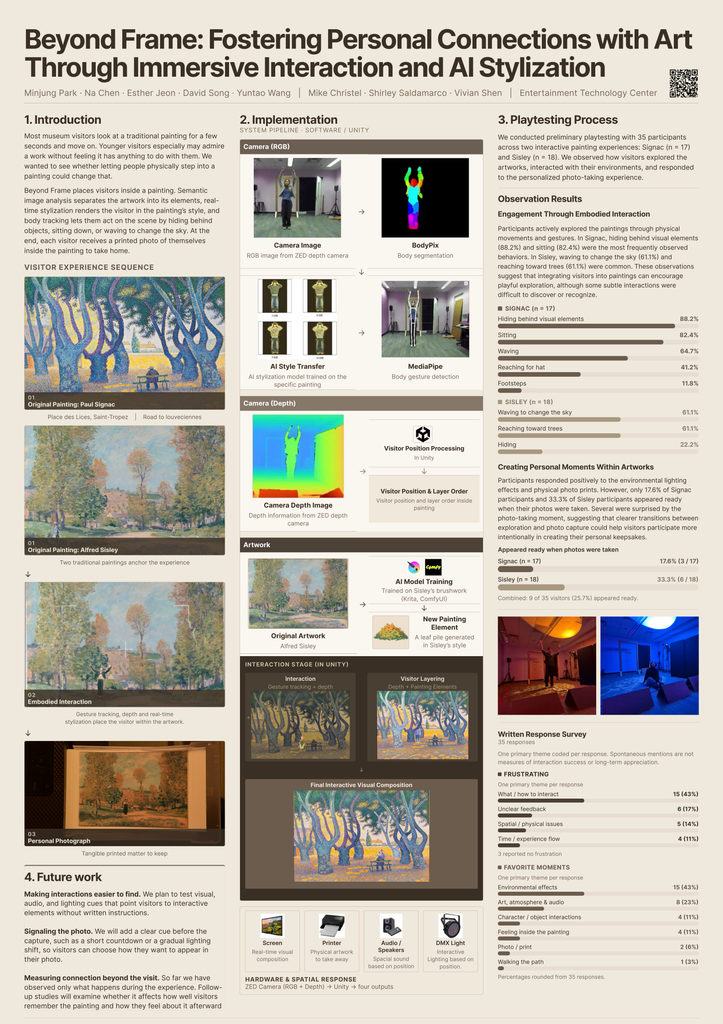
Presenting the installation outside our development room also introduces new technical requirements.
Our current laptop is not powerful enough to run the full experience reliably in this setting, so we are exploring a stronger computer and display setup for the event.
Rather than depending entirely on unfamiliar equipment at the venue, we want to bring a tested configuration that can deliver a consistent experience.
Looking Ahead
As we approach our next public milestones, our priorities are becoming increasingly focused.
We want to make interactions easier to discover, reduce the need for verbal explanation, improve the physical presentation, and ensure that the entire system can operate reliably on its own.
Our recent playtests have also helped us understand that a successful visitor experience is not necessarily one where everyone discovers every interaction.
Instead, it is one where visitors feel encouraged to explore, recognize that their actions matter, and leave with a meaningful memory of the artwork.
The next step for Beyond Frame is not simply to become more interactive, but to become a complete experience that can speak for itself.