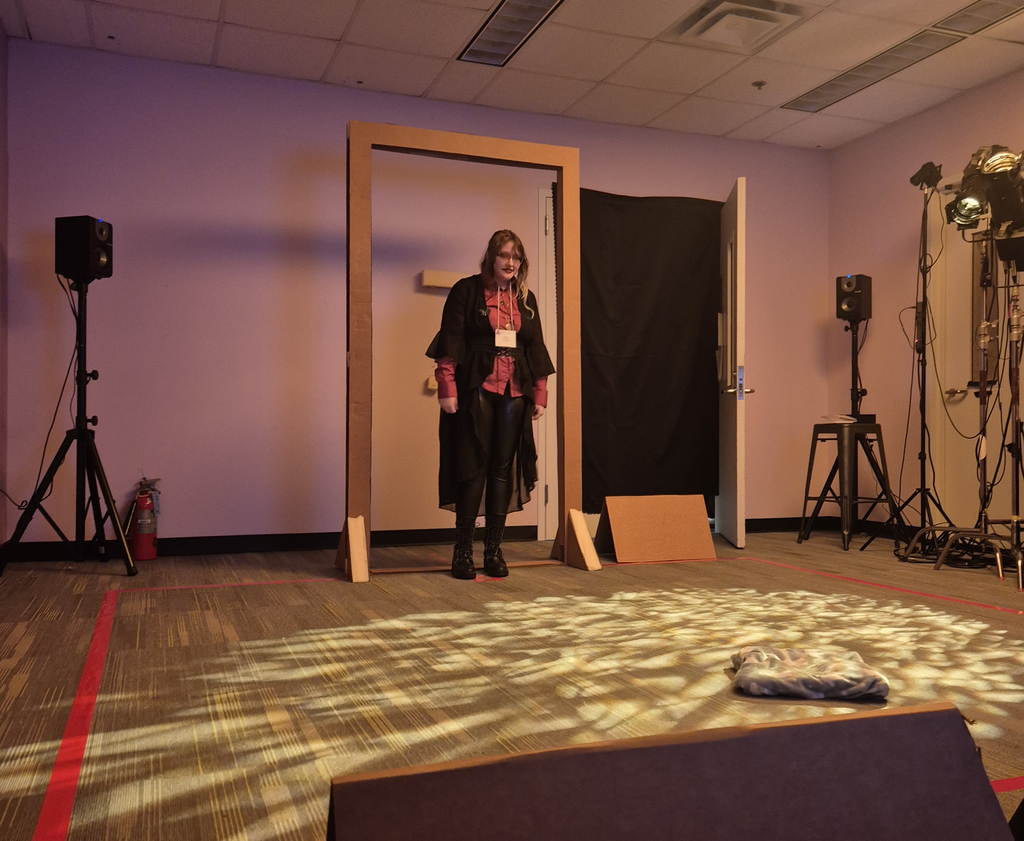
This week, we reviewed the results of our October 31 playtest, where more than 30 participants experienced Beyond Frame.
After several weeks of refining our two paintings, the playtest gave us an opportunity to observe how visitors interacted with the installation and what they found most engaging or confusing.
The results helped us move beyond assumptions about how the experience should work and toward a clearer understanding of how visitors actually experience it.
The overall response was encouraging. Visitors particularly enjoyed the environmental lighting, depth-based movement, atmospheric changes, and the personalized printed photograph.
However, the playtest also revealed an important challenge:
Visitors enjoyed the experience most when they understood how their actions could affect the painting.
What We Learned from the Playtest
One of the strongest responses came from our newly integrated Unity-controlled lighting system.
When visitors triggered changes in the painting, the physical lighting in the room could respond as well. These moments helped extend the artwork beyond the screen and into the surrounding environment.
Depth-based hiding and environmental transformations were also particularly engaging.
At the same time, we noticed several recurring problems.
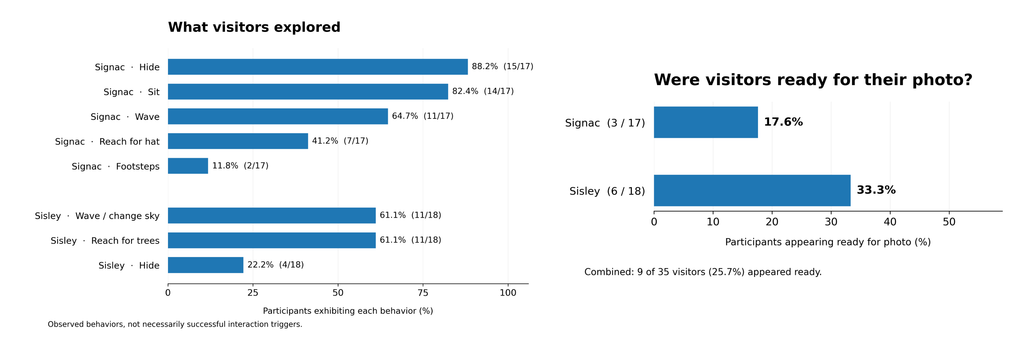
Some visitors were unsure which elements were interactive, what gestures they should use, or whether an environmental change had actually been caused by their actions.
Others became focused on a single interaction and missed the rest of the experience.
Interestingly, several participants wanted more time to explore once they understood how the system worked.
This suggests that our biggest challenge is not necessarily adding more interactions, but helping visitors understand and enjoy the ones that already exist.
Creating a Common Interaction Language
Based on the feedback, we began reconsidering how visitors learn to interact with different paintings.
Currently, different interactions use different gestures and triggers. While this creates variety, it can also make the experience harder to understand.
Our next direction is to establish a more consistent interaction language.
For example, reaching or touching could become a shared interaction gesture across different elements, while the resulting response would remain specific to each painting.
We are also exploring subtle feedback around the visitor’s hands or body to communicate when an interaction has been successfully triggered.
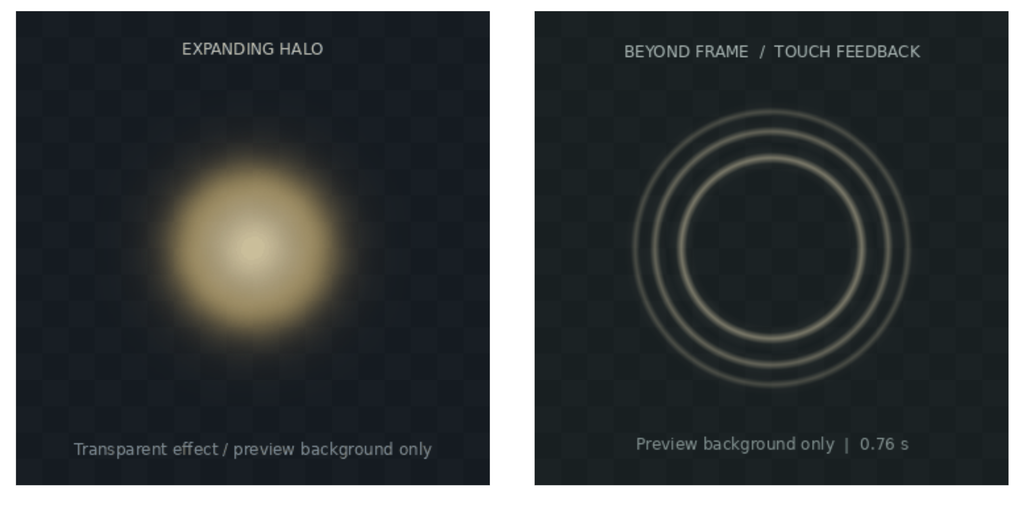
The challenge is to make these responses feel like part of the painting rather than interface elements placed on top of it.
Soft light, environmental movement, particles, and painting-specific sounds could all help communicate a simple message:
“I caused that.”
Making the Interactions More Satisfying
Another takeaway from the playtest was the importance of responsiveness.
Small environmental responses, such as leaves reacting to footsteps, can be surprisingly satisfying when they happen immediately and clearly.
We are now experimenting with faster and more consistent responses, particularly for reaching, touching, and walking interactions.
For the first painting, we are exploring new ways for visitors to interact with fallen leaves on the ground.
For the second painting, we are continuing to refine the seated figure and hat interaction.
We also reconsidered the seating interaction in the second painting.
Our current setup uses a blanket to suggest sitting, but visitors may interpret it in different ways. They might sit on it, pick it up, move it, or simply ignore it.
A very low chair could communicate the intended action more clearly while preserving the visual relationship between the visitor and the seated figure in the painting.
These adjustments are helping us focus on the quality of each interaction rather than simply increasing their number.
Using Lighting with Intention
The playtest confirmed that lighting is one of the most powerful tools available to us.
However, we also realized that dramatic lighting changes can lose their impact if they happen too frequently.
Rather than creating a major lighting transition for every interaction, we are considering approximately two significant lighting moments per painting.
These could include environmental transformations, changes in the sky, or interactions that connect visitor movement with the physical atmosphere of the room.

By making these moments more selective, we hope they will feel more surprising and memorable.
Rethinking the Beginning and Ending
We also received useful feedback about how visitors enter and leave the experience.
The updated entrance cues, including sound and spotlighting, helped visitors identify where to begin.
However, some participants were still uncertain about when they could start moving or what kinds of actions were possible.
We are now considering a short visual introduction using simple pictograms.
Rather than teaching every interaction, this introduction would communicate that visitors are free to move, gesture, reach, and explore.
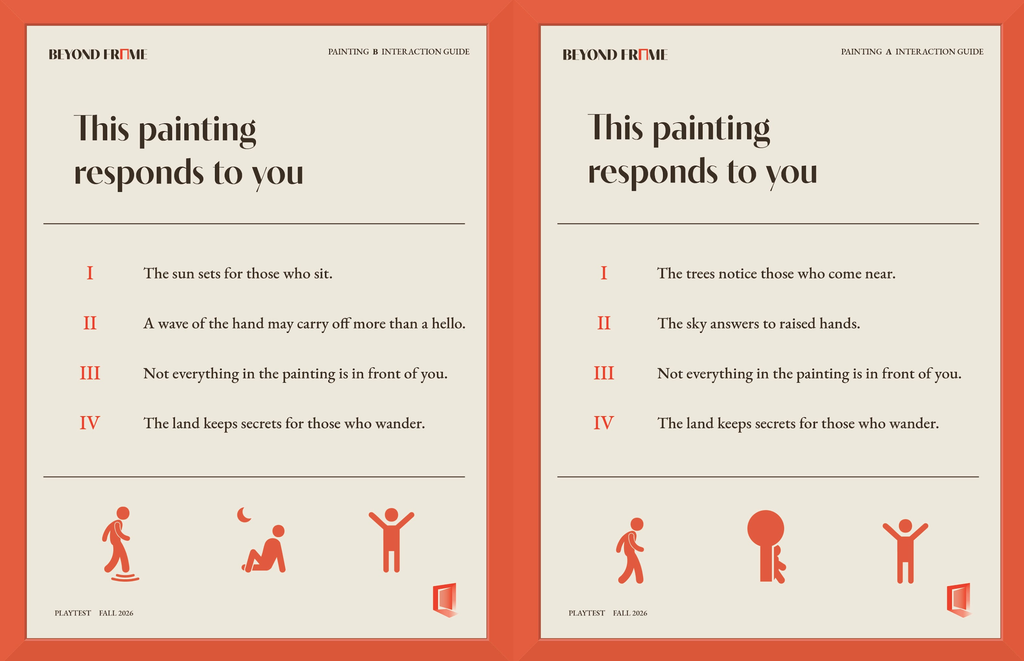
The photo-capture moment also produced mixed reactions.
Some visitors wanted more warning before the photograph was taken, while others appreciated the spontaneous nature of the capture.
After discussing the results with our client, we decided to preserve the natural, unexpected quality of the photograph rather than turning it into a posed portrait.
We will continue refining the timing and ending transition so visitors can better understand when their experience has concluded.
Toward a Self-Running Installation
With the soft opening and Fall Festival approaching, our next technical priority is to make Beyond Frame operate more independently.
Currently, parts of the experience still require manual control or intervention.
Our goal is to create a complete automatic loop:
Visitor enters → experience begins → interactions unfold → photo captured → experience ends → system resets for the next visitor.
This will be an important step toward making Beyond Frame function as a real museum-style installation rather than a supervised prototype.
For now, we are continuing to prioritize polishing our two existing paintings before expanding to a third.
Looking Ahead
The October 31 playtest gave us a clearer understanding of what makes Beyond Frame compelling.
Visitors responded most strongly when they could recognize the connection between their actions and changes in the artwork—especially when those changes extended into the physical environment.
Moving forward, we want to strengthen that connection through clearer interaction language, more reliable gesture recognition, better environmental feedback, and more intuitive onboarding.
As we prepare for our soft opening, our goal is becoming increasingly focused:
Not simply to create more things visitors can do, but to make every action feel meaningful inside the painting.