

It’s already week 4! How time flies. This week, with Quarters behind us, we sat down and started working on our second prototype. The way we’ve scheduled these out, our aim was to be done with this one in just a week, so we really had to hit the ground running.
Our primary goal for this prototype is to think about the ‘Daily Experience’; that is to say, what would an experience designed for the people that pass by the Space Bridge multiple times a day (Students, Faculty) look like? The idea that immediately stuck out to us was to make an incremental game (or, more commonly known as a clicker game).
Why?
Well, the gameplay loop of a clicker game is essentially structured around our exact audience context*. The gameplay interaction is immediately obvious, the feedback of the interaction is immediately satisfying, and a player isn’t expected to have to play the game for any long, contiguous period of time. One ‘complete’ interaction can be as easy as just pressing a satisfyingly clicky arcade button as they head to the elevators to grab lunch at the food truck outside.
*But, this does ignore the actual physical reality of the Space Bridge, of course. A physical, communal, six-screen console is not the same as the typical home for a clicker game, the mobile phone.
However, this actually provides us with an interesting opportunity, that we are excited to explore. Given the communal nature of the Space Bridge and its public space, it lends itself naturally to the idea of creating an experience that evolves on a schedule over a set period of time (e.g., a day or a week). We’re interested in the idea of a clicker game where the ‘clicks’ are a community effort, and the world of the game is ‘built up’ in some manner by the collective clicking of various passersby throughout the day. And, since we’re especially thinking about students and faculty, people who would pass by the Space Bridge multiple times throughout the day, the excitement of seeing some game world grow is something that we can actually leverage.
A week is not enough time to fully realize such a lofty goal, but it is something that we’re thinking about as we build this prototype, which will serve as a way for us to experiment with building a foundation for such an experience. And, when it came to actually thinking of what kind of world we wanted to make for this particular purpose, we were drawn to the idea of an aquarium. What’s an office lobby without its trust aquarium?
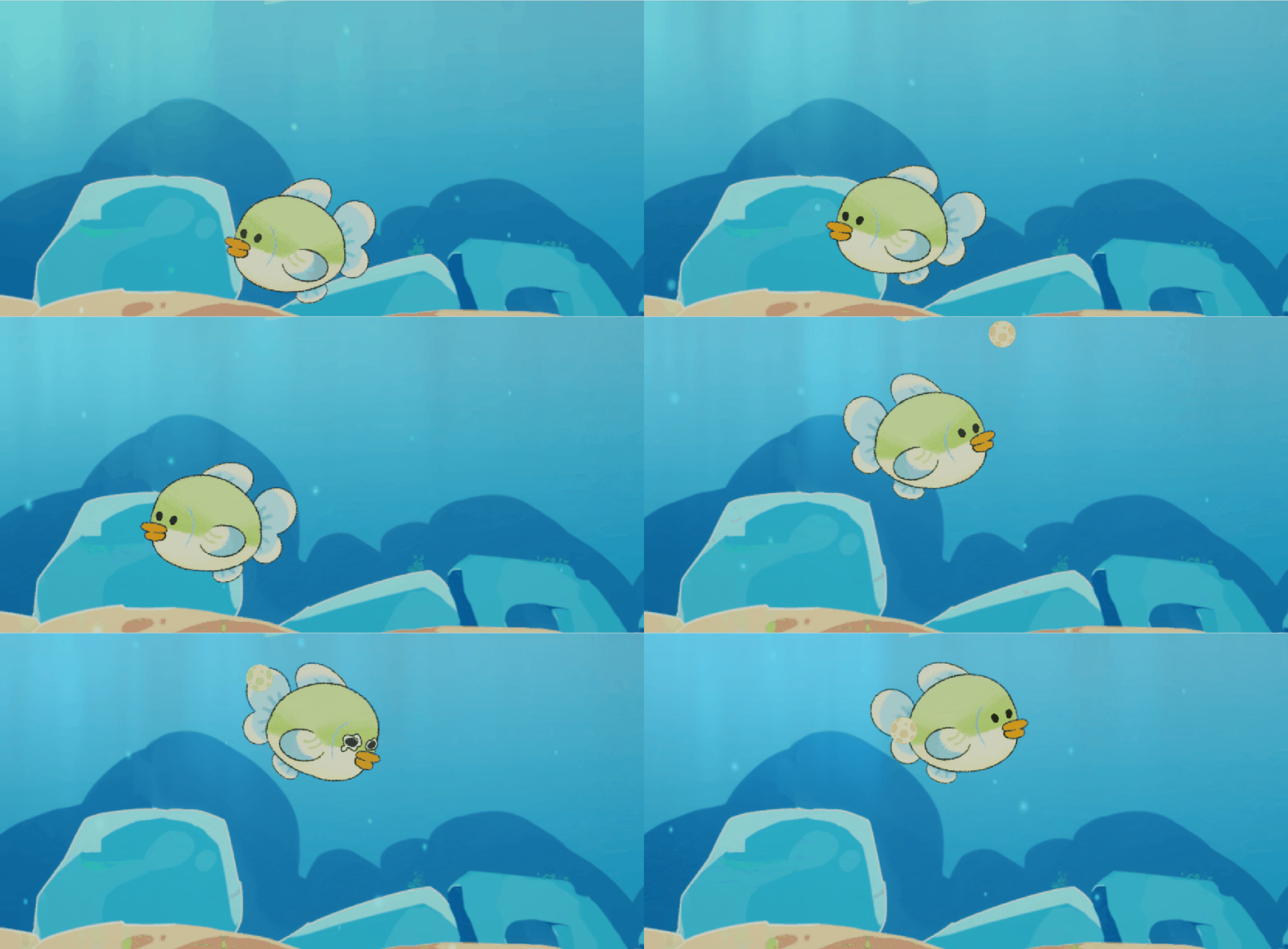
So, we made an aquarium. The idea is that there is one contiguous aquarium that spans the three upper screens of one side of the Space Bridge. When you press any button on the consoles, a bubble is generated. These bubbles can be spent for upgrades on the touchscreen, which add little decorations and elements to the aquarium and also improve the speed of bubble generation in various ways. The aquarium also has some fish that swim around and respond to a handful of interactions (e.g., buying the upgrade ‘fish food’ both improves bubble generation and also drops a piece of fish food into the tank, which fish will seek to eat). With enough bubbles, one can also buy extra fish.
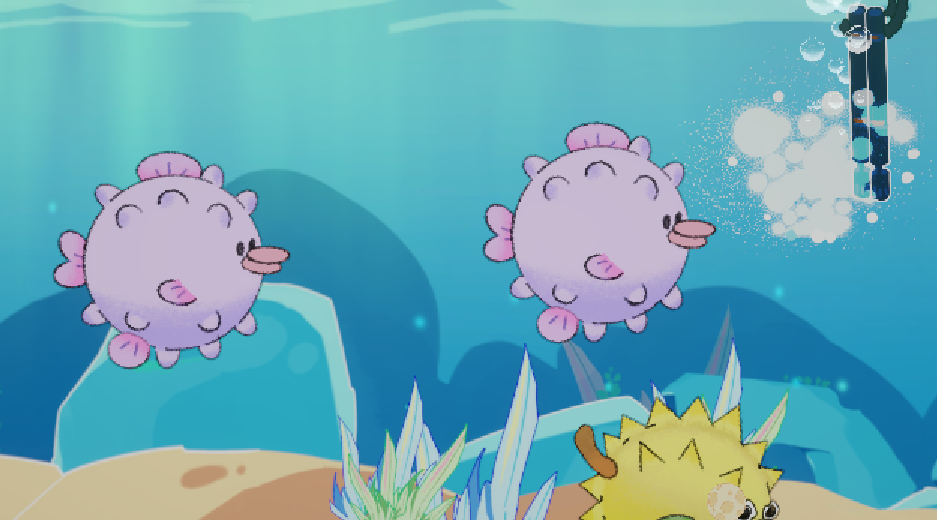
There’s a bit of tension in this set-up, with the upgrade purchasing taken directly from traditional incremental games being a bit of an awkward analog in this distributed multiplayer system. That’s potentially a sticking point, since each upgrade directly translates to making the fish tank feel more ‘alive’ in some way, the hope is that this potential conflict-of-interest between players actually becomes more of a fun bonding interaction. A player might walk by the tank in the morning, press the buttons a couple of times, and then walk away. Then when they pass by the tank again, say for lunch, they can expect to see the aquarium transformed into a more lively, exciting home for the fish, and they would know that that was the result of multiple people throughout the day modifying it a little at a time.
Our quick timeline does result in a weakness in our pipeline: it is difficult for us to playtest this hypothesis. The idea of the game is built on the idea of change over an entire day, but unfortunately we don’t currently have the time to field test such a timeframe. Hopefully we can in later weeks.
We have found that people really like clicking the buttons though. Something about the very tactile arcade buttons is a huge draw. Very satisfying.
Anyways, on to the next prototype!
Over and out,
The Intergalactic Buttoneers