

This week marked one of the most critical turning points for our SoKids project. While previous weeks focused on identifying usability issues and refining interaction systems, Week 12 pushed us to confront a deeper challenge:
Are we actually capturing meaningful behavior, or are we unintentionally shaping it?
At the same time, we shifted heavily into preparing for our SOFTs presentation, which required us to rethink not just what we built, but how we communicate and stage the entire system.
 Playtesting
From “It Works” to “Is the Data Valid?”
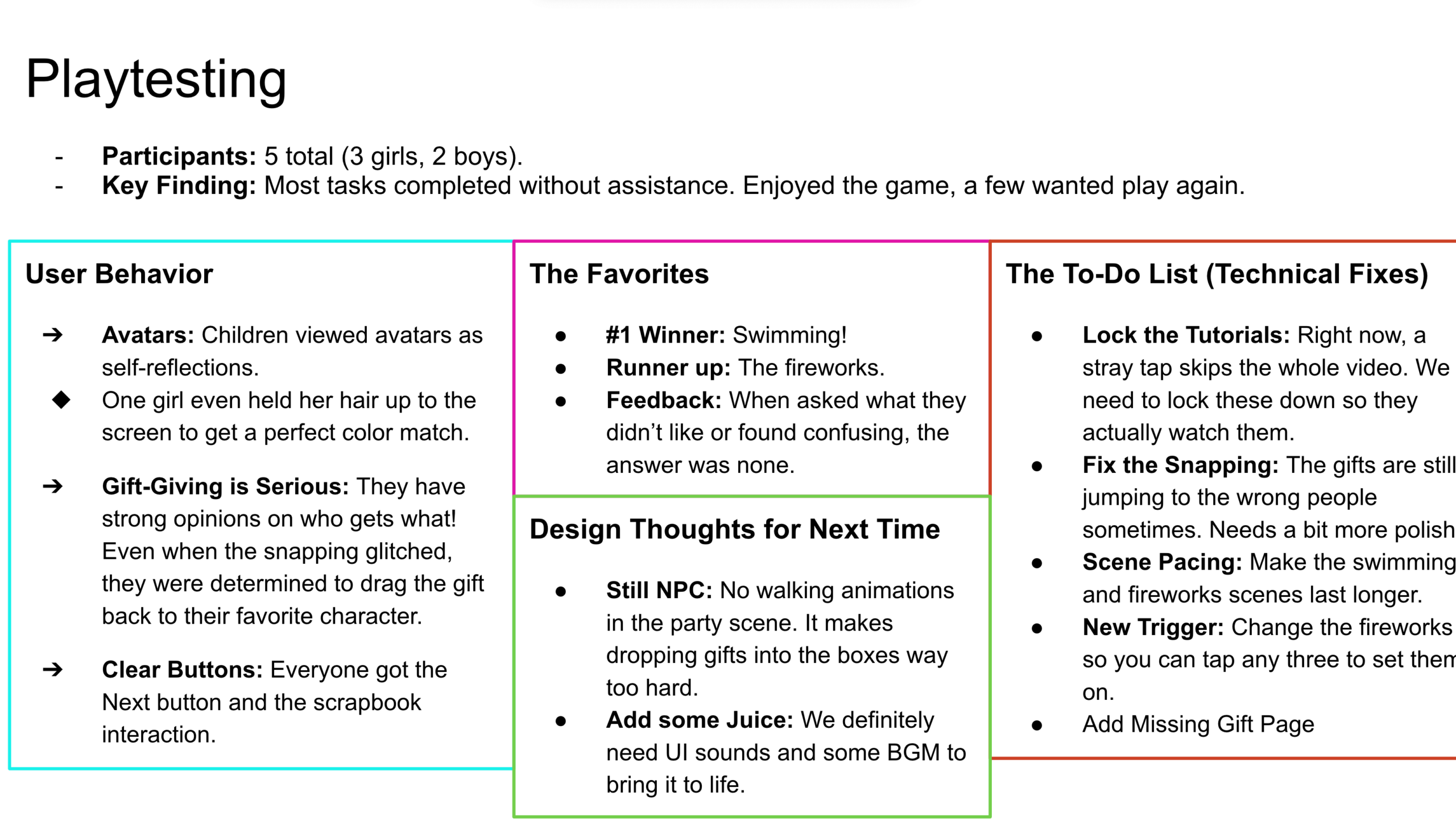
Our latest playtesting session revealed something surprising:
Children were highly engaged and able to complete most tasks without assistance, and several even asked to play again.
At first glance, this seemed like a strong validation of our design. However, a closer look revealed more nuanced, and more important, insights.
1. Strong Ownership & Self-Projection
Children consistently treated their avatars as extensions of themselves:
- Some tried to match real-world features (e.g., hair color)
- Many placed their own character in central or preferred positions
- Resource allocation (e.g., cookies, gifts) often reflected self-prioritization
This reinforces that our system successfully creates meaningful identification, which is critical for studying social categorization.
2. Social Reasoning Emerges Naturally
We observed that children:
- Group characters based on similarity (e.g., color, “friends”)
- Construct their own narratives during interactions
- Show strong preferences in decisions (e.g., who gets gifts)
These behaviors suggest that social reasoning is emerging organically, even without explicit prompts—exactly what SoKids aims to capture.
3. When Interaction Design Breaks Data Validity
Despite high engagement, several interaction issues directly affected data quality:
- Timer-based progression confused and led children to change answers just to trigger UI responses
- Delayed “Next” or confirmation buttons made children think their actions were incorrect
- Weak snapping mechanics caused mis-logged or lost interactions
- Character overlapping led children to reposition elements for visual clarity rather than intent
As highlighted in the session, these issues are not just UX problems; they are data integrity problems.
Children were not always changing their choices because of preference—but because the system behavior was unclear.
This was a major shift in our thinking: We are not just designing interactions, we are designing a measurement instrument.
4. Unexpected Behavioral Patterns
Some of the most interesting findings came from emergent patterns:
- Children often place their avatar in the center position in group photos
- In resource allocation tasks:
- Some children are distributed equally
- Others prioritized themselves when “their character was missing.”
- Sequential dragging behavior still appeared in certain tasks
These patterns are extremely valuable, but only if we ensure they are not artifacts of the system design.
Design Implications
Toward More Reliable Systems
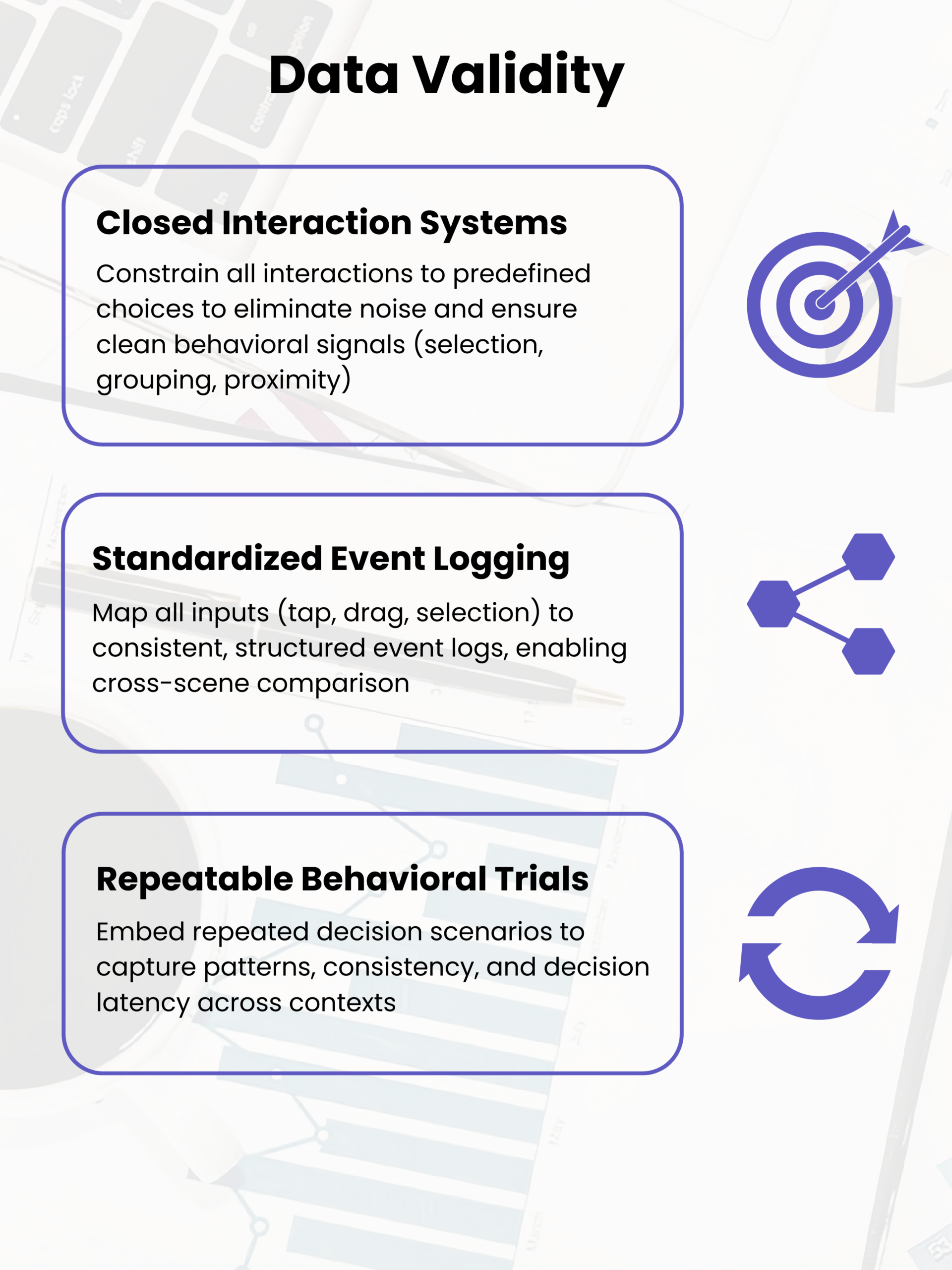
Based on these findings, we identified several key design directions:
- Replace timer-based triggers with interaction-driven confirmation logic
- Ensure feedback is immediate and consistent
- Improve snapping precision and visual clarity
- Introduce light narrative/context cues to support interpretation
- Redesign ambiguous scenes (e.g., cookie, toy store)
We also began exploring mechanic variations, such as:
- Scarcity vs. abundance in resource distribution
- How different constraints influence children’s decisions
This moves the project closer to a research experiment design, not just a product iteration.
Preparing for SOFTs
Designing an Experience, Not a Presentation.
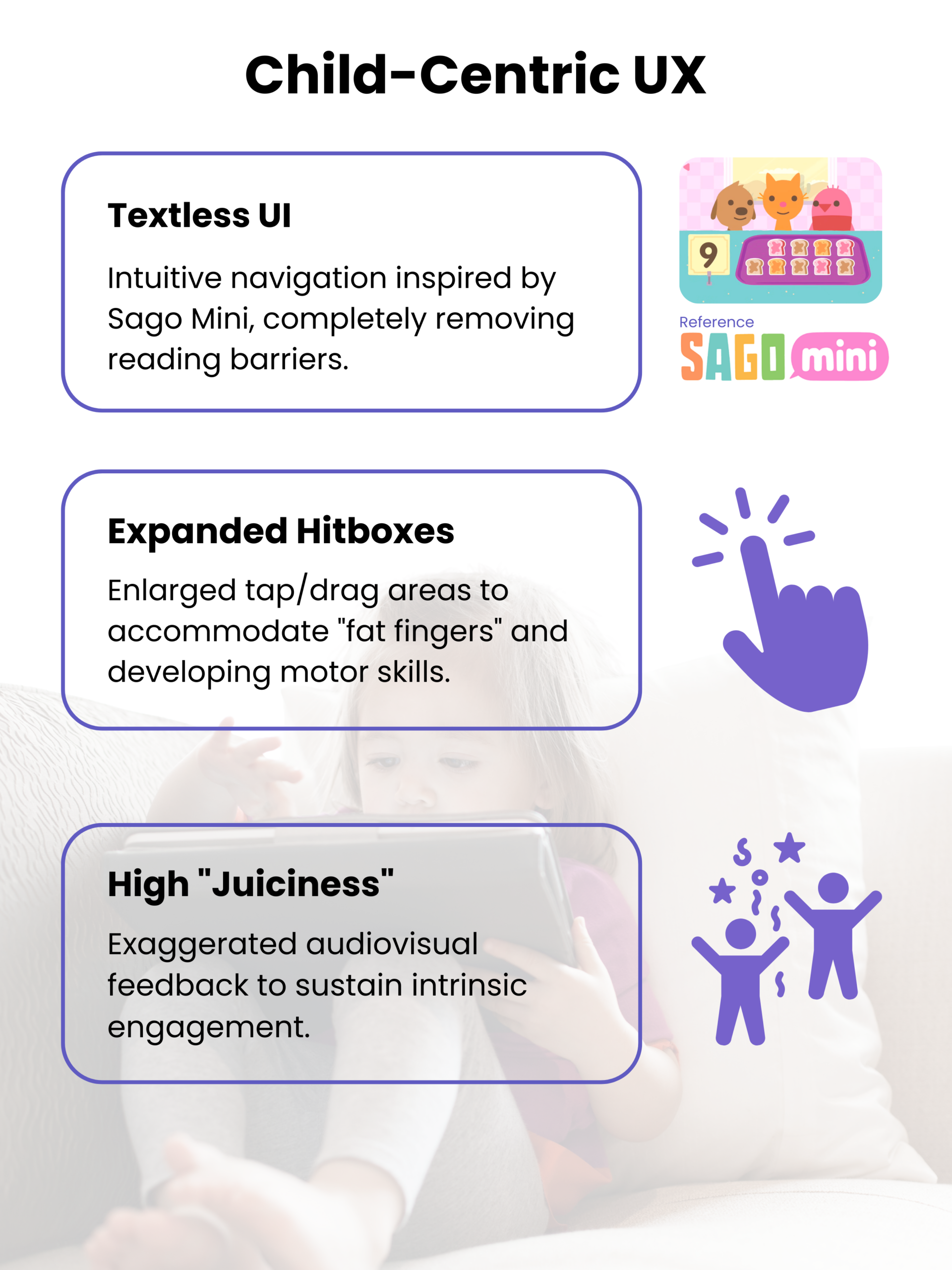
Design strategies
Part 1
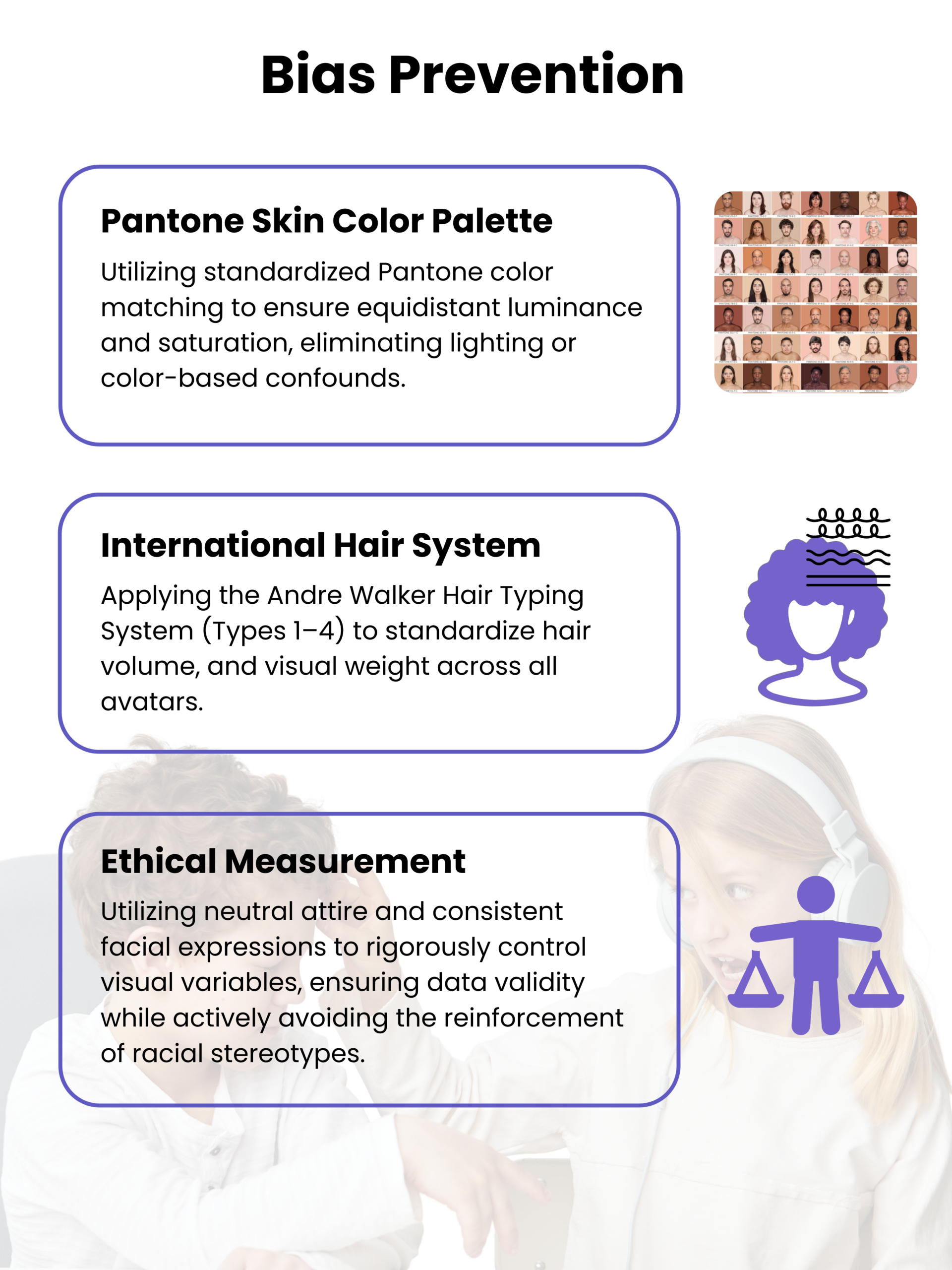
Design strategies
Part 2
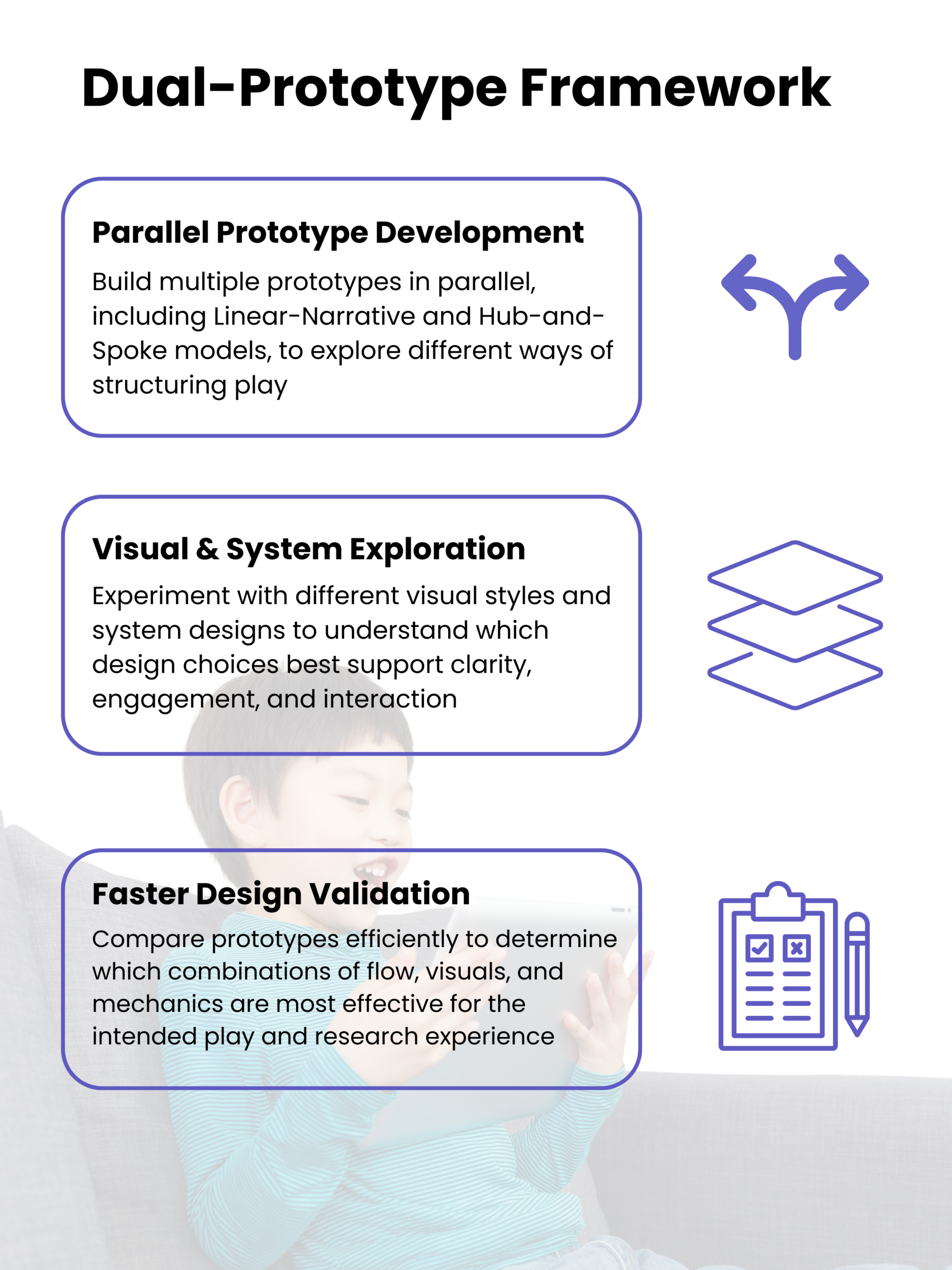
Design strategies
Part 3
Design strategies
Part 4
Alongside playtesting, a major focus this week was preparing for SOFTs.
We shifted from thinking about SOFTs as a presentation to designing it as an interactive, exploratory experience.
The structure now centers around a station-based setup:
- Gameplay station (hands-on interaction)
- Video station (observing children’s behavior)
- Backend/data station (understanding data capture)
This aligns with the goal of SOFTs:
- Not to present information linearly
- But to invite conversation and exploration
Poster & Visual Communication
We also continued refining our research poster, moving away from dense academic layouts toward a more visual and engaging format.
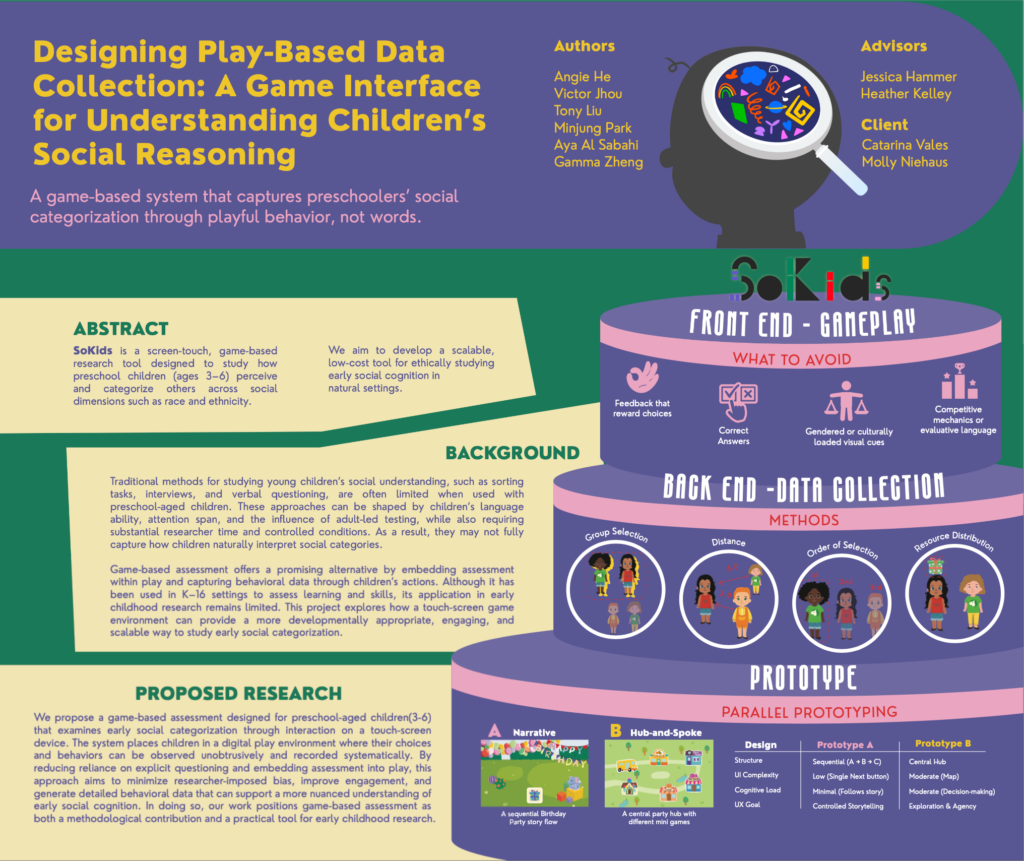
Instead of presenting full papers, we:
- Extracted key quotes from research
- Created layered visual collages to communicate ideas
- Used design to guide attention rather than text
As shown in our current poster draft (see below), the goal is to:
- Communicate the system at a glance
- Support discussion rather than replace it
 Reflection
Week 12 fundamentally changed how we evaluate our progress.
Before, success meant:
- Kids can play the game
- The system is engaging
Now, success means:
- Interactions produce valid and interpretable data
- The system does not unintentionally bias user behavior
- The experience aligns with both design and research goals
At the same time, preparing for SOFTs forced us to step back and think about:
How do we make others understand and experience the system we built?
This dual focus, designing for users and designing for researchers and stakeholders, is what makes SoKids both challenging and uniquely impactful.
As we move into SOFTs and the final presentation, our goal is no longer just to refine the product, but to ensure that the system, the data, and the story we tell all align.


