

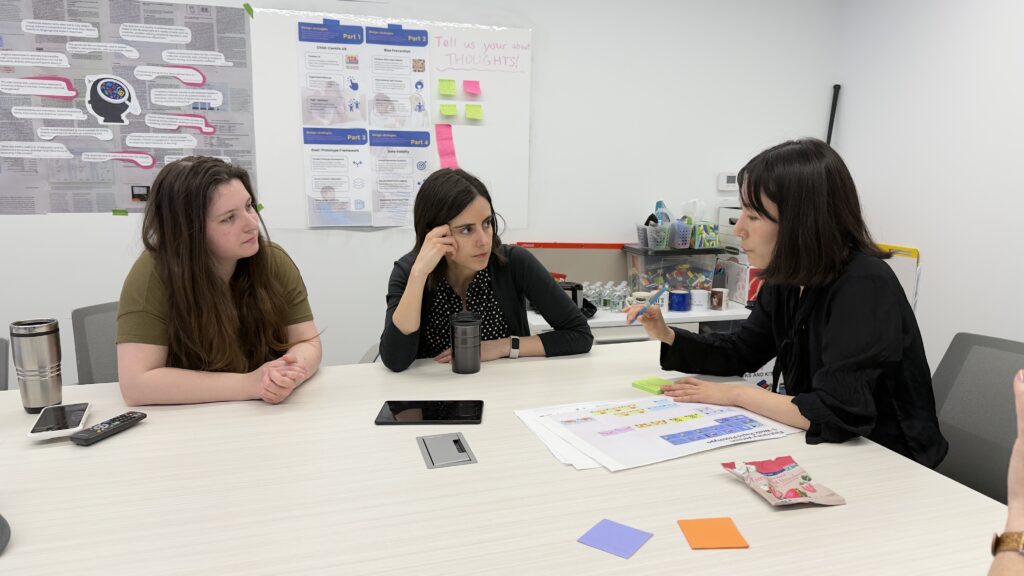
This week marked a major milestone for our SoKids project as we presented at SOFTs and received valuable feedback from faculty, peers, and stakeholders. It was also an opportunity to observe how people engage with our system in a more open, exploratory setting.
We structured our space as an interactive experience, allowing visitors to play the prototype, observe playtest videos, and explore how data is captured. This format helped communicate the full pipeline of our project and led to many insightful conversations.
 Key Takeaways from Feedback
More specific feedbacks from Mike: https://docs.google.com/document/d/1lyIPk94rE0x_P-zHn7_ihKoltryLIF1J3DQZ0FtwYas/edit?usp=sharing
A clear theme from SOFTs was that SoKids needs to function not just as a playable prototype, but as a reliable research tool.
We received especially detailed feedback from Mike, who emphasized that:
- Interaction accuracy directly affects data validity
- Drag-and-drop precision, target size, and UI consistency are critical for ensuring reliable results
- The system should feel “hardened” for 3–6-year-old users, minimizing unintended errors or ambiguity
This reinforced our understanding that even small UX issues can introduce significant noise into behavioral data.
In addition, Dave provided valuable feedback on our presentation itself. He suggested that we should include more concrete, specific examples showing:
- How playtesting observations led to design changes
- The logic behind our iterations
- How research insights directly translate into gameplay adjustments
This helped us realize that while we have been iterating extensively, we need to make that process more visible and explicit in how we communicate our work.
Iteration and Constraints
Following SOFTs, we began implementing key improvements:
- Improving drag-and-drop reliability
- Simplifying avatar creation flow
- Strengthening UI feedback and consistency
- Fixing major bugs across builds
At the same time, we recognize that we won’t be able to fully address all feedback within this semester. Our current focus is on stabilizing the prototype and prioritizing changes that most directly impact usability and data reliability.
Looking Ahead
Many of the more ambitious improvements—such as:
- More advanced research tools
- Stronger onboarding and interaction validation
- Further refinement of child-friendly interaction systems
will be carried forward into summer and fall development.
We see SoKids as a long-term system, and SOFTs has helped us identify the next steps needed to strengthen both its research rigor and design quality.
Reflection
SOFTs pushed us to think beyond building and focus on how our system performs under real scrutiny.
It also highlighted an important shift: It’s not enough to iterate—we need to clearly show how and why we iterate.
As we move into the final stage, our goal is to deliver a system that is stable, clear, and trustworthy, while also setting up a strong foundation for continued development in the future.


