

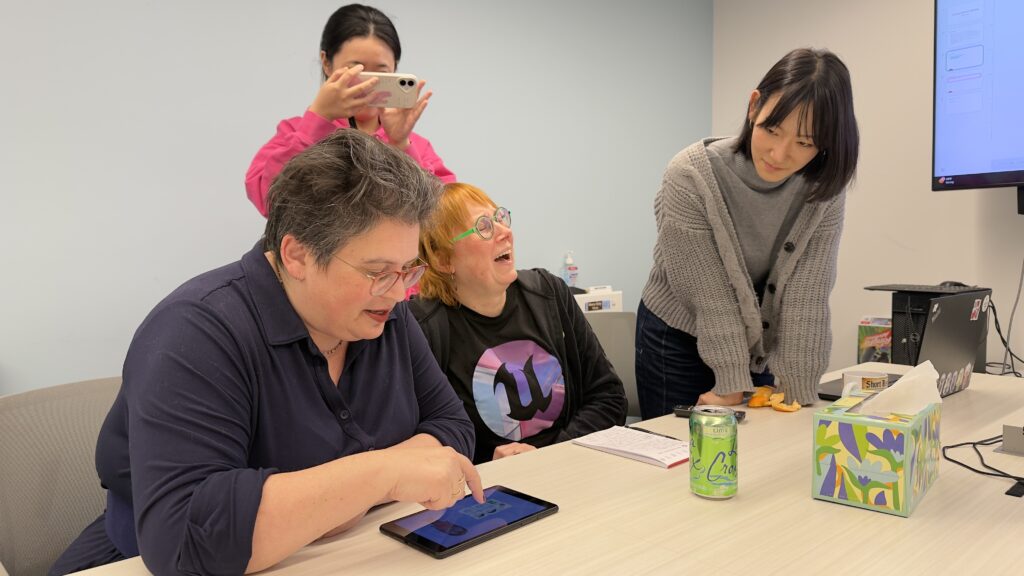
Week 10 focused on a deeper evaluation and refinement of Prototype 2 through targeted playtesting and design discussions. We conducted another round of playtesting at the CMU Children’s School, gathered more structured observations, and used those insights to guide iteration priorities. Alongside this, we received detailed feedback from Heather Kelley and held internal discussions between the design team to align on system design, interaction consistency, and data collection strategy. At the same time, we engaged in a guided co-writing session with Jessica Hammer, making significant progress on our research paper structure and framing. This week helped us better understand how children interpret tasks and how our design choices impact both usability and research outcomes.
 Playtesting Focus: Prototype 2
This week’s playtesting specifically focused on Prototype 2, allowing us to evaluate its full interaction flow and research potential.
The session revealed that while children were initially curious and engaged, their overall experience varied significantly. Some children repeated activities multiple times, showing curiosity and persistence, while others lost interest or felt the experience “wasn’t a real game.”
A key insight was that many children created their own narratives to make sense of the experience, such as interpreting the scenario as a birthday party or inventing reasons for giving gifts.
Task Understanding & Gameplay Clarity
One of the most critical findings this week was that task understanding remains a major challenge.
Many children:
- Misinterpreted the purpose of tasks (e.g., cookies, gifts, sequencing)
- Repeated actions without understanding the goal
- Completed tasks through trial-and-error rather than intention
Additionally, children often hesitated between steps or asked “what do I do next,” indicating that our game flow lacks clear guidance and structure.
This suggests that, beyond interaction design, we need to strengthen the context and framing of the experience to help children understand why they are performing each action.
Interaction & Navigation Challenges
Consistent with previous weeks, interaction issues remained a key problem.
- Drag-and-drop interactions were still not intuitive and were often discovered accidentally
- Children frequently clicked randomly or skipped steps, especially with navigation buttons
- The overall flow felt non-linear and confusing, with children jumping between actions
We also observed that some children attempted to interact with non-interactive elements, suggesting an expectation for a richer and more responsive environment.
These findings reinforce the need for:
- Clearer onboarding of interaction mechanics
- More structured, step-by-step progression
- Stronger feedback systems to guide behavior
 Advisor Feedback from Heather
We shared our updated Prototype 2 with Heather Kelley and received detailed feedback that directly informed our next steps.
A major focus was interaction consistency. Currently, some tasks involve dragging objects to characters, while others require dragging characters to objects, which can confuse children.
She also highlighted important design considerations for data collection mechanics, particularly around the cookie system:
- Whether cookies should be limited or unlimited
- How different constraints might influence children’s decision-making
- The importance of validating these choices with research goals
Additionally, she emphasized:
- Avoiding “pixel hunting” by making interactions more forgiving (e.g., cookie dispenser instead of individual targets)
- Using accessories like sunglasses carefully, since they may not clearly signal meaning but could still produce interesting behavioral data
- Randomizing the order of children to avoid bias from sequential placement
Design Discussion
This week also included an in-depth internal discussion between Gamma, Victor, and Tony to align on priorities and next steps.
A key takeaway was establishing a clear prioritization framework:
- Does it improve data collection quality?
- Does it help children understand what to do?
- Does it improve game feel and engagement?
Several important design directions emerged:
- System & UI Improvements
- Refine button systems (e.g., “Check” and “Go Back”)
- Standardize interaction patterns
- Adjust asset positions, sizes, and visual hierarchy
- Game Experience Enhancements
- Add voiceover to guide children
- Improve background visuals for a more complete experience
- Introduce clearer feedback for actions
- Data & Mechanics Decisions
- Experiment with infinite vs. limited resources (e.g., cookies)
- Randomize character order to reduce bias
- Explore alternative layouts (stack vs. line) for interaction clarity
These discussions helped unify our design approach and ensure that every decision supports both usability and research goals.
Iteration Priorities Moving Forward
Based on playtesting and feedback, we identified key areas for improvement:
- Clarify task goals and narrative context
- Improve interaction consistency and discoverability
- Redesign navigation to reduce confusion and skipping
- Strengthen feedback systems for user actions
- Align mechanics with research data needs
- Continue refining Prototype 2 as our primary testing focus
Co-Writing Session & Research Paper Progress
 https://docs.google.com/document/d/10K0WNTl9aqaMZy3ywwV-iRaiLWn5XT8S-Xrpterbino/edit?usp=sharing
We also made significant progress on our research paper through a structured co-writing session led by Jessica Hammer.
During the session, Jess guided us step-by-step in translating an example paper into our own structure, helping us understand how to:
- Clearly frame the research problem
- Connect our game design to research goals
- Structure arguments across the abstract, introduction, and literature review
Rather than aiming for perfection, she encouraged us to produce a “crappy first draft”, focusing on:
- Getting ideas down quickly
- Identifying gaps in our argument
- Iterating later with clearer direction
We divided into groups to work on different sections:
- Abstract & Introduction
- Literature Review
- Research & Design Methods
Since last week, we have made strong progress in:
- Clarifying our core research argument
- Defining the gap between traditional methods and game-based assessment
- Positioning SoKids as a non-transformational measurement system
Our current draft emphasizes that:
- Traditional methods (e.g., interviews, sorting tasks) are limited and biased
- Game-based systems can capture implicit behavioral data
- Our approach focuses on measurement without influencing children’s beliefs
This co-writing process helped us align our design work with a clear academic contribution, ensuring that our project functions as both a game and a research tool.
Reflection: Designing for Understanding
Week 10 highlighted a crucial realization: Children are willing to engage, explore, and even persist through confusion, but understanding does not come automatically.
Our biggest challenge is no longer just building interactions, but designing experiences that are:
- Intuitive
- Meaningful
- Interpretable both by children and by our research framework
As we move forward, our work will focus on bridging this gap, ensuring that what children do in the game truly reflects what we aim to study.


