

Post-Playtest Iteration & Level 0 Production
This week, following our playtest, we made several important adjustments to the gameplay structure. Based on player feedback and observation, we reorganized parts of the gameplay sequence to create a more intuitive and logically coherent flow. Our goal was not only to improve clarity and pacing, but also to ensure that the full experience remains achievable within our timeline leading up to the soft opening.
After aligning on the updated structure, we divided responsibilities across the team and shifted our primary focus to completing Level 0. Everyone began working in parallel—finalizing core interactions, refining gameplay beats, and polishing environmental and model details. In addition to building new content, we revisited earlier mechanics to improve feedback clarity, responsiveness, and overall cohesion between player and robot actions.
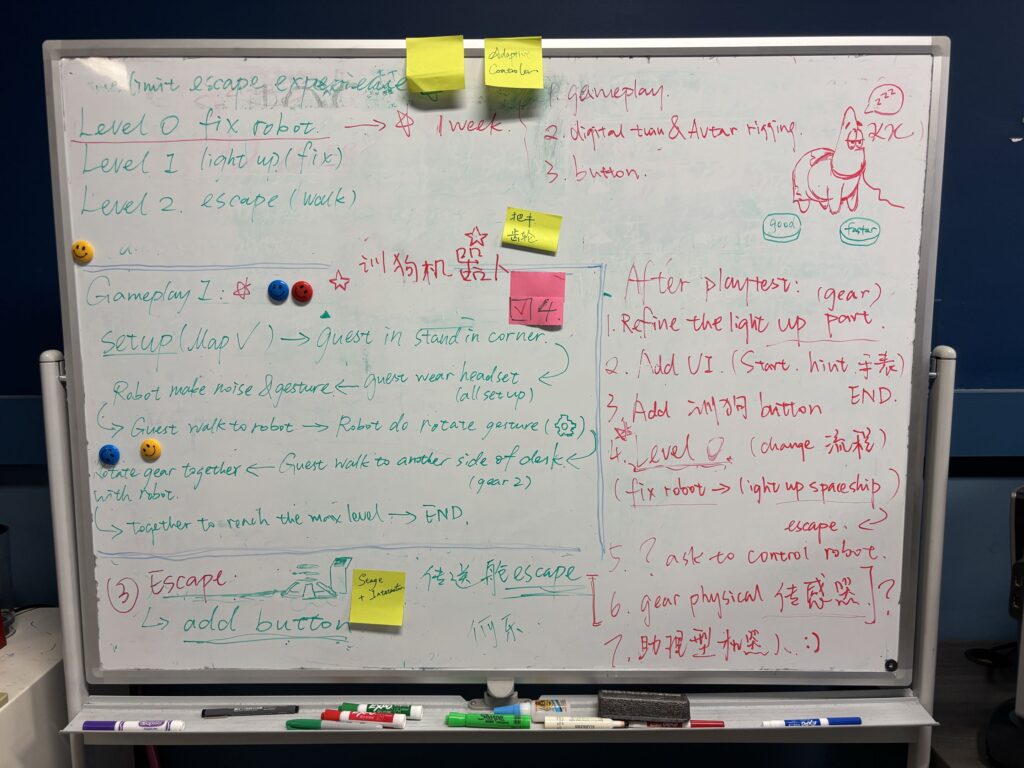
One of the most exciting additions this week was the introduction of a “dog button” interaction system. We implemented four physical buttons, each mapped to a different instruction or hint. Instead of relying on spoken dialogue, the robot can now tap these buttons to communicate with the player nonverbally. This adds both personality and a playful cooperative dynamic, reinforcing the idea that the robot is an active partner rather than a passive tool.
We also conducted feasibility testing for the dog button hardware interaction, ensuring responsiveness, clarity of feedback, and physical usability. The results were promising, and the system proved viable for integration into our gameplay loop.
Overall, this week marked a strong transition from experimentation to focused production. By refining structure, locking scope, and introducing a more embodied form of robot communication, we are steadily moving toward a cohesive and test-ready experience for soft opening.