

First, we reflected on our Playtest Day results, and continued developing the details of our other scenes of the experience.
Unfortunately, we weren’t able to get to how different patterns changed peoples emotions as not even the difference of patterns were perceived correctly. However, this determined our important design refinements.
Post-Playtest
Analysis
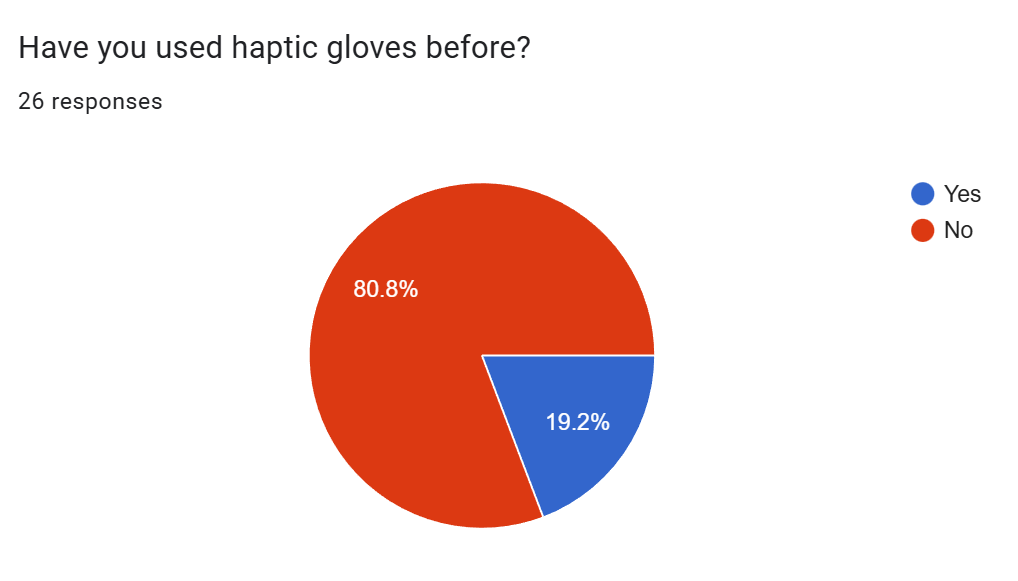
Basic screening data: our VR naivety follows a normal distribution, and most of the people who have used VR have also used hand tracking. There are unexpectedly more people who have used haptic gloves (though, to be frank, they were ETC community people who have playtested our project before)


The data we got from the technical difficulty portion of the survey gave us the following important suggestions:
- Hospital needed more items to fill the scene for immersion.
- The heart pattern needs to be more clear.
- Crushing needs to be taught better (it was extremely difficult to crush)
- The cartoonish and not realistic style is good so it doesn’t feel too scary.
- The void-ish emptiness of the title tutorial scene is good because it lets player focus on the heart.
Analyzing interview qualitative data
With the help from Claude AI, here are some summaries.
The understanding of the overall experience: “It’s a VR experience where you play Death and squeeze hearts with really good haptic feedback—it’s interesting but dark/sad.”
Pedestal Scene vs. Hospital Scene Player Perceptions
- Both scenes rely on stillness – “nothing is reacting to your presence”
- Haptic feedback worked well in both (weight, squeezing felt realistic)
- Both were “approximately the same” mechanically
- Both created a “mouthwashing vibe” (unsettling, atmospheric)
- Emotional Impact
- Pedestal: Removed, abstract, “mythological,” epic/cinematic (Indiana Jones, Doom 2016)
- Hospital: Personal, emotional, “way more impactful,” sadder, “evil feeling”
Player Perception: Owner of the Heart’s Feelings
- Players are treating the body as an object (like the pedestal) rather than a person with subjective experience.
- “Couldn’t tell if they were dead or not. Assumed they were dead. So assumed nothing”
- “Probably in grief, feeling like sorry for the soul”
- “They look like they were sleeping, no energy, sick”
How Players Decided Whose Heart to Take
- Visual/Physical Cues
- Bed/lying down position as primary indicator
- One person clearly “more deadish” or lifeless
- Emotional Weight
- Task described as “daunting,” “heavy,” “weighty”
- “Taking a kid’s life is super sad for the mom”
- Not wanting person to suffer
- Lack of exploration – Many didn’t look around or try both options
The Emotions Survey
After transcribing the physical survey into computer spreadsheet, we got the following.

While doing the interview, we also asked for the why the playtesters filled in the survey as it was:
- “Hesitance, worry – Don’t want to crush it”
- “Worried about the consequence
- “Questioning morals”
- “Powerful because crushing heart is satisfying”
- “Understood role as ‘grim reaper’, and therefore detached himself from the sadness”
- “They don’t know what I’m doing, lonely sad about it. I was right there with them but distant”
- “I didn’t notice any change in the heart beat or the rhythm, so distant”
- “Saw two living people didn’t want to do it. Sad because knew that had to. Remorseful after I did”
- “Shock and surprise, not something that normal game will do”
- “Shock was from bursting the heart”
And then we did a simple data visualization after reordering the survey data according to the emotional wheel, and got this:

Refinements
Redesigning the heart moment from feedback
First of all, the reason why haptic patterns are not clear is because they are currently played the same time as crushing. Our original rationale was that, from the moment of crushing, it symbolizes what the characters feel about death as death is taking their soul. However, playing two haptic patterns on a vibrotactile feedback gloves are not differentiable. Therefore, we decided to separate the two. Our first refinement: heartbeat pattern, then crushing (which includes crushing low intensity to high intensity).
The second refinement is that, since we are taking apart the two patterns, we should make more haptic patterns. This week, we mapped all the characters out with their heartbeat patterns assigned.
Contextual content refinements
Apart from the heart itself, our environment and contextual details that go into users consideration of their perception of the heart has to be refined so it doesn’t break immersion. We already know that, we just have to get to work!
On the other hand, for better tutorial, we decided to have not 1, but 3 pedestals of different heartbeat pattern hearts, so that players can practices sensing the different haptics, as well as practice crushing, which was the gravest difficulty during Playtest Day.
Going granular on player experience
Aside from all the refinements, it’s also time to start making the assets for the entire experience. With all the feedback, we know what to watch out for the next scene, as well as how we talk / interact with the players. The greatest change was that instead of 3-5 scenes, we decided to scope down to just 3.
Player experience doc
We created a very detailed player experience doc, where each player interaction and scene change is listed in order, accompanied by the dialogue details. It is presented here. It is a central area where programming, art, and design all look at. It gets constantly updated, and are shared with faculty for feedback regularly.
Script
The complete script has also been written.
For each scenes, our goal is clear.
- Tutorial: tell players their goal as a grim reaper, and onboard them to feel the heartbeat and crush the heart, all within the narrative characterization of death. We teach them carefully to 1. hold the heart facing themselves (so Meta SDK can detect their hands), and 2. close their fists slowly with all fingers closing in (so crush can be detected correctly.) Also, we don’t want players to feel that this is a moral decision, but understand that death is predetermined. This is extremely important as moral implications would be too emotional, but hard to design for emphasis on haptics (the emotions will not come from haptics)
- Hospital 1 (with 1 old man lying on bed and a relative by their side): teach the player to look for hearts in the scene and choose just one. This is a scene where death is foreseen.
- Car accident scene (with 1 driver, 1 victim hit by the car, and 1 bystander): this is a more difficult level so to say. It will not be apparent that who out of the victim and the driver will be dying. The bystander is also there to showcase a different heartbeat, where they are filled with horror of witnessing the scene. The scene conveys the random and suddenness of death.
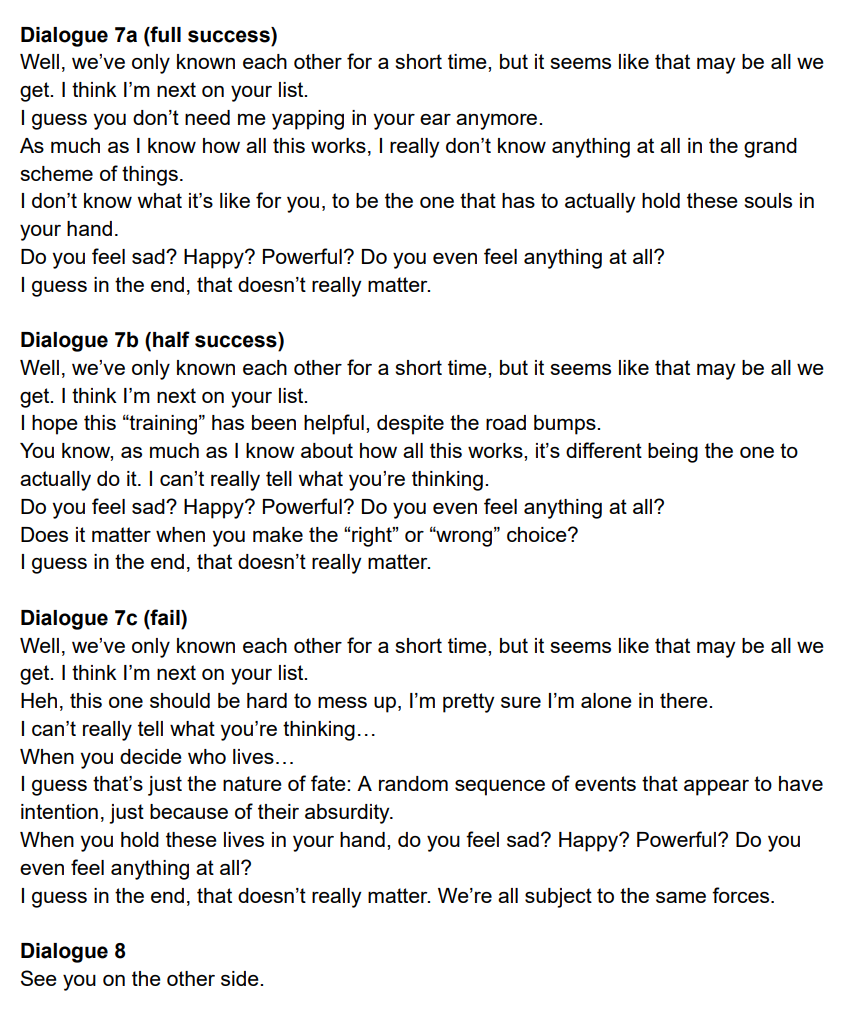
- The final scene Hospital 2 (the companion – or the narrator – a spirit who is helping you and teaching you): this is to convey a graver sadness or emptiness from sending away someone that has accompanied you on your journey of grim reaper training. They are peaceful to go, but emptiness should linger longer. In addition, it shares the same hospital as the first scene, which is why narratively they are able to talk with you in the first place.


The road scene
In order to showcase a scene that is clearly an accident that cannot have been prevented, we have a tree branch that fell on the road, indicating that the driver was avoiding it, but accidentally hit a person.


Next steps
Having a clear direction for iteration, our next step is simply build, build, build!! Please look forward to our assembled final experience.