
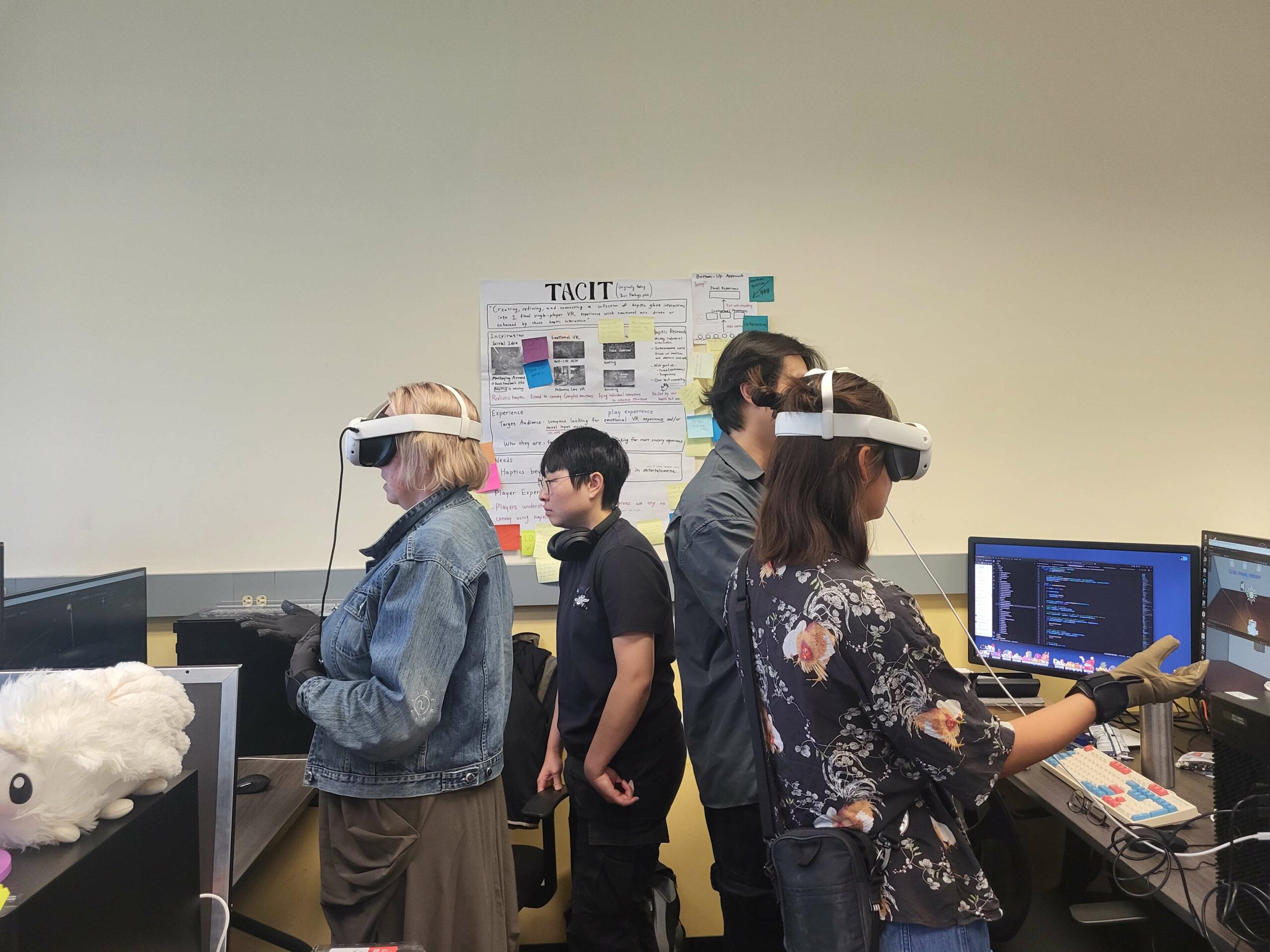
This week is Quarters Walkarounds, when faculty rotate in project rooms listening to project teams share their initial research and direction. As a pitch project, our goal is to revive their memory of what we shared about our project and plan during pitch, as well as show our progress. In addition, we continued researching the problem space by reading more academic papers on how haptics and emotions create powerful interactions so our understanding became more solid. We also refined the three summer prototypes for the first Playtest Night next week, an approximately biweekly playtesting held on main campus for a space to playtest. We eventually also showed these prototypes with faculty during Quarters. Finally, with the feedback from faculty both on our project direction and prototypes, we sat down for a retrospective and next steps planning.
Continuing from last week
Research
We continued reading research from different fields of studies.
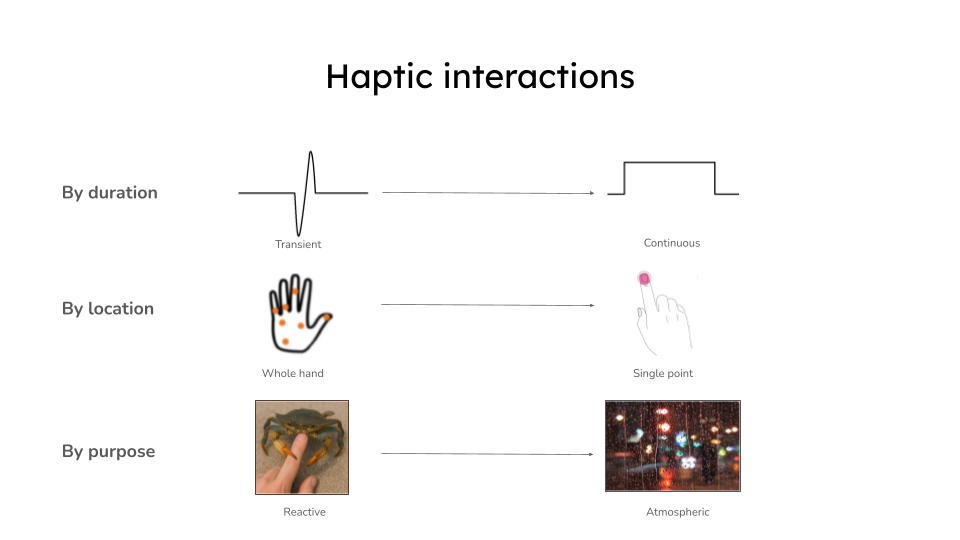
- HCI: We focused on how previous research on haptics and user experience, whether it’s related to emotions or not, categorize haptic patterns. We settled on a few parameters, including but not limited to duration, location on hand, repetition, decay pattern (decreasing / increasing), and path (direction of pattern movement across hand).
- Psychology: We focused on perception of touch, and how different sensory modalities work or compete with each other for the brain’s attention.
- Experience design: we focused on case studies of haptic experiences, such as haunted houses, 4D movies (and how camera design changes perception), previous haptic glove demos.
- Narrative structures: We also investigated games with narrative structures similar to what we wanted our final experience to be like. Namely, we looked for games similar to Before Your Eyes.
Development
We needed to integrate haptic gloves into our exploratory proof of concept prototypes, namely, the telekinesis, the elastic band, and the rain. (Touch grass was removed due to complexity in modeling, and was replaced by rain.)

A/B Testing
For rain and telekinesis, we created content for A/B testing.
- Rain: we test how context is effective by turning on and off the music (rain ambience still there)
- Telekinesis: we tested if subtle difference in vibration intensity matches expectation of visual context by having players move a huge rock vs. a tennis ball.
Quarters Walkarounds
Our plan for quarters is:
- Refresh memory from pitch about our goals and what we plans to achieve.
- Give a simple research finding summary on our haptics parameters, the final experience reference projects, and technology constraints.
- Try out the exploratory prototypes, either rain or telekinesis, since haptics is very difficult to understand without actually trying them out.

Feedback
Faculty were mostly intrigued and confident in our exploration process. The main questions and suggestions raised were the following:
- Jonathan noted that there were three ways of building from exploration to delivery. Our final experience will may come from:
- A single successful haptic pattern that we reuse and changed its contexts throughout the storytelling experience.
- A couple of successful haptic patterns stringed through narrative, like a haptic experience playground.
- A single successful interaction that uses different haptic patterns but has the same interaction meaning, built as a core mechanic of the final emotional experience.
- Jesse suggested us to utilize the two column method, where we:
- Have haptic patterns on the left, and come up with as many context for it as possible, or
- Have contexts on the left, and come up with as many different haptic representations on the right column
- All faculty echoed that testing is the most important factor of our projects. A/B testing, qualitative interview for emotions (since emotions are perceived and very hard to quantitatively measure), using the inner circle of emotion wheel so as not to prime players, think-aloud protocols to gauge how players are choosing their interactions, etc.
- Moshe suggested that we have as many faculty come in our room to try our experience as many times as possible, because haptics is very hard to test!
Retrospectives
After quarters, even though it was already Friday evening, we decided it is still extremely crucial to talk about all our feedback, refine our exploration strategy, and reflect on our collaboration in this past three weeks. It was a exhausting session, but we came out of the meeting room confident about our next steps, and ready for the next weeks to come!
- Team direction section
- We should ask for Vivian and Heather’s advice on testing strategies from technical haptic patterns to emotional experience.
- We have been building tier-2 prototypes, or rather, the contextual prototypes, without first testing the primitive haptic patterns that the gloves supports. It’s useful to use 2 column strategy where left is tier-2, and on the right we think of possible tier-1 haptic patterns, but it’ll also be very informative vice versa where we simply do tier-1 on the left, testing with what the technology is able to do, and think of possible tier 2 prototypes through different hand movement/gestures. We decided that on Monday, we will do this to inform us what prototypes we will focus on through halves. (We define tier 1 as bHaptics designer, pure patterns, systems that support tier 2).
- Model of creative development, using Jonathan’s 3 methods, namely a. one single mechanic but changes haptic feedback throughout the narrative.(holding fire that changes and flickers through the whole journey) b. powerful haptic discovered discretely stringed into an experience tied by narrative. (haptic playground with story) c. create vocabulary for the haptic interactions and string them discretely through narrative. Our consensus is that we are currently doing c, and finding ways to get b, and trying to see if we can find any a. Therefore, part of our “Exploration” is this process of exploring the right pipeline.
- Team collaboration section
- There are times when team members aren’t sure what to do. This is because:
- This is an exploration phase. Artists aren’t sure how many models should they focus their attention on.
- Programmers are implicitly expecting artists to create concept art for prototype visions, but our artistic talents are in 3D modeling and not 2D illustratioin.
- Therefore, we need a central asset list on Trello where we can see an overview of the prototypes, and within it, each person adds what they need according to that vision.
- If times come when any of us don’t know what to do, tell the team, and we can discuss!
- There are times when team members aren’t sure what to do. This is because:
Next steps
With all the feedback and reflection, we’re prepared for our first major playtest of the contextual prototypes at Hunt Library. It is also the crucial time of carrying out our pivot back to the simplest form of what the gloves can and cannot do through defining and creating the haptic patterns on bHaptics Designer and testing for their effectiveness and coming up with next step prototypes to test for contexts.