
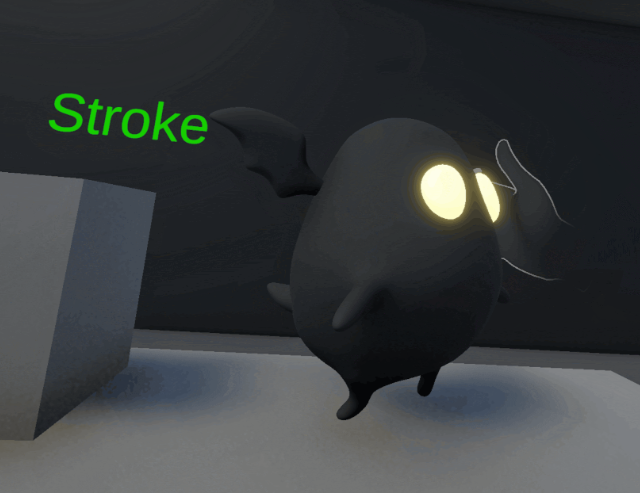
This week we’re testing our first batch of “context prototypes”, which includes the selected haptic patterns from our haptic pattern testing that we deemed as high potential for interaction, as well as a “testing environment” we set up that will give us information on what contexts works with the haptic patterns best, and what we should look out for for each haptic pattern.
This week, we had a Hunt Library Playtest Night on Tuesday, testing with slap, pinch, and heartbeat, while continuing developing the next set of prototypes: stroke, crushing, and breathing.
Playtest Night
Our main goal of the context prototypes is to see how much context we change change that has emotional potential. Therefore, fore each pattern, we made different changes, and asked for emotional responses using the emotional wheel.
Slap
For slap, the chosen context change was sound, and we had a button on the side that changes the feedback, from one that matches what balloon slapping sounds like, to one that is comical and funny. However, the haptic feedback remains the same.
Result: It was interesting to find that, many people felt that the comical sound made things unserious, and that they felt that the haptic feedback became lighter. This matches our expectation that context really influences your perception of reality. Players expect a certain feedback from their sensed memories, and that can be made using just a sound change.
Pinch
For pinch, we changed the text on the wall, indicating that the character you are pinching up would be: your mom, your ex, a king, a prisoner, etc.
Result: less about the haptic feedback, the annoying voice made a lot of players want to pick the boy up and throw them to the ground. On the other hand, if that person has context “your mom”, they are more reluctant, a drastic contrast to if the text is “a prisoner”. This showcases how context as simple as a character would change a person’s interaction intention, and that’s something a glove-related interaction project could work with.
Heartbeat
For heartbeat, we tested with different intervals of heart rates: slow / steady, fast, increasing, and decreasing.
Result: very immediately, people associated increasing heartbeat with nervous and excited, while decreasing heartbeat with sleepy and dying. On the other hand, the steady slow and fast ones, did not convey much difference, even though extremely fast made people nervous. It is apparent that heartbeat is a pattern that can clearly convey meaning, and even influence emotions.

Final Design Brainstorming

Even though we are still testing with the context prototypes, it is near Halves Presentation, and we wanted to have an outline for our final experience. We decided to discuss what we have learned and what we believe should make out the final experience.
We simply know that the structure of the final experience would be formulated by many haptic patterns (whether it’s the same or different ones) accumulating to an emotional climax.
Design Guiding Questions
To aid out brainstorming, we compiled 3 main questions to ask ourselves when coming up with an idea.
- What is the climax
- What is the small form that interaction
- What patterns? What actions?
- What emotion stems from and must build up to
- What’s the theming
- Where the interaction and haptics happen
- Style
- What is the main emotion
Three Ideas
… and we came up with three ideas!
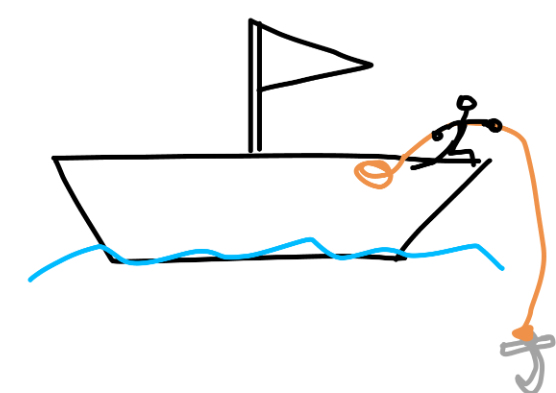
Rope pulling tension as a deckhand, from pulling up treasures to being unable to pull up a fallen ship crew, for an emotion of desperation.
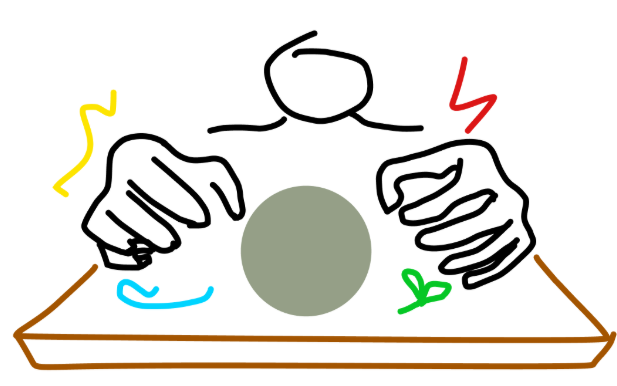
God simulator, merging and blasting their creation to the world, feeling different textures of the creations, emotion changing between powerful and being careful.
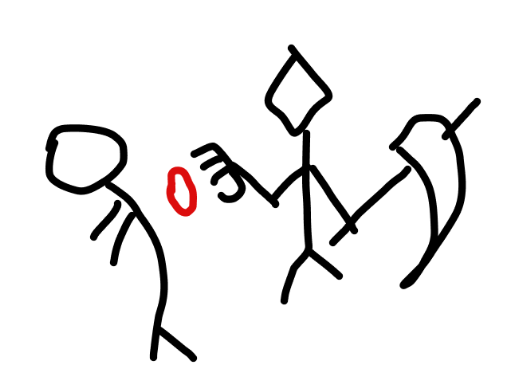
Grim reaper feeling people’s hearts and crushing it. Climax will come from crushing someone they know, which is a complicated emotion.
Next Steps
While preparing for Halves and coming up with design plans, we’re still continuously developing our second batch of context prototypes, which is set the be Playtested at ETC the day before the presentation.