

Welcome back to school! To prepare for a Playtest Night at Hunt Library the second day we’re back, we immediately got our MVP we discussed before fall break working. In addition, we started setting up the assets template for the experience, and making detailed design of our first scene.
Integrating heartbeat + crush
With our previous prototypes, combining the two was simple. There was only 1 catch: Meta SDK handtracking: we realized that, for heartbeat, it is crucial to have players face their palms to the camera, so that it can detect a grab, and therefore play haptics at the correct moments. For crushing, it was more complicated, as we realized that the timing of fingers closing into a fist, aka the moment transitioning from crushing to crushed, needed to be carefully detected, and that preventing players from accidentally crushing prematurely or being unable to crush is exceedingly crucial.
Combining individual haptic patterns
For the haptic design, we had the heart play the original heartbeat patterns, which is a lub-dub beat, played along with sound and heart animation, and heartrate interval controlled by an exposed variable that can be controlled by other scripts. We initially thought the moment of touching the heart should have a select haptic pattern, but we eventually abandoned this as heartbeat is strong enough.
For the crushing haptic pattern, since we noticed that people close their fists naturally as intensity of vibrations go up, and to balance between the granularly design bHaptics event with the purely code-driven PlayMotors() function that the bHaptics SDK provided, we divided crushing into low and high intensity, and a final “crushed” pattern, which used the “residual impact” pattern.

Adding sufficient context
What we noticed about the heart crushing moment from heartbeat to crushing is that, purely haptics and no visual / sound feedback, makes heartbeat indistinguishable from crushing, and would cause player confusion. As a project focusing on haptics, our goal is to add only sufficient audio and visual context, just enough to convey our intended meaning, as well as not break immersion. Therefore, we identified a few moments where audio and visuals were crucially needed:
- Heart beating pattern: beating sound, beating animation
- Transitioning beating to crushing: sound changing from beating to a squeezing sound. Visual is not as needed to convey the meaning, but very crucial for immersion. Our main programmer Jing transferred into our official technical artist, and created a VFX for blood being spurted out.
- Crushed moment: we for now did not added anything.
And we ended up with this very bloody heart that spurts blood when being crushed.
Minimal scene diorama
We knew that the structure of our final experience includes a title scene that teaches heart grabbing action, and a hospital scene that teaches the goal of the player, followed by 1-3 stop motion humanoid posing for a scene that represents a person’s last moment before death takes away their life. To test this process in the playtest to see if this minimal transition makes sense to the players, we created two scenes: 1st being a heart on a pedestal that needs to be crushed, and 2nd, a body lying in the ground, with a heart in their body that will be revealed through a shader activated when your hand reaches into the person’s body.
Playtesting this bloody heart and a scene transition
Since it was the start of the second mini semester, no one went to the Hunt Library Playtest (neither did pizza arrive), so we started walking around the library to recruit playtesters randomly. We eventually got 3 (+ Anthony, the ETC playtest coordinator)!
For the heart moment, we were interested in their reactions to this heart crushing moment, and what emotions were elicited. We found that, because of the bloodiness, most people felt “disgusted”. On the other hand, the action of reaching into a person’s body for a heart, not only enhanced the “disgust” feeling, but also the sense of “powerfulness”. In addition, the haptics were clear, was perceived as a very important part of the experience (especially for VR naive guests, which was a surprise since we at the beginning set our target audience as VR non-naive guests). However, whatever sensation given was not explicitly paid close attention to. Whether it is heartbeat or crushing did not matter as much to the experience.
For the final experience procedure from tutorial to diorama scenes, we were interested in seeing if players intuitively look for the heart in people’s body, if it makes sense, and what players might do that we further want to design to encourage or discourage. We found that, players immediately knew their goal. However, some were reluctant to reach into people’s body. On the other hand, the heart being non-kinematic (aka not affected by gravity) gave a sense of relief, as players felt more confident playing with the heart itself: some started throwing it, which is something we will want to discourage, but was interesting to observe.
Overall Experience
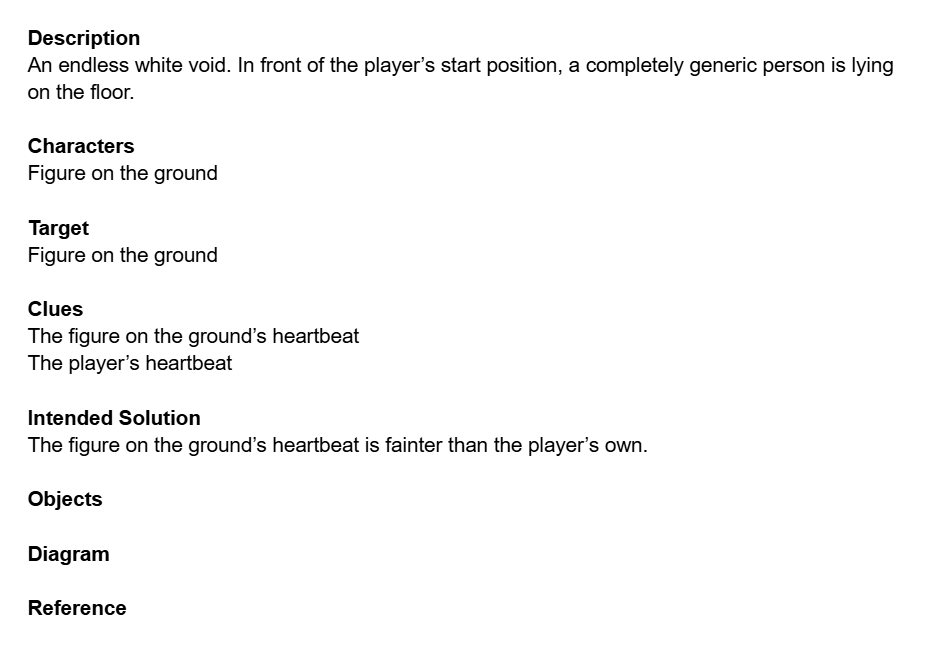
Building on the gold spike, we started planning out the scenes in detail. We created a scene document that lists out an overview of the scene, the player’s goal, the haptic patterns used, and assets needed along with reference pictures as a central hub for the team to align on the vision of each scene.
Narrative goal (+ how haptic enhances that)
What made our team excited for the players being death and taking people’s life from feeling their heartbeats and crushing it was that this is inherently an emotional scene, giving us a huge emotional space to work with, and by having players needing to figure out whose life to take by feeling the heartbeats, we also had a space to explore designing the haptics where haptics is crucial to progress the experience (no haptics will make the experience unplayable).
Our player will be death in training, who is guided by a companion, going through a hospital scene at the beginning to understand their goal is to feel people’s hearts and determine who is dying, a few more scenes with more complicated heartbeats (where haptic design comes in play), and in the final scene, they’ll realize their last person in this training is that companion, who is simply a wise soul following around with death before their time ended. The final scene is our emotional climax, and our goal is to have the impact of feeling the heartbeat and crushing the heart as filled with emptiness and loss as possible.
Hospital scene design
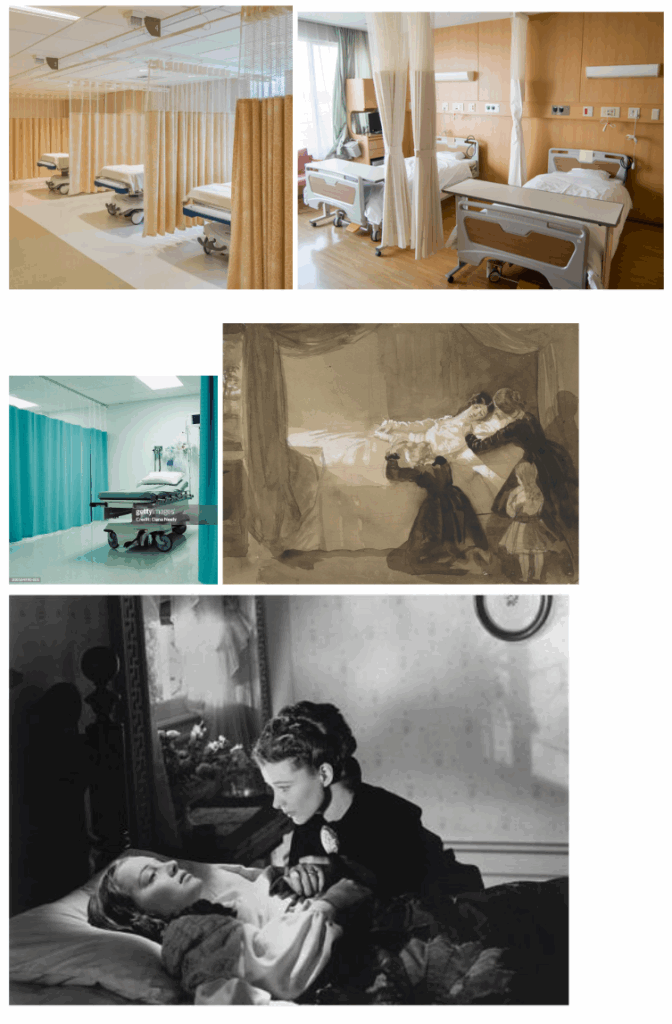
For our first scene after a title scene of tutorial of grabbing and crushing the heart, we are making the hospital. As our goal is to have players experience the complex emotions facing death, we decided that a hospital scene is a great first scene, as it will be simple to decide who is on their deathbed (usually the person on the bed).
Our minimal scene design includes: 2 humans, a patient who is dying, and 1 relative who is by their side. A hospital room, bed, and a curtain (p.s. the companion actually came from the same hospital, but on the other side of the curtain – this makes sense story-wise, and we’d be able to re-use assets yay).
We determined that the humanoids should not be as realistic as the ones we tested at Hunt Library, as that would be too emotional by the scene itself, so that we will go for a stylized cartoonish style.

Next steps
Our goal for next week is to continue making the hospital scene, determining the crucial questions we would be asking during Playtest Day next Saturday, and developing a testing plan and artifacts for that.