

This week, preparing for Playtest Day on Saturday, we reevaluated how our final experience answers the core question of our project goals: “How does our design of haptics and context influence how emotion is perceived in a full narrative arc of an experience?“. We first discussed within the team, then had a talk with Dave Culyba, one of the ETC faculty, and discussed with our project consultant and advisors. Finally, we executed the elaborate testing plan we came up with, for the artifacts we developed up until this week, the Tutorial and Act 1 of our experience.
Haptics role in an experience
After guidance from Dave Culyba (a teaching professor who teaches the rapid iteration experience design course Building Virtual Worlds at ETC), we identified the three core guidelines to think about our final experience design related to our goals as a haptics project.
What is the moment of haptics we are focusing on?
Knowing that we are focusing on feeling the heart itself to be the core to the emotional climax , it is crucial for us zoom in on that heart moment to the finest details, and refine it.
There are three main phases of the heart:
- Feeling the heartbeat
- Crushing it
- Consequence of having crushed it
Each phase is accompanied by different haptic patterns, and designing for it to be differentiable with adequate visual and audio context is important. Our design guideline would be to first design a pattern, add context according to it, and refine the moment whether to amplify the pattern or finetune the context details according to how clearly these can be differentiated from each other.

How does haptics affect our understanding of an experience
But the first design guideline simply ensures haptics is “perceivable”. It does not equate to emotional response. We recalled our insights from all the prototypes from before halves, where “haptics understanding is based upon sensed memories, whether it’s from realistic experience, cognitive understanding, or interaction of hands, and that’s what’s changing people’s emotional response”. Therefore, in order to employ a haptics-first design, where haptics informs every other part of design, the design goal for each haptics experience will come from what sensed memories we want to get the players get reminded of. This includes having sufficient (but not too distracting) context, haptics that matches expectation and reinforces the understanding (ideally changes how players interact), and if needed, things that helps with changing people’s interaction intention.
For each of haptics, audio, and visual, they can be categorized into helpful, neutral, and distracting. For our purposes as a haptics-first approach, ensuring haptics are only helpful or neutral is crucial. Context design should support that and not lead.
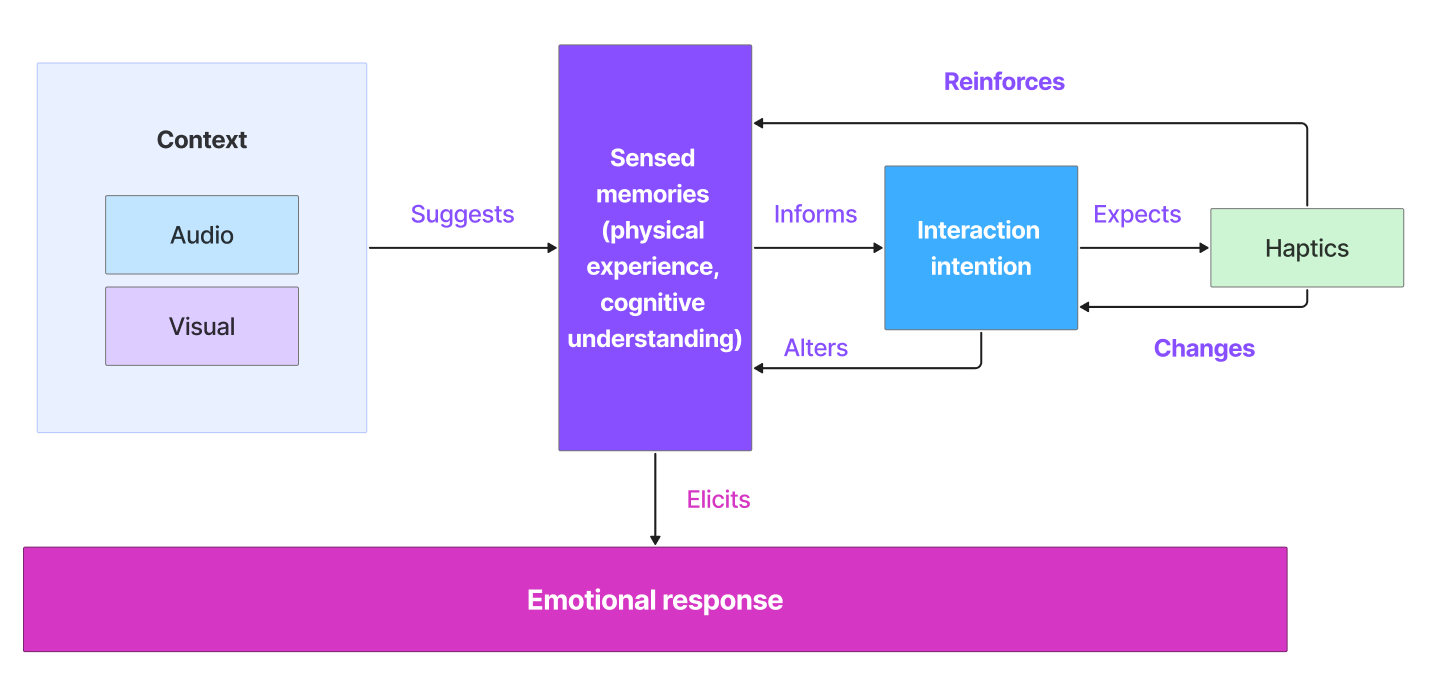
What is our emotional goal for every haptics we put in the experience
Since we are an exploration project on haptics and emotional design, our final experience should include as many different ways haptics changes our emotional responses. Therefore, we need to ensure our design goal for different haptics is to lead to different emotions. This requires us to design different sets of sensed memories that lead to different emotions. And this is what we will ultimately be playtesting for our complete experience, making sure a haptic experience matches our intended emotions.
Playtest Planning
With our design directions and insights gained, preparing for our playtest on Saturday became purposeful: we are playtesting for the effectiveness of the heart moment to the overall experience. We would test different sets of patterns to see how that changes perception of a sensed memory, and therefore the emotion, as well as the effectiveness of haptics itself.
Since we are focusing on the heart moment, we identified 2 parameters that change the heartbeat pattern: intensity (strong, weak) and heart rate (steady, increasing, decreasing, arithmetic). This leads to 8 different patterns. Treating each of the scenes as a small investigation scene, where the player (death) investigates different hearts to determine who’s closest to dying, we speculate that a weak, arithmetic, and decreasing heart is definitely close to death. Any strong heart would be associated with life, an increasing one leads to nervousness, and steady / fast / slow can change depending on context.
For this time, our playtest artifact will be the tutorial scene along with the hospital scene where the patient will have a different haptic pattern depending on playtest group. We came up with three groups of playtests:
- Group A: increasing heartbeat (test perception to emotion)
- Group B: decreasing heartbeat (test perception to emotion)
- Group C: no haptics at all (test haptic effectiveness)
On the other hand, with our dialogue still in development, to still ensure player character embodiment, we as playtest administrators decided to simply “speak out” the narrator’s dialogues to 1. teach the players how to interact with the heart., and 2. teach them what they should look for (a heart pattern closer to death) in the hospital scene.
Testing methodologies
Our experience has a strong emotional space, so it’s crucial to navigate the nuances that might arise, which influenced our testing methodologies.
- content warning about depiction of death, reaching into character bodies, hospital scene, and blood on the heart.
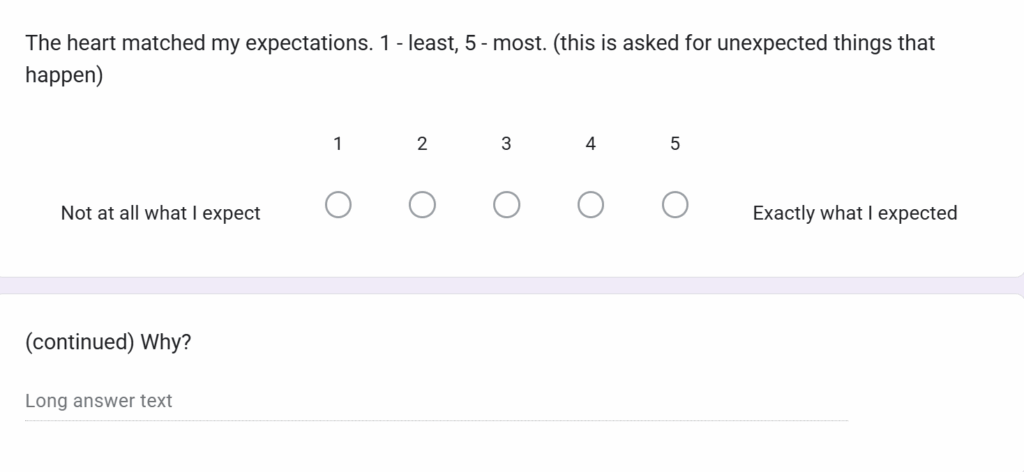
- Likert scales for VR experience
- A Likert scale is survey question technique that uses a statement and asks the playtester to choosing from 1-5 or 1-7 on how much they agree on the statement. For our experience, we decided to utilize Likert scales to see how much VR, hand-tracking, and haptics experience they have before to easily screen their VR naivety.
- interview questions for overall experience
- Knowing that playtesters might not have time to finish a long survey, we decided to use interviews to help them reflect on their experience, and us developers will record the answers in a survey ourselves for more convenient future data analysis.
- The interview questions were split into sections:
- VR naivety (Likert scale)
- Technical difficulties encountered (asking this here ensures it gets out of the way when asking about the actual experience)
- Their understanding of player goals and therefore interaction intentions in each scene.
- What they perceived about the heart moment, and how that influenced their decision in choosing to crush it.
- Give them the PANAS survey
- Ask about the extreme values in the survey.
- PANAS for emotions
- PANAS is a technique for asking what emotions contribute to an experience. We adapted the emotional wheel, choosing 25 most relevant ones, and created a survey that prompts playtesters to check emotions that they felt at the moment of crushing a heart, and for each emotion they felt, circle an intensity that contributes to that feeling.



Playtest Procedure
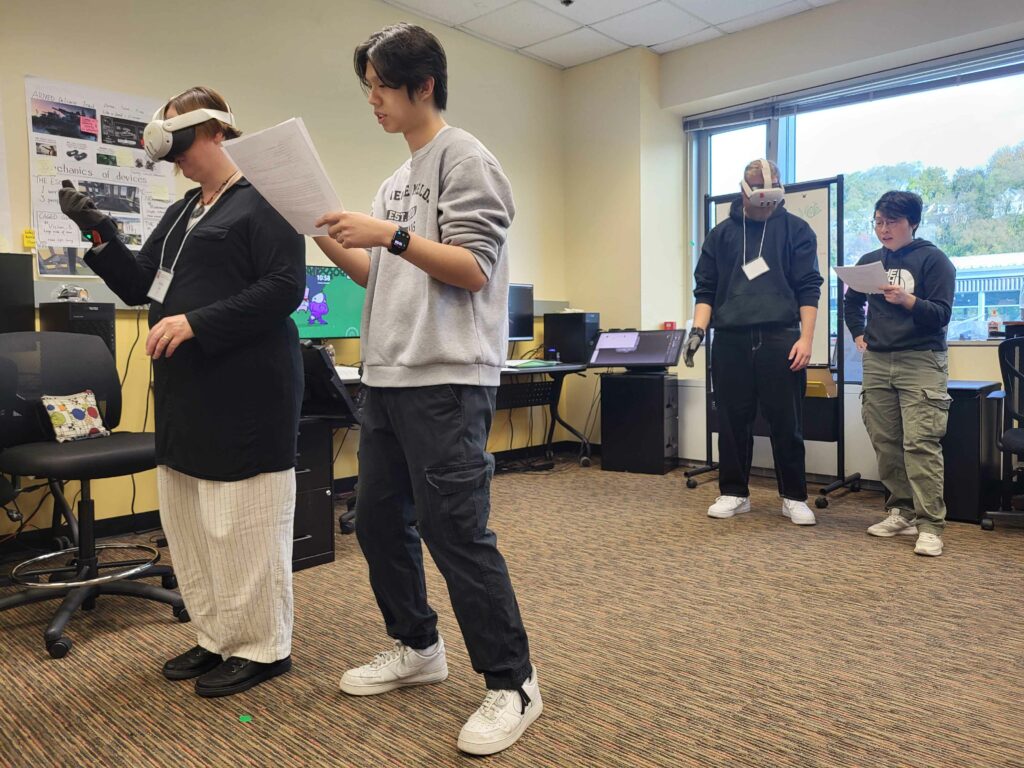
Whew, that was a lot. Recap: for each playtest group, we do intro (including content warning); in the experience, we read from the script to teach players, and for different playtesters, we give them different groups of haptic patterns of the patient; finally, we survey them by interviewing.
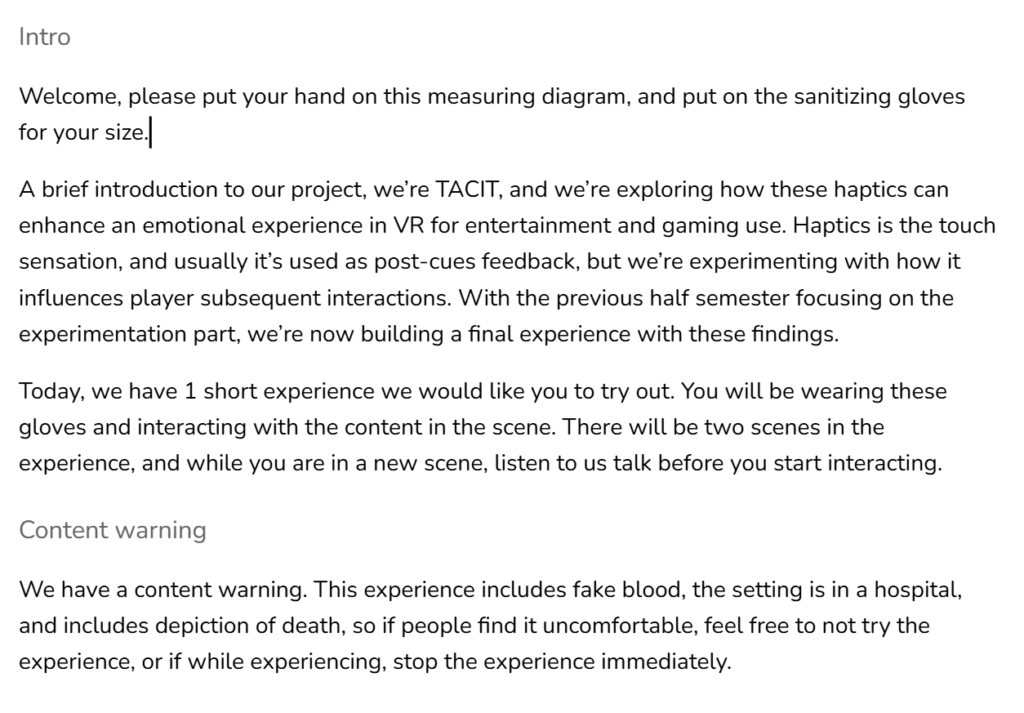
- Introduction to the team and content warning for our currently bloody heart. Onboarded the playtesters to listen carefully to us talking to them. Give them sanitizing gloves for their hand size.
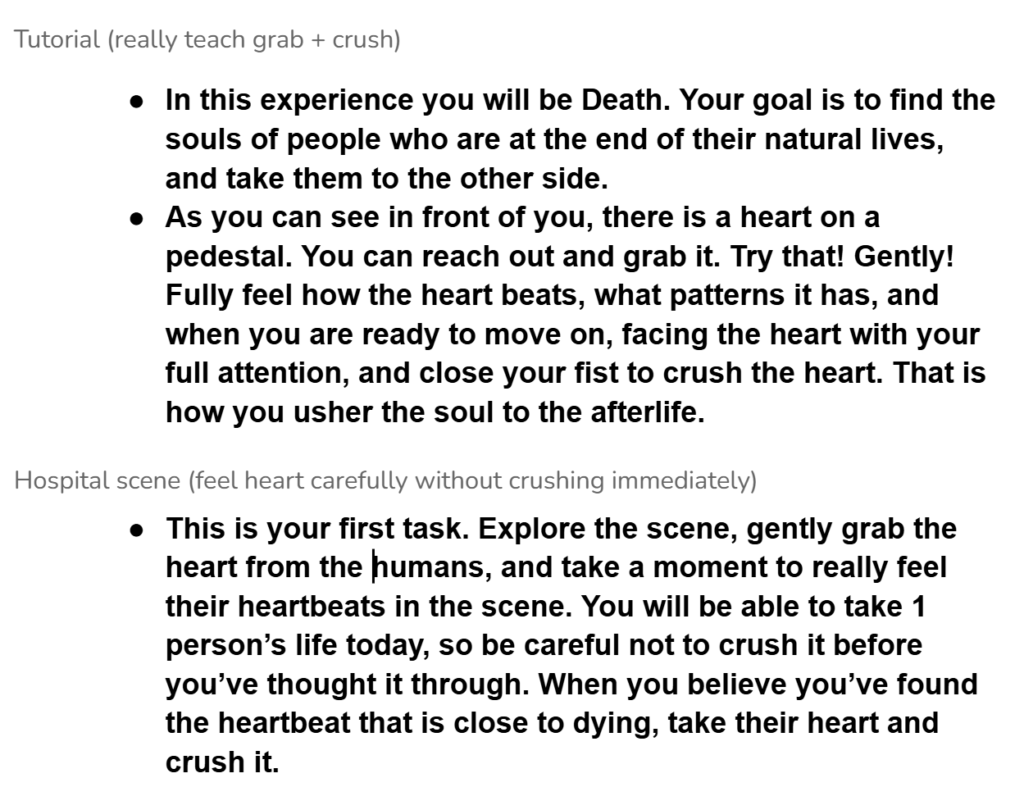
- Start the experience. Note which group they are in. A, B, C. Read from a script to guide them.
- Interview their experience
- Screening for VR naivaty
- Overall understanding of the experience, including technical difficulties
- How they decided who to take life away
- A survey for their specific emotion at that moment of crushing the heart
Next steps
And that’s all! On playtest day, we executed the plan, and even though there were difficulties where C group would be very unhappy not being able to test haptics, so we decided to only test A and B groups; our script had to dynamically change according to each playtester and iterate on the contents we add; and that our haptic patterns were not distinct enough that identifying the haptic pattern was very difficult, we still got 27 survey results, which helped us understand how our design of haptics, context, and dialogues (onboarding) can improve, and we’ll walk you through it next week!