

Designer’s Notes From Trinity
We can introduce the game mechanics to players at the very start of the game, literally:
By making all players use their game mechanics (together) to start the game
Weekly Update
This week’s Trinity was entirely focused on preparing for Playtest Day. We are ensuring every detail is covered to gather the most valuable feedback on the game
The Road to Playtest Day
Following up on last Friday’s workshop, the core of our plan is to establish a clear Player Experience Goal (PEG) and define measurable ways to track it.
Here are the key dates we are tracking for our playtest efforts:
- October 29th: Submit our playtest plan/survey to Mike for review.
- October 30th (12:00 PM – 1:00 PM): Conduct a preliminary playtest session with high school students.
The Playtest Day Itinerary (Nov. 1)
We’ve structured the Playtest Day itself to maximize efficiency and player interaction.
Logistics:
- Guests from RPIS will be picked up 10 minutes before the morning and afternoon sessions.
- Each group session will last 20 minutes, broken down as follows:
- 17 minutes: Play and interview time.
- 2 minutes: Send the guest to the next group.
- 1 minute: Set up the device for the next group.
Sharpening Our Player Experience Goals (PEG)
Mike provided crucial feedback, suggesting we clarify our PEG and focus on finding a correlation between time-based game metrics and our survey/video-based measurements.
Our overarching goals for the Trinity player experience are Fun, Significance, and Connection. To make these actionable and measurable for the Playtest Day, we are refining them:
| Player Experience Goal | Definition for Playtest Day |
| Fun | Nobody quits playing halfway. |
| Significance | Everybody’s contribution is recognized by others. |
| Synchronization/Connection | Are players doing actions in the sequence we planned out? The overall atmosphere, including mood and laughter, will also be observed. |
Measurement and Data Collection Plan
Gathering the right data is key to validating our PEGs. Our measurement strategy is multi-tiered:
- Essential: Video recording of players (in reality and in-game) to gather time-based data.
- Important: A follow-up survey to capture the unspoken psychological experience of the players.
- Nice to Have: Follow-up interviews with players (if time permits) and the collection of in-game analytics data (for time-based metrics).
New Features: To Test or Not To Test?
We also discussed whether to include a new feature in the playtest. The consensus is: if we can build it, we can test it.
The strategy for testing new content is to avoid making players “play it from start to finish”. Instead, we will focus on creating a Minimum Playable Level for the new feature, specifically focusing on the user onboarding process.
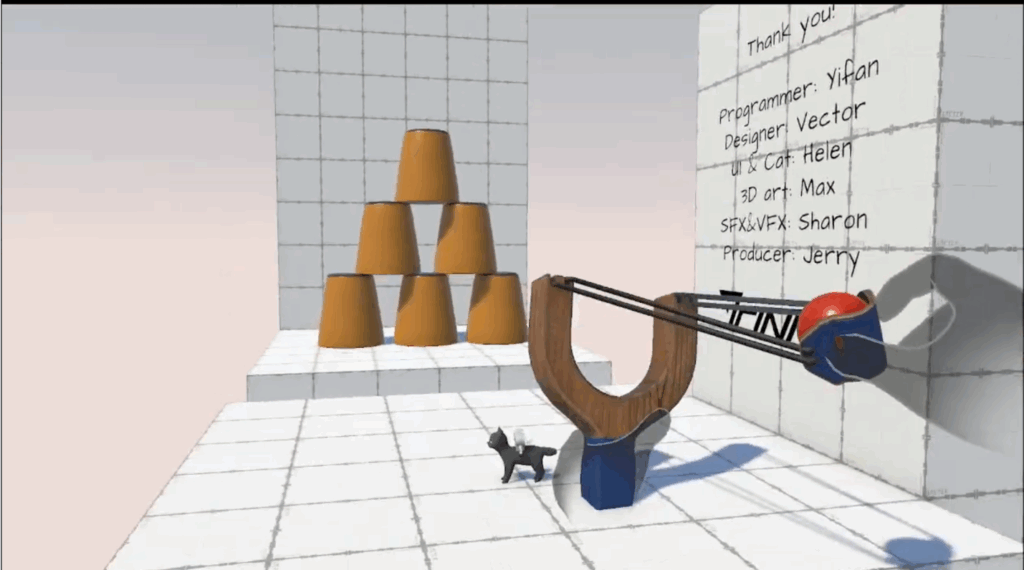
Here is the level: players can crash down the cup tower together. VR can use a slingshot, PC & Mobile can directly crash down the cups with physics. We don’t know how it can fit in any future level, but it definitely feels fun to play.