Art Progress:
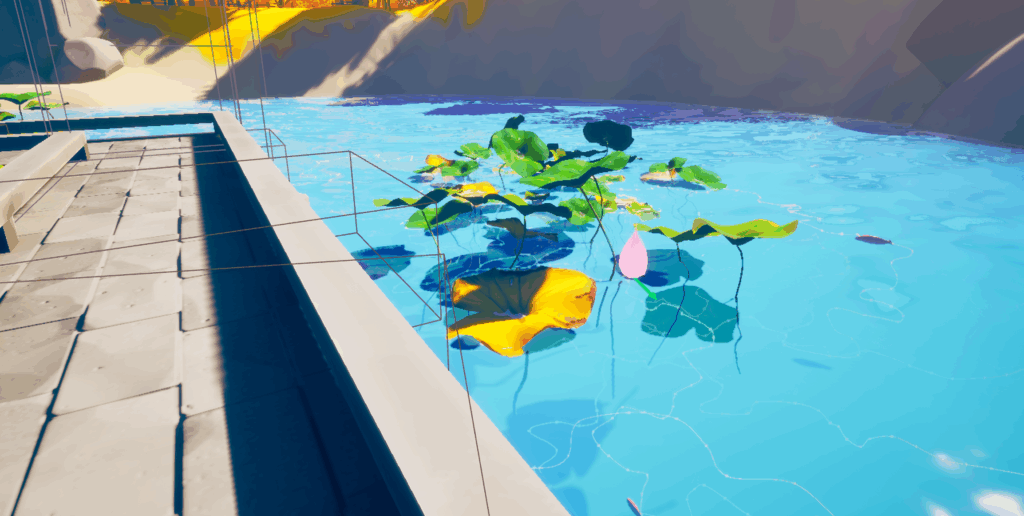
Most of the art work is now essentially finished. This week, we focused on polishing and final fixes. We resolved an issue with strange reflections of water surface, making the water look more natural and consistent with the rest of the scene. We also optimized several transparency planes across the environment to improve performance and reduce unnecessary rendering load. Adjust some fish swim path. With these adjustments, the overall visual quality and stability of the experience have both improved, and the art assets are now in their near-final state for Festival.
Tech Progress:
The major technical issue this week was rendering performance. When we tested the build on our current headset setup, the system began stuttering even before loading our scene — the Meta Quest’s default home environment was already lagging. This indicated that the problem was not caused by our project, but rather that the machine or setup itself was struggling to handle VR.
To isolate the issue, we tested the project on a separate workstation equipped with a 5090 GPU, and the difference was dramatic — the experience ran smoothly and clearly, with almost no performance issues.
To further understand the cause, we compared performance with a Unity VR project, which generally ran without issues on the same hardware. This made it unclear whether the bottleneck is related to PC performance, Unreal Engine’s VR optimization, or external factors. For example, a faculty member previously discovered that a Parsec-related drive was affecting performance; removing it temporarily improved the situation, but the stuttering later returned.
Our faculty instructors are helping us continue investigating these possibilities, and we will keep testing to narrow down the cause. Ensuring that our Festival build runs reliably on the available hardware is one of our main priorities moving into next week.
Soft Playtest Feedback:
Overall, our Softs playtest went smoothly. Since the build ran perfectly on the workstation with the 5090 GPU, many faculty members became very interested in our ongoing rendering performance issue on the original machine. We are still working with them to pinpoint the exact cause.
Because foot tracking still had some drift issues and made directional control difficult, we adjusted the system before Softs so that the foot trackers handle only rotation, while movement is controlled with the hand controller. This separation helped improve stability for many testers. Some players adapted to this setup very quickly and were able to complete the entire experience smoothly.
However, some still felt that the direction control was inaccurate or that the separation between rotating with feet and moving with controllers felt unintuitive. For a few testers, this mismatch can caused motion discomfort, since their real body wasn’t walking but the VR character was.
We suspect the issue may be related to individual height differences and walking styles. Our current direction calculation takes the midpoint between both feet, which may be affected if someone naturally walks with their feet pointing outward or inward. During Softs, some testers suggested attaching the tracker near the waist, since waist movement is generally more stable than foot movement. A few people tried this and found that the direction was noticeably more consistent and less prone to drifting.
We are still exploring how to create a direction-control system that feels intuitive, stable, and comfortable for most players, and this will continue to be a major focus in the coming week.
