Coming back from Fall Break, we picked right up from where we left off at Halves and started working on the next steps that we discussed in our presentation.
To provide players with greater creative freedom and flexibility in designing not only the pump tracks but also the surrounding park area, we began adding in 3D models of amenities that could be placed by the track pieces. We are starting out with benches and picnic tables, along with foliage like trees and flowers, that are commonly seen in most parks. We have a list of requested amenities from our clients as well, and we are working down that list, so in the future we will also have other activities like swing sets and playground pieces, barbecue grills, fountains, and pavilions.
We are continuing to work on our custom controller, and we are iterating on the specifications of the printing model’s structure. After collecting our test prints of the container last week, we need to adjust the sizes to fit the load cells and their wires, along with the springs to hold the central piece.
We also thought more about what types of input we would be able to achieve using our custom controller. We have pumping with the load cells, and we knew from the start that we want to use rotation for steering just like a real bicycle. This week, we came up with a mapping of controls for both the Xbox controller and the associated action for the custom controller.
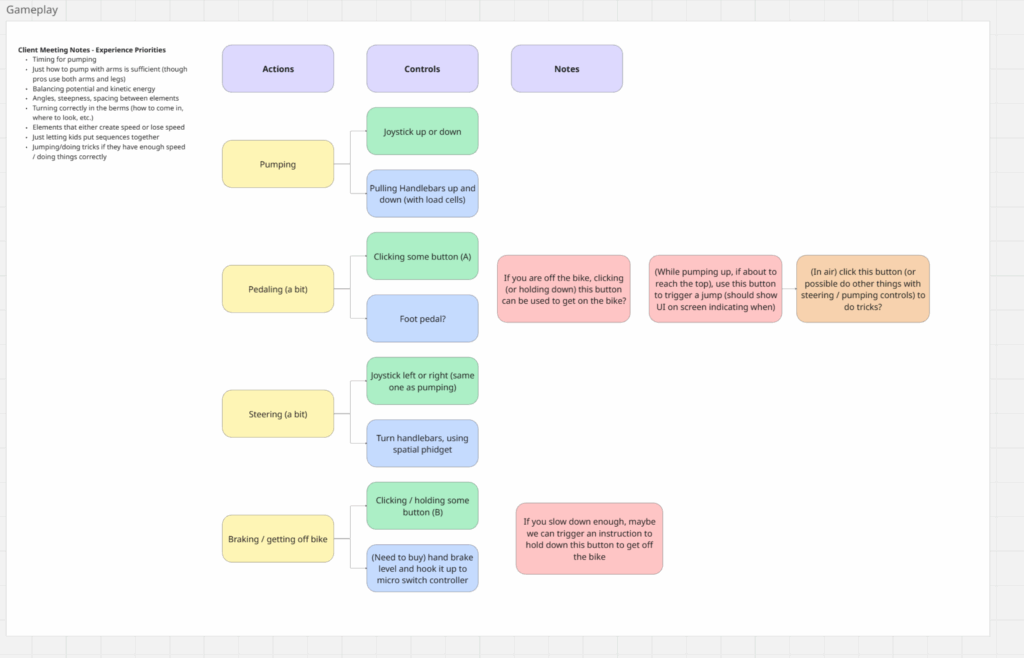
On the Xbox controller, we wanted to be able to accelerate and brake on top of just pumping and steering, so we needed to think about what we could add to the custom controller for the same effect. We decided that we could use a foot pedal in order to provide quick bursts of acceleration, similar to how we saw that real BMX racers will mostly keep their feet level on the pedals but occasionally quickly push down and pull back up to gain a bit of speed. A foot pedal that can be plugged into a USB port will be a simple addition that doesn’t need to be integrated with the microcontrollers. For the brakes, we want to use actual hand brake levers attached to the handlebars, but we this would require finding a sensor that can read the input of pulling the lever properly and figure out how to hook this up with the phidgets. After doing some research, we purchased a magnetic contact switch and a digital input that could connect to the phidget hub, and we will try setting that up once those pieces arrive.
On the tech side, we added input support for the bicycle controls for the Xbox controller.
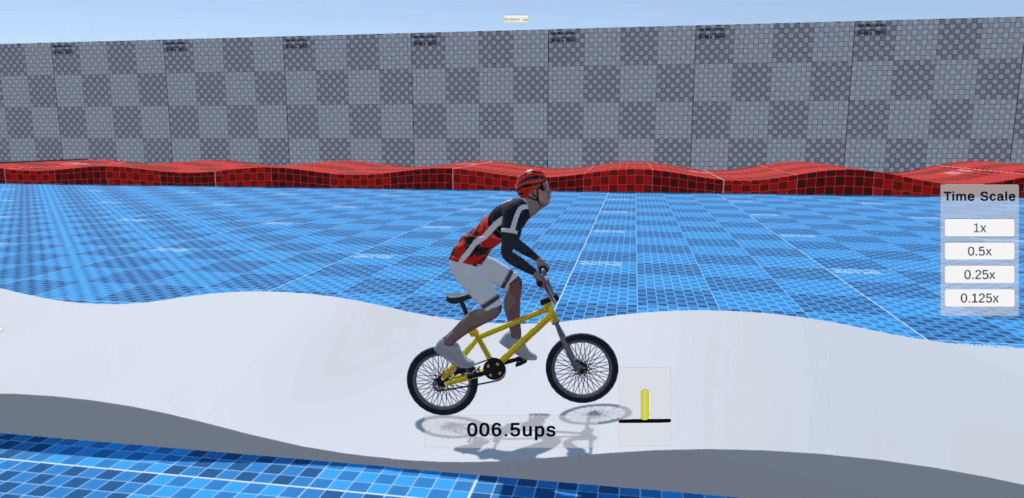
This week, the focus for the program was implementing an automatic tilt that follows the curvature of the ground, which will be crucial in getting the player to properly ride on the berms. This requires a lot of artificial forces applied to the character so that way the bike doesn’t easily fly off the ground or follow it too closely and have unrealistic wobbling. This will require more fine tuning in the coming weeks.
Additionally, we retooled the inverse kinematics (IK) system of the provided rig and animations to support animations for the pumping actions. The movement is still stiff and requires further adjustment, but this is a good start in making the character’s actions more realistic to riding on a pump track. The pedal positions have also been adjusted so that the character will try to level out their feet on the pedals while pumping, which is what our clients have shown us is how people ride on pump tracks in real life.

Next week, we will continue to make improvements and implement more features as we prepare for ETC Playtest Day.