
This week is all about preparing for Halves — our mid-semester presentation that, as our faculty advisor John Dessler aptly put it, is really more for ourselves than for faculty.


Putting this presentation together has “forced” us to pause, reflect on what we’ve actually learned, and define a smart direction for the rest of the semester. The key words here are learned and smart.
Unlike a typical ETC project that primarily showcases what has been built, our team has been operating with two parallel prongs from day one: research AND production.
It’s rare to work with a technique so new that even industry professionals are still figuring out what to do with it. There’s considerable buzz around 3D Gaussian Splatting (3DGS) in the visual effects sector, yet even top-tier studios with advanced equipment and substantial funding are still exploring how to best leverage it. We’re contributing to that same exploration. Our goal is to make a real-world contribution to the evolving conversation around 3DGS — and that’s something we’re genuinely proud of.
As for being smart: we don’t have unlimited time or funding. With six weeks left, we need to define a final deliverable now — something tangible and compelling. Not just a product for the sake of having one, but a piece that thoughtfully showcases what we’ve discovered in a cohesive and presentable way.
So what have we learned so far?
1. 3DGS does not behave like a mesh model — and treating it like one defeats its purpose.
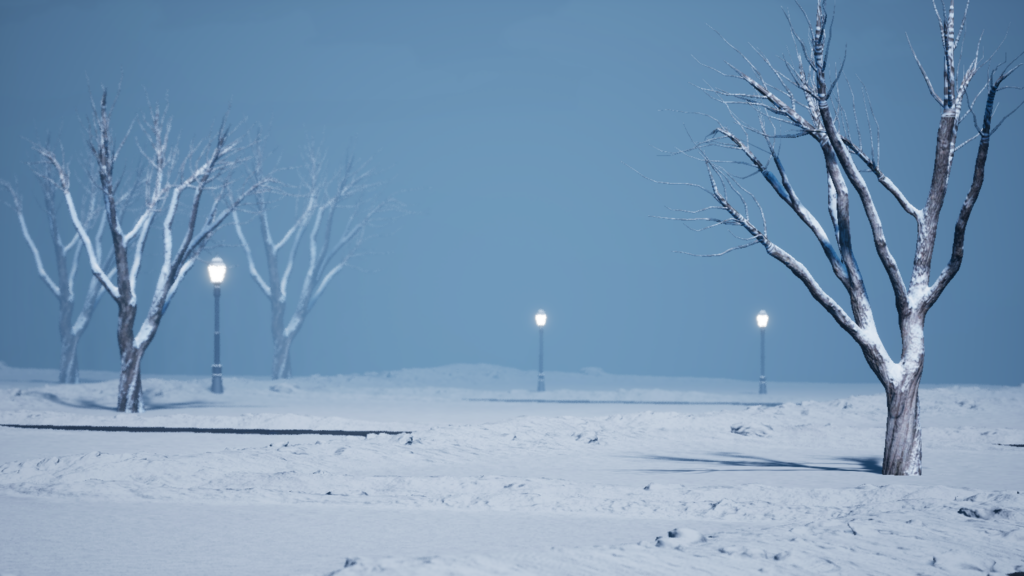
For instance, we attempted to place a 3DGS-scanned object onto a dark, snowy street at night. Because the object wasn’t originally captured under those conditions, it felt visually disconnected from the environment. It casts no true shadow, and we cannot edit its “surface” to accumulate snow — point clouds have neither physical surfaces nor traditional shading behavior. Technically, we could build a low-poly proxy mesh to fake shadows and create colliders for snow interaction. But that additional manual labor undermines one of 3DGS’s key advantages: reducing modeling time and manpower.


2. A particle-based medium is powerful on its own terms.
Rather than forcing points to behave like meshes, we began asking: what are points naturally good at? Think of pointillism in fine art — the beauty comes from embracing the medium’s inherent qualities. Points disperse, gather, shimmer, dissolve, and flow. They excel at fluidity, transformation, and atmosphere. When we stop trying to forcefully control the 3DGS models — to edit, rig, or collide them like rigid geometry — new creative possibilities emerge.
Just before Halves, we’ve reached a meaningful turning point. We’ve accepted both the limitations and strengths of 3DGS, and we’re choosing to lean into what it does best. Our final direction is to create an exploratory, artistic music video that highlights the unique, point-based visual effects we’ve uncovered this semester.
Alongside the piece, we will document our pipeline and offer practical recommendations for where 3DGS shines. Our goal is not just to make something beautiful, but to contribute insight into what this medium can meaningfully become.
You can find a recording of our Halves presentation on the Media Page. In addition to the reflections shared in this Week 7 blog, the presentation dives deeper into our production pipeline, the lighting workflow we’re developing for mixed-media scenes, and the music-inspired visual effects that will shape our final piece.
2/23-2/27/2026