Week 12 focused on preparing for Softs by refining the prototype, addressing major design challenges, and continuing iteration through playtesting and feedback.
Playtesting and Narrative Refinement
During Playtest Night at Hunt Library, the team tested the current build. While some UI elements were missing, we adapted by verbally guiding players through the tutorial, which still provided valuable insights. A key outcome was strong feedback from peers who asked clarifying questions and suggested ways to reframe core mechanics for better understanding.
In parallel, the team revisited the narrative, editing for clarity and concision before further refining the tone to better reflect the style of oracle bone inscriptions.
Prioritization and Softs Goals
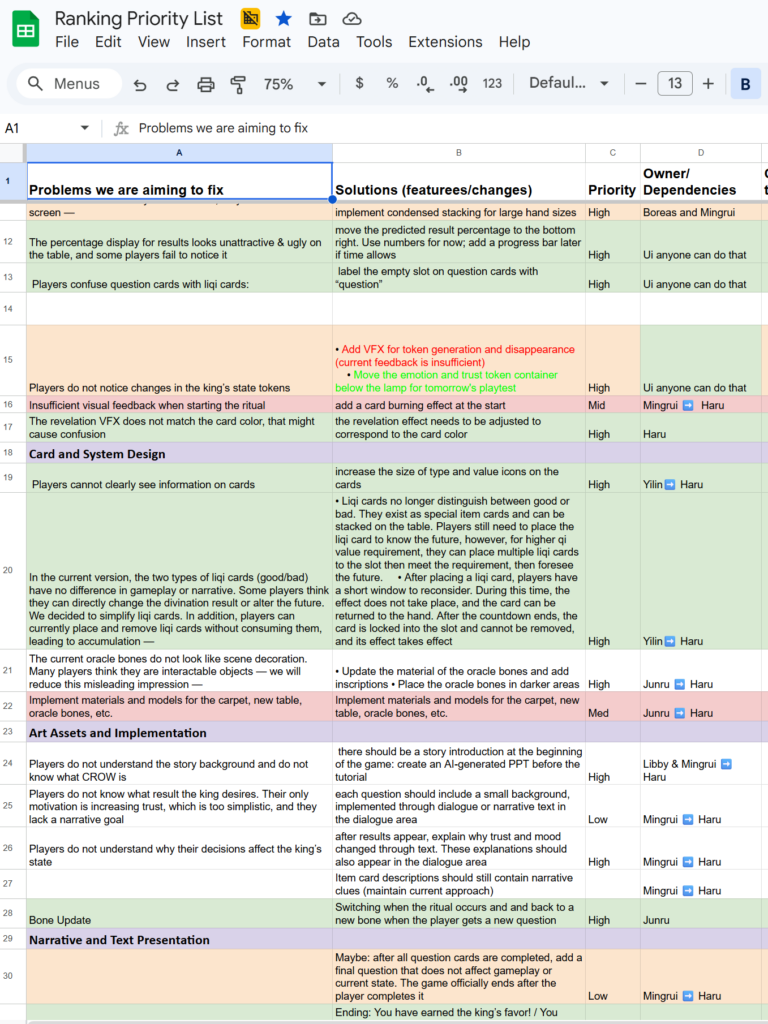
Using the established priority list, the team aligned on key goals for Softs:
- Implement a functional tutorial and finalize its format
- Complete UI integration and clarity improvements
- Refine core gameplay systems (card balance, Li Qi functionality)
- Implement sound effects and music
- Integrate art assets, including updated bone textures and environmental details
- Finalize six narrative rounds with balanced outcomes
The overarching goal was to deliver a playable, engaging, and nearly complete experience by the end of the week.
Integration and System Challenges
As systems came together, several challenges emerged:
- A card overflow issue, where optional cards (Li Qi and sacrifices) could exceed the interface limit
- Continued difficulty explaining the Li Qi system clearly to players
- Bugs affecting card interaction and readability, particularly around selection vs. dragging
These issues highlighted the complexity of balancing gameplay depth with clarity, especially within a short, museum-oriented experience.
Design Iteration and Solutions
In response, the team explored multiple solutions. One proposed direction simplified the system by:
- Treating questions as static prompts rather than cards
- Emphasizing resource management as the core mechanic
- Reducing cognitive load by limiting overlapping systems
By the end of the week, a refined approach allowed the team to retain Li Qi while restructuring how and when it is introduced:
- Li Qi is introduced early and required once, then becomes optional
- Sacrifice cards are introduced later and required consistently
- Card distribution and outcomes are carefully balanced across rounds
To support this, the team developed a combinatorics-based balancing approach, mapping out all possible player states across the game to ensure:
- Players always have a viable hand
- The total number of cards remains manageable
- Mood and Trust outcomes create meaningful stakes
Final Push Toward Softs
Alongside these system-level changes, the team continued:
- Implementing UI and tutorial elements
- Improving visual and VFX feedback (e.g., ritual transitions, bone changes)
- Fixing bugs and interaction issues
- Integrating sound design and assets
Week 12 was a critical turning point, balancing technical integration, design clarity, and system complexity. By addressing core issues and refining the structure of gameplay, the team moved closer to delivering a cohesive and testable experience for Softs.