Week 04
Narrowing Our Direction
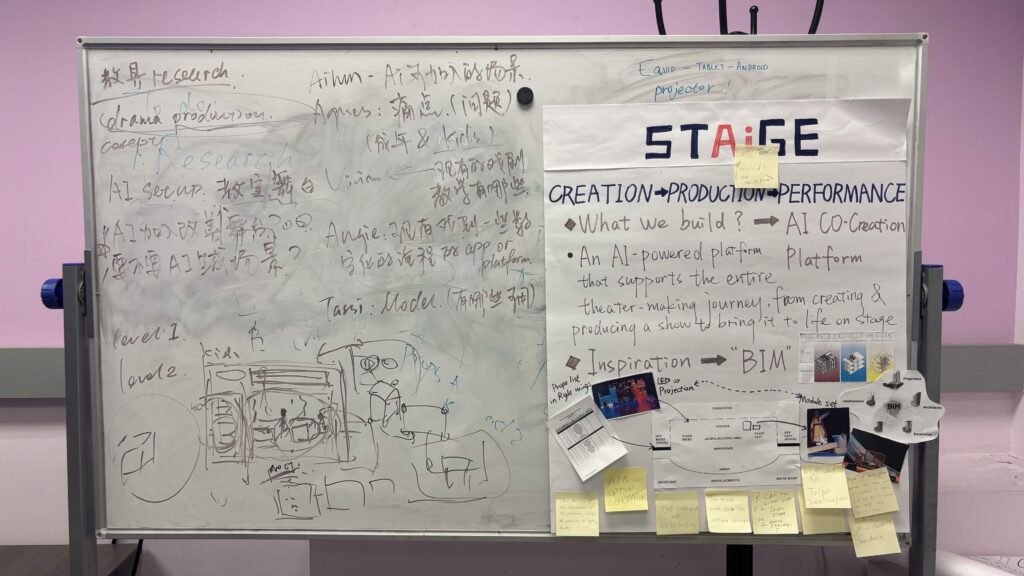
In Week 4, we focused on turning our broad exploration into a more clearly defined project direction. Through another meeting with our client, internal discussions, and early technical testing, we began to establish who STAiGE is for, what content it should support, and what the experience should ultimately produce.
Refining Our Target Users
One of the most important outcomes of our client meeting was defining our target users more clearly.
We narrowed down the age range of the students we want to design for and discussed the role of teachers within the experience. This helped us move away from designing a general theatre-making platform and toward a more focused educational tool that can support classroom learning through drama.
We also narrowed down the academic subjects we want to explore first. Defining these boundaries gives us a more realistic foundation for testing and allows us to design around specific classroom needs rather than trying to support every possible subject and age group at once.
Defining the Input and Output
We also clarified the basic input-and-output structure of STAiGE.
Our current direction begins with existing educational material, such as a lesson plan. STAiGE then helps transform that content into a classroom-ready theatrical experience.
This process requires more than simply asking AI to “write a script.” The output needs to consider the learning goals of the original lesson, the number and age of students, role distribution, performance length, classroom constraints, and the amount of dialogue each student can comfortably perform.
Defining this pipeline gave us a clearer framework for both our design and technical development.
Testing Lesson Plans and Script Generation
On the programming side, we continued improving our generation process and began testing different types of lesson plans.
We compared how different educational materials were interpreted by the system and whether they could produce scripts that were both meaningful as performances and faithful to the original learning objectives.
These tests also helped us identify a larger design question: what makes an AI-generated classroom script actually usable?
Rather than focusing only on whether the system can generate a script, we began investigating how the generation process should be structured so that the resulting script has appropriate characters, dialogue, pacing, participation, and educational value.
Exploring 3D Stage Maps
Alongside script generation, we conducted early experiments with 3D stage maps.
These tests explored how spatial information could help teachers and students understand where characters should stand, move, enter, and interact during a performance. We are beginning to investigate how stage directions generated from a script might eventually connect with a visual representation of the classroom performance space.
Building the STAiGE Identity
This week, we also completed our team poster and developed the STAiGE logo.
These materials helped us establish a clearer visual identity for the project as we move from early exploration toward a more unified product experience.
Looking Ahead
Our next step is to organize the structure of the STAiGE project website and determine what information and functions belong in each section.
From there, we will begin developing the website’s UI and visual system while continuing to refine the technical pipeline behind the experience.
At the same time, we will continue testing lesson plans, script generation, and stage visualization to better understand how each part can work together as one coherent experience—from educational content, to theatrical adaptation, to classroom performance.