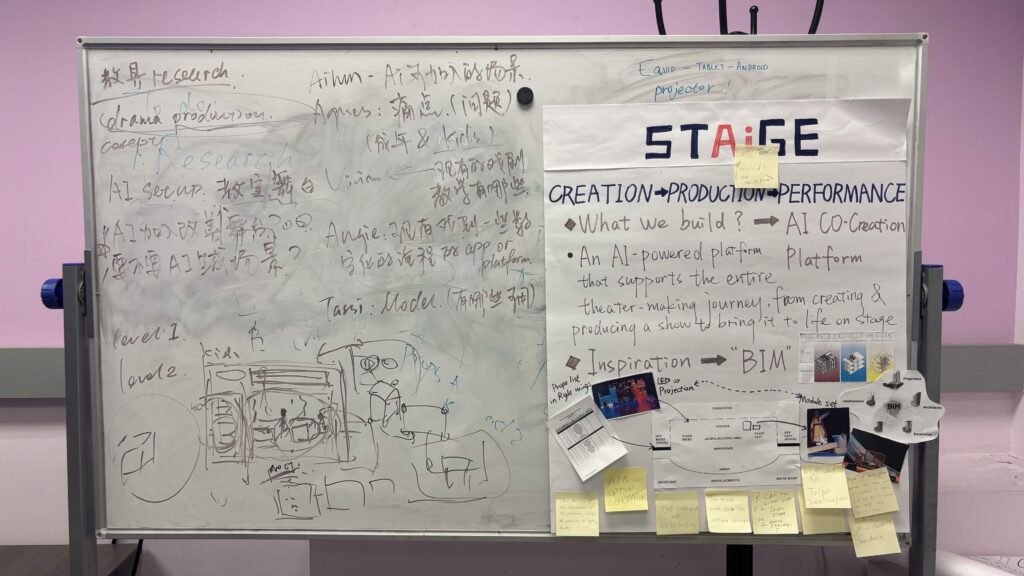
Defining Our Starting Point
In our first week, we began by bringing together a multidisciplinary team with backgrounds in UX design, creative technology, theatre and set design, interactive art, game development, and programming.
This mix of perspectives shaped an important early question for the project: where can AI meaningfully support the theatre-making process?
Meeting with Our Client
We also met with our client, a theatre actor, to better understand the personal motivation behind the project.
He shared that his son enjoys writing stories but does not enjoy performing on stage. This helped us recognize that theatre is not only for actors. Writing, directing, set design, visual storytelling, sound, props, and production planning are equally meaningful ways for young people to take part in a theatrical experience.
Our client also imagined a platform that could help children transform their stories into stage plays, while giving them ways to visualize and build theatrical worlds. He referenced creative building games such as Minecraft as an example of how young people might enjoy designing spaces and environments.
This conversation expanded the project beyond theatre creation alone. We began to consider how STAiGE could support teachers and students across different subjects, helping them turn academic content into stories, scenes, and classroom performances.
Creation: AI as a Creative Partner
We mapped theatre-making into three connected stages: Creation, Production, and Performance.
Our first direction explored an AI-assisted co-creation platform for developing original theatre.
We imagined AI as a brainstorming partner that could support early creative work, including story structure, character development, script development, music composition, visual concepts, set ideas, and mood exploration.
The goal was not for AI to replace artists or writers. Instead, we were interested in how it could help people begin, explore possibilities, and develop ideas that might otherwise feel difficult to express.
Production: Rethinking Theatre Planning
Our second direction focused on theatre production.
We explored the idea of a “Theatre BIM” platform: a centralized system that connects the many layers of a single production. This could include a 3D stage model, set information, lighting and sound cues, entrances and exits, prop lists, cast tracking, scene changes, schedules, budgets, and technical documents.
This direction raised a key question: what would it look like to make the complex and collaborative work behind a performance easier to understand, organize, and share?
Performance: AI in the Live Moment
Our third direction considered how AI could be used during a performance itself.
We explored an AI-assisted improv and live performance tool that could introduce new prompts, characters, constraints, or environmental changes in real time. AI-generated projections, sound, music, lighting, and shifting scenarios could create a more dynamic performance environment for participants.
This direction opened up possibilities for AI not only as a planning tool, but also as a responsive creative partner in live theatrical experiences.
Questions We Carried Forward
At the end of Week 1, we identified the questions that would guide our next phase of research and design:
- Who is the platform for: students, teachers, theatre makers, or all three?
- What level of technical experience should the platform assume?
- Which stage of theatre-making should we focus on first?
- How can AI support creativity without taking creative ownership away from people?
These questions became the foundation for our later research into drama education, classroom needs, student agency, and human-centered AI collaboration.