Defining STAiGE as a Process Drama Platform
In Week 3, we refined our direction and clarified the educational purpose behind STAiGE.
STAiGE is an AI-powered platform that helps teachers transform academic content into embodied theatrical learning experiences. Rather than focusing only on a final performance, the platform is inspired by process drama: a form of drama education where students enter an imagined world, take on roles, encounter tension, make decisions, and reflect together.
This approach matters because many current drama activities are difficult to adapt across subjects, require substantial teacher expertise, and take significant time and resources to prepare. STAiGE aims to make drama-based learning more accessible without removing teacher creativity or student ownership.
The system begins with teacher input, including:
- Learning goal
- Lesson content or source material
- Student age and class context
- Classroom space, time, materials, and technology
- Preferred balance of knowledge structure, AI support, and student ownership
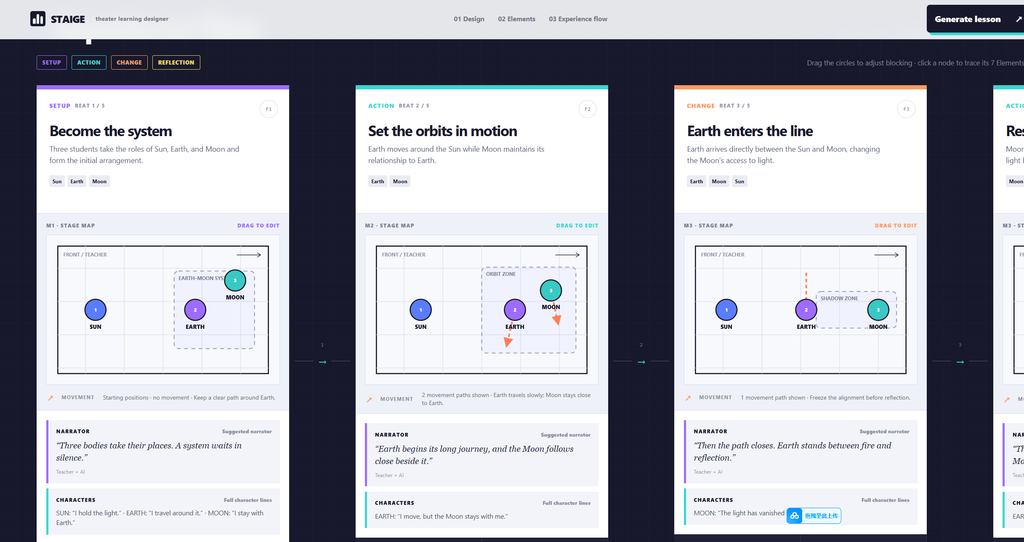
From this input, STAiGE identifies seven dramatic elements: entities, attributes, relationships, rules, actions, events or changes, and tension. It then transforms the lesson into a performance-ready learning experience, including stage maps, action and change flows, narrator cues, and optional elements such as sound, props, background visuals, and lighting.
We also developed examples showing that one framework can work across different subjects. A literature lesson might become a family story; a science lesson might become a photosynthesis journey; and a mathematics lesson might become a Pythagorean theorem exploration.
Importantly, teachers remain in control. They can decide how structured or open-ended the activity should be, how much AI support is appropriate, and how much agency students have in shaping the experience.
Looking Ahead
Our long-term vision goes beyond a digital planning tool. We imagine STAiGE as a hybrid online and offline toolkit that helps teachers plan, stage, and run embodied learning experiences in real classrooms.
The digital platform can support lesson input, story structure, stage mapping, and activity design. The physical toolkit can include modular blocks, role cards, event cards, prompt cards, props, and projection elements that bring the experience into the room.
As we continue developing STAiGE, our focus will be on keeping the platform simple, flexible, and human-centered: supporting teachers, empowering students, and making learning something they can physically explore together.
Prototype: https://staige-theater.xingzhao11099.chatgpt.site