

Prototyping and Early Design Exploration
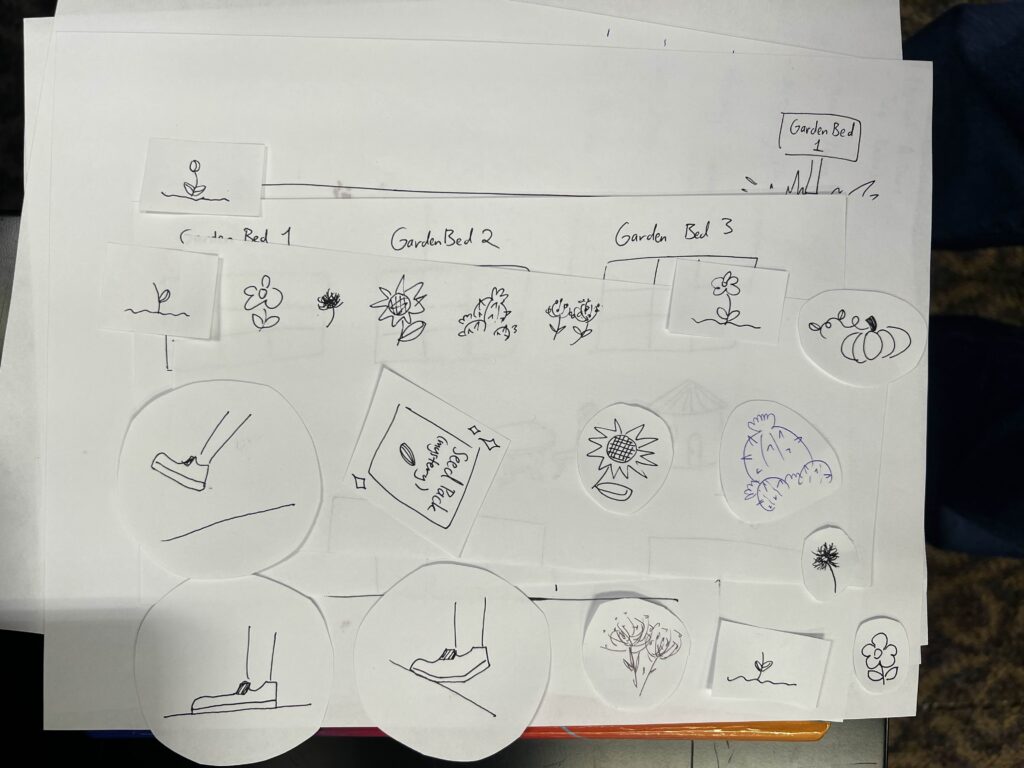
Building on the concepts generated in the previous week, our focus turned to creating paper prototypes to test the clarity of gameplay and better understand how player actions could map onto in-game responses. These prototypes allowed us to visualize different interaction flows, explore pacing and feedback loops, and evaluate whether the movements captured by the NuShu shoes felt intuitive and rewarding for players.
In parallel, the art team began gathering visual and stylistic references, exploring warm and approachable aesthetics that balance playfulness with therapeutic credibility. The goal is to create environments that feel inviting and comfortable, while also motivating players to engage in meaningful physical activity.
1/4s Presentation and Faculty Feedback
On September 10, the team presented its progress during the 1/4s milestone review with ETC faculty. The session provided valuable external perspectives on both design direction and technical feasibility.
Faculty feedback highlighted several key areas for improvement:
- Simplify interaction layers – Physical movements should map directly to game actions, avoiding unnecessary complexity.
- Clarify the target demographic – Narrow the scope to a specific audience, with strong encouragement to focus on older adults and elderly populations.
- Refine technical direction – Move from Unity HDRP back to URP to support performance, accessibility, and iteration.
Faculty also emphasized the importance of designing for prevention as well as rehabilitation, supporting both physical and cognitive challenges, and framing progress as self-competition and long-term improvement. Potential collaboration opportunities with PT/OT departments, UPMC Sports Medicine, and community centers were also highlighted as valuable next steps.
Subject Matter Expert Consultation
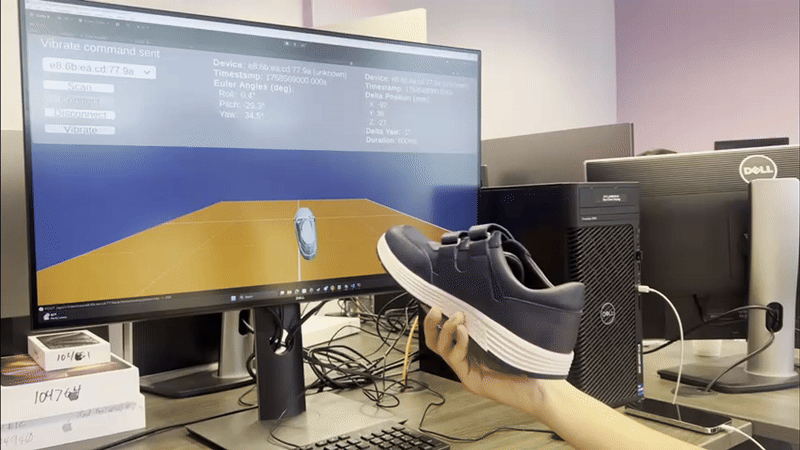
Another highlight of the week was our first SME consultation with Ian Lonich, a Board-Certified Neurologic Specialist from AHN. Ian provided deep insights into how therapy sessions are structured, the types of exercises most beneficial for neurologic and geriatric patients, and how cognitive tasks can be paired with physical activity to strengthen learning and carryover.
Key takeaways from Ian’s session:
- Balance and gait: Exercises like stride length, foot clearance, and reactive balance are high-value targets, especially for fall prevention.
- Challenge point: Design should aim for “difficult but doable,” adapting difficulty dynamically based on a user’s success rate.
- Feedback to feedforward: External cues (like vibration) should help users internalize improvements and eventually perform movements more automatically.
- Dual-tasking: Adding cognitive elements (such as recall tasks or simple counting challenges) can be powerful, but only after users succeed at a baseline physical level—too much failure reduces motivation.
- Real-world carryover: Games should bridge the gap between controlled environments and everyday mobility challenges.
His expertise validated many of our design assumptions, while also steering us toward more structured approaches for integrating feedback, adaptability, and cognitive layering into our prototypes.
Partnerships and External Outreach
Building on faculty feedback and Ian’s guidance, the team also began reaching out to local PT clinics and professionals to explore possible collaborations. These conversations will help us test prototypes with real users, validate therapeutic value, and ensure the project remains aligned with clinical best practices.
Next Steps
Following 1/4s and our first SME consultation, our immediate priorities are to:
- Iterate on the simplified prototypes and refine gameplay verbs.
- Narrow our target demographic to older adults and elderly users.
- Transition development from HDRP to URP.
- Continue building connections with PT professionals and clinics to prepare for upcoming playtests.
Comments are closed