Welcome back to our Blog. In Week 1, our updates focused primarily on the technical side of developing for the Board. With that foundation in place, Week 2 marked our formal transition into game design. Our priority was to define the overall player experience, establish a clear core loop, and determine how the Board’s physical interactions could support a readable and strategic PvP game.
From the Foundry to the Arena
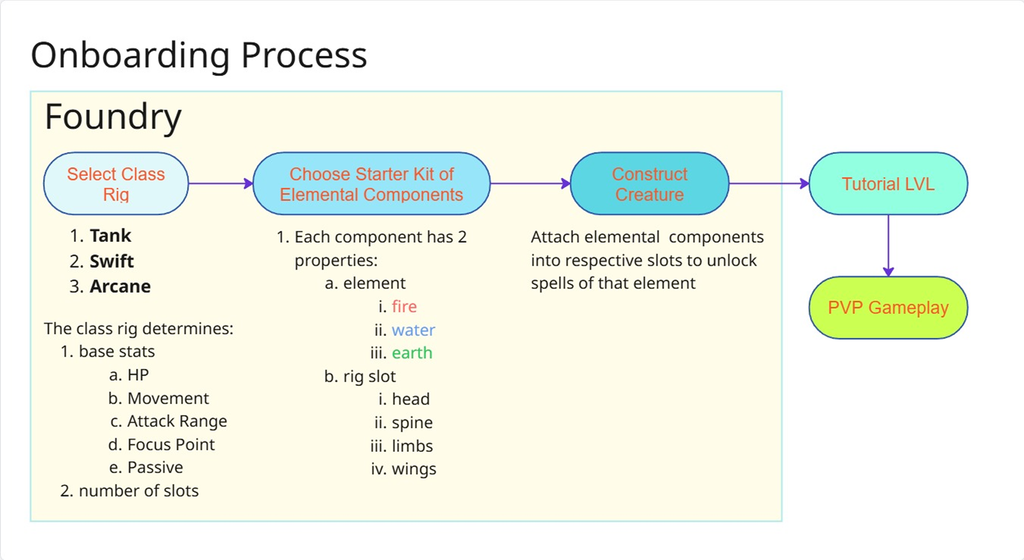
We began by mapping the full experience from onboarding to combat. Before entering the arena, players visit the Foundry, where they select a class rig—Tank, Swift, or Arcane—and choose a starter kit of elemental components. Each component has an elemental identity—Fire, Water, or Earth—and occupies a specific body slot, such as the head, spine, limbs, or wings. By attaching these components to their rig, players construct their creature and unlock a corresponding set of spells. After a tutorial introduces the system, the completed build enters PvP gameplay.
This onboarding flow is important because character construction is not separate from combat strategy. A player’s rig determines their base attributes and general playstyle, while their elemental components determine which spells they can bring into the arena. In other words, the creature players assemble becomes the foundation of every decision they make during a match.
Defining the Player Turn
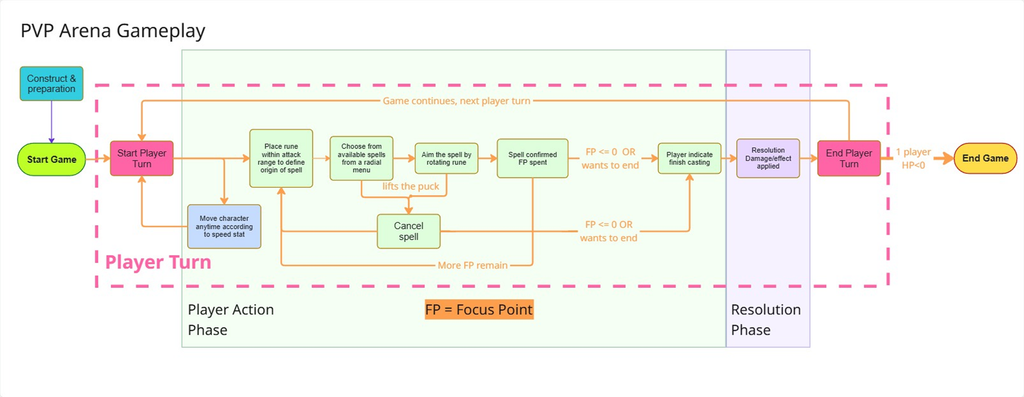
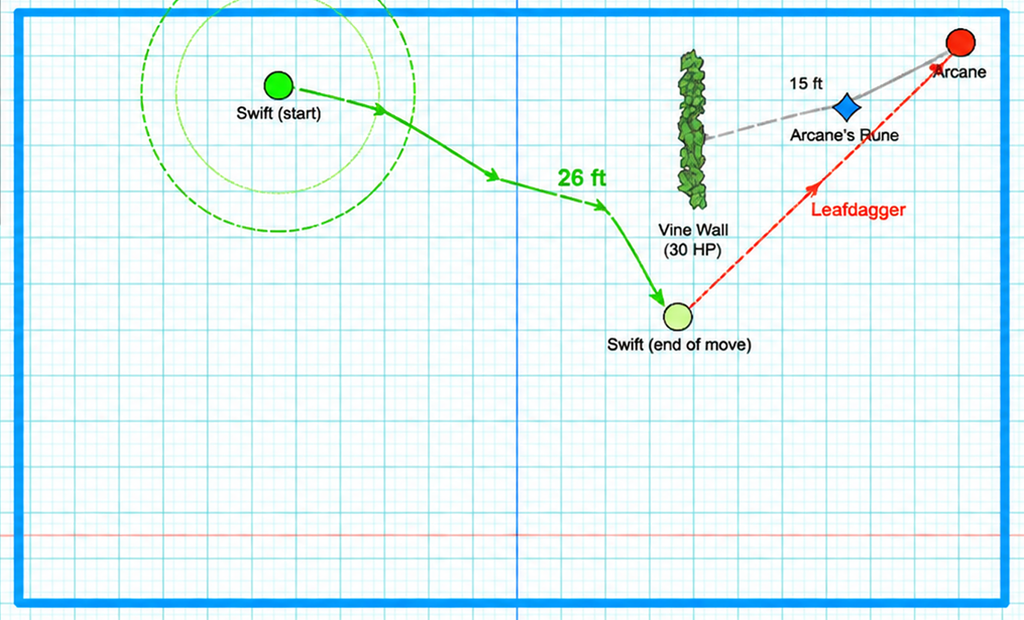
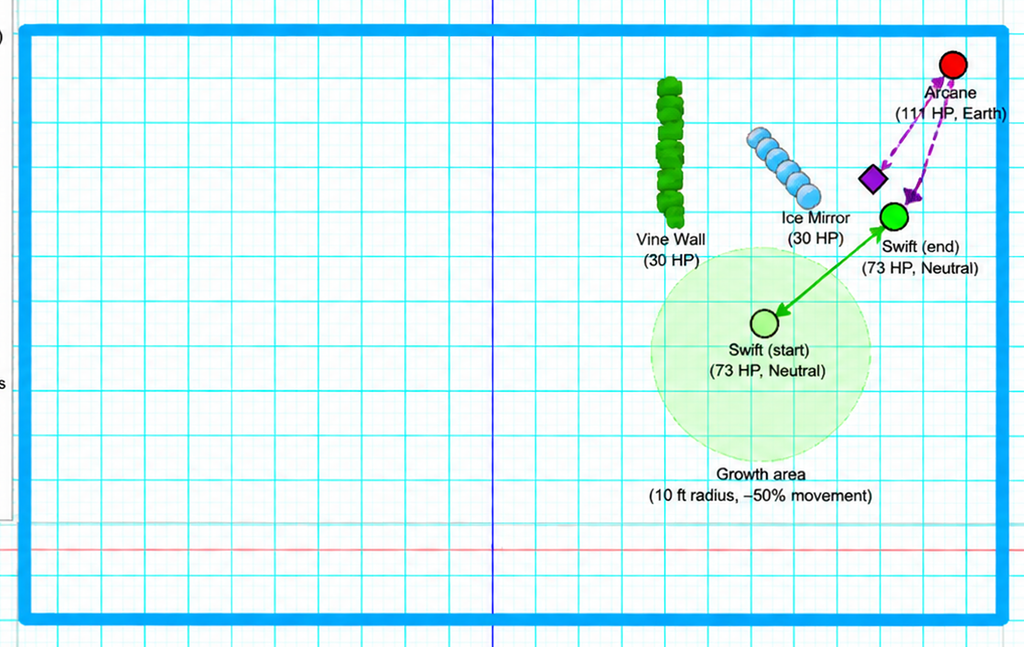
Once the broader experience was established, we focused on the moment-to-moment structure of a match. During a turn, a player first moves their character according to the movement value of their chosen class. They then place a rune puck within the character’s casting range; the puck’s position defines the origin of the spell.
Placing a puck opens a radial menu containing the available spells for that element. After selecting a spell, the player rotates the puck to aim it. A player may lift the puck to cancel before committing, or leave it on the Board to spend a Focus Point. This process continues until the player has spent their available Focus Points or chooses to finish casting. The game then enters a resolution phase, applying the damage and effects of every confirmed spell before passing the turn to the next player.
This separation between the player action phase and the resolution phase allows players to plan multiple actions before seeing their combined result. It also makes the physical rune pucks more than simple input devices: their placement and rotation directly communicate where a spell originates and where it will go.
Three Connected Design Systems
With the turn flow defined, we organized the game around three closely connected systems:
- Rig & Elemental Components >> enable Elemental Spells
- Spells & their cost/reward >> How player uses them in game
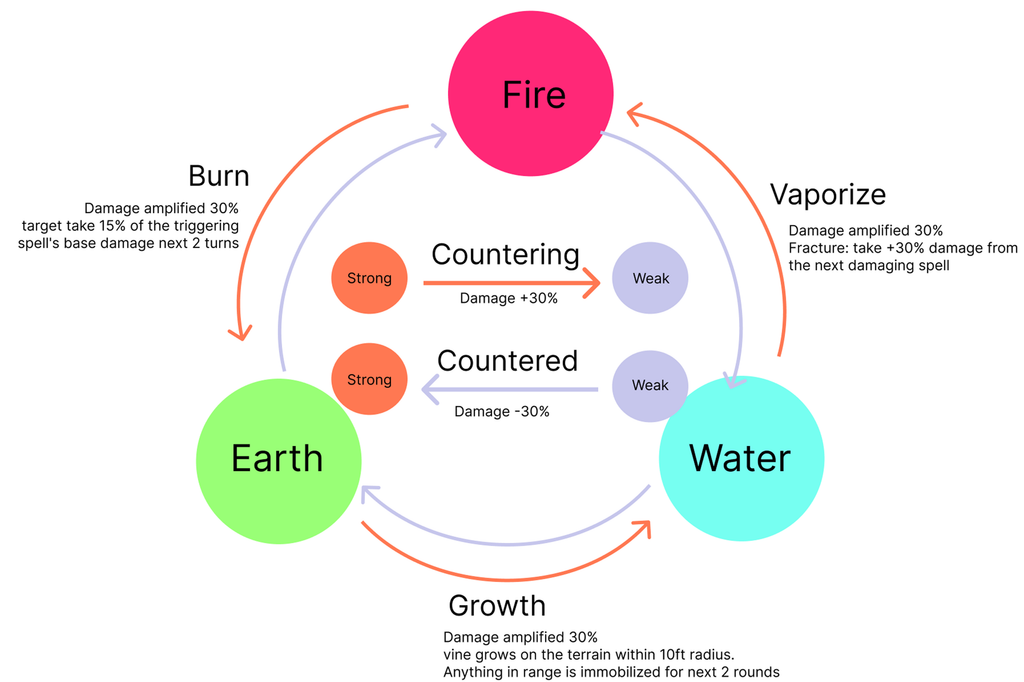
- Element Counter Cycle & Elemental Reaction System and effects >> how player strategize and setup a reaction

Testing the Loop with Paper Prototypes
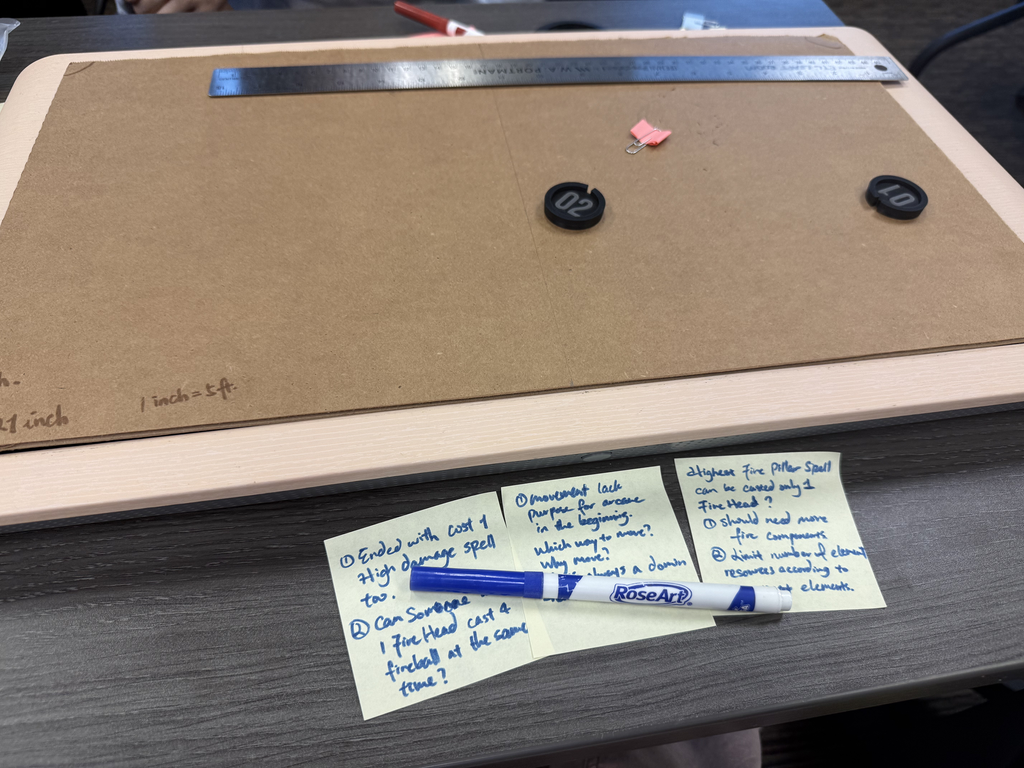
Diagrams gave us a structure, but paper prototyping revealed how that structure actually felt in play. Across three early versions, we tested the turn flow, movement and range, spell economy, class identity, constructs, and elemental reactions.
Playtest 0.1.0: Establishing the Basic Turn
Our first prototype tested the base turn flow, distance, and movement without elemental interactions. Players began in opposite corners with one Focus Point. This made the opening too slow: they could not reach or meaningfully interact with each other until the third round. Once they could engage, a one-Focus-Point Fireball was strong enough to decide the match, leaving little reason to use other spells. Shields also expired too quickly, which especially disadvantaged the player acting later.
In response, we increased the starting Focus Points to two, introduced basic attacks with longer range and lower damage, and extended the duration of sustained spells. These changes were intended to create meaningful choices earlier in the match without allowing one efficient attack to dominate the entire spell list.
Playtest 0.1.1: Testing Class and Spell Strategy
In this prototype we added class rigs and examined how movement and spell selection shaped strategy. The Arcane class naturally encouraged players to stay at a distance, place traps, and damage opponents from afar. However, the available spells did not yet provide enough environmental tools to support that intended playstyle.
We also found that direct damage remained the dominant solution. If a low-cost spell could accomplish the same goal as a more expensive one, players had no reason to invest in high-cost options. The test also raised important questions about how elemental components should limit spell access: should a character with only one Fire component be able to cast the strongest three-Focus-Point Fire spell, or cast several Fireballs in a single turn?
Our next iteration lowered the raw damage of several spells, reduced the cost of traps and environmental conjurations, allowed some constructs to remain until destroyed or triggered by a reaction, and placed additional constraints on high-level spells. These adjustments moved the system away from repeated direct attacks and toward positioning, setup, and longer-term control of the arena.
Playtest 0.1.2: Making Elemental Reactions Worth Pursuing
The last prototype we made this week focused on elemental reactions and asked whether they should create effects beyond a simple damage modifier. Players did not place enough elemental spells to produce reactions consistently, and the reward for intentionally setting one up was not yet strong enough to motivate them. Constructs also disappeared too quickly, especially because players needed several rounds to accumulate enough Focus Points for a satisfying two-spell combination. Compared with a shield’s reliable flat HP, a construct offered too little protection or strategic value.
To address this, we began treating constructs as persistent elemental filters or modifiers. Any spell that passes through a construct reacts with its element and receives a corresponding buff or debuff. Constructs remain in the arena until another reaction removes them, giving players time to build plans around the changing environment instead of relying only on immediate damage.
Looking Ahead
The design is still evolving. Our next questions include how to balance the advantage of acting first, whether players should begin with fewer or differently distributed Focus Points, and how strongly a character’s equipped components should restrict access to higher-level spells. As we continue iterating, our goal is to make every part of the experience feel like part of the same strategic system!