

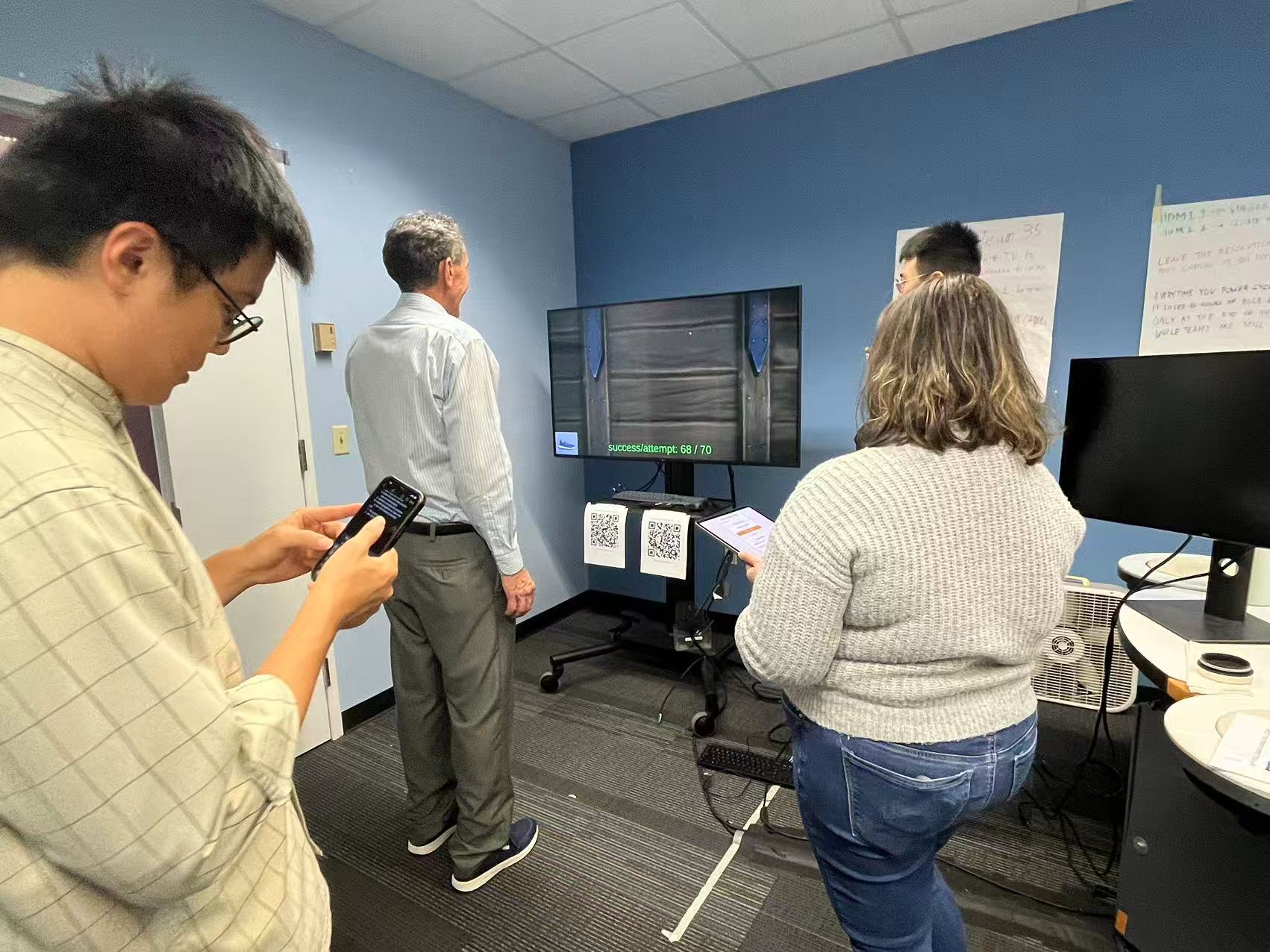
After our November 1 Playtest Day, Week 10 focused on turning real user feedback into concrete design and technical changes. It also became the week where we rethought our third mini-game and made an important decision about how closely in-game actions should map to real-world physical therapy exercises.
Key Takeaways From Playtest Day
Players reacted positively to the core idea—many said they felt “tricked into exercising”—and therapists appreciated the overall structure of the PT interface. At the same time, several recurring issues emerged:
- Tracking and connectivity instability, especially on the right shoe
- Unclear pacing and round structure in the Reactive Stepping game
- A few SFX that felt too harsh
- Color-only cues that were easy to miss
- In the Heel Raise game, the “new item” in the scene was sometimes too subtle
These findings set the priorities for this week’s iteration work.
Updates to Existing Prototypes
Reactive Stepping
To make rounds easier to understand and more stable:
- Added a Start button, countdown, and time-left display
- Rebalanced animal spawns
- Softened SFX and added a mute option
- Tightened movement validation to block toe-raise exploits
- Introduced a visible shoe-connection indicator and a one-tap reset/reconnect
Heel Raise
To better support the cognitive “spot the difference” task:
- Increased new-item visibility (outline/flash/brightness)
- Paired color cues with shape/text indicators
- Adjusted timing so players can comfortably search while holding the heel raise
System & PT Interface
On the system side we:
- Continued shaping a two-layer PT interface: Simple (Easy/Medium/Hard presets) and Advanced (a small set of parameters such as stimulus frequency, directionality, step distance, and hold duration)
- Began exploring clearer live visuals like expected vs. actual movement and simple trend views rather than dense data tables
- Worked with Conrad on improving Unity client stability and websocket reliability through longer streaming tests and better handling of timeouts
Rethinking the Third Mini-Game
Playtest results and ongoing hardware constraints also led us to re-evaluate our tandem-walking “narrow bridge” game. We discovered that:
- Certain tandem-walking patterns are difficult for the current shoe hardware to detect reliably
- When we try to fully 1:1 map complex PT movements into game mechanics, we often face a trade-off:
- Either the game is not very fun, or
- The shoe cannot sense the movement precisely enough, which creates frustration similar to our early Reactive Stepping experiments
Because of this, we decided to retire the tandem-walking bridge game and explore a new direction for the third mini-game.
We are now pursuing two design paths:
- Abstraction Layer on Top of PT Exercises
Use the inherently repetitive nature of PT exercises to drive progress bars or meters, and map those to a separate layer of gameplay. Our first prototype in this space is a mini-golf concept, where consistent, high-quality reps fill a meter that controls power and outcomes in the golf scene, instead of trying to literally move the avatar with every step. - Feedback-Only Motivation
Explore how far visual, audio, and haptic feedback alone can go in motivating players, without adding a full game loop on top. The question is: how much “game” is actually necessary to keep people engaged in rehab?
In our Week 10 meeting, Conrad was particularly excited about the first direction and encouraged us to push the abstraction-layer approach further. He agreed that the second idea is valuable but noted that it is large enough to become its own semester-long research project, so he recommended we not pursue it fully within this course.
Playtest Day Photos
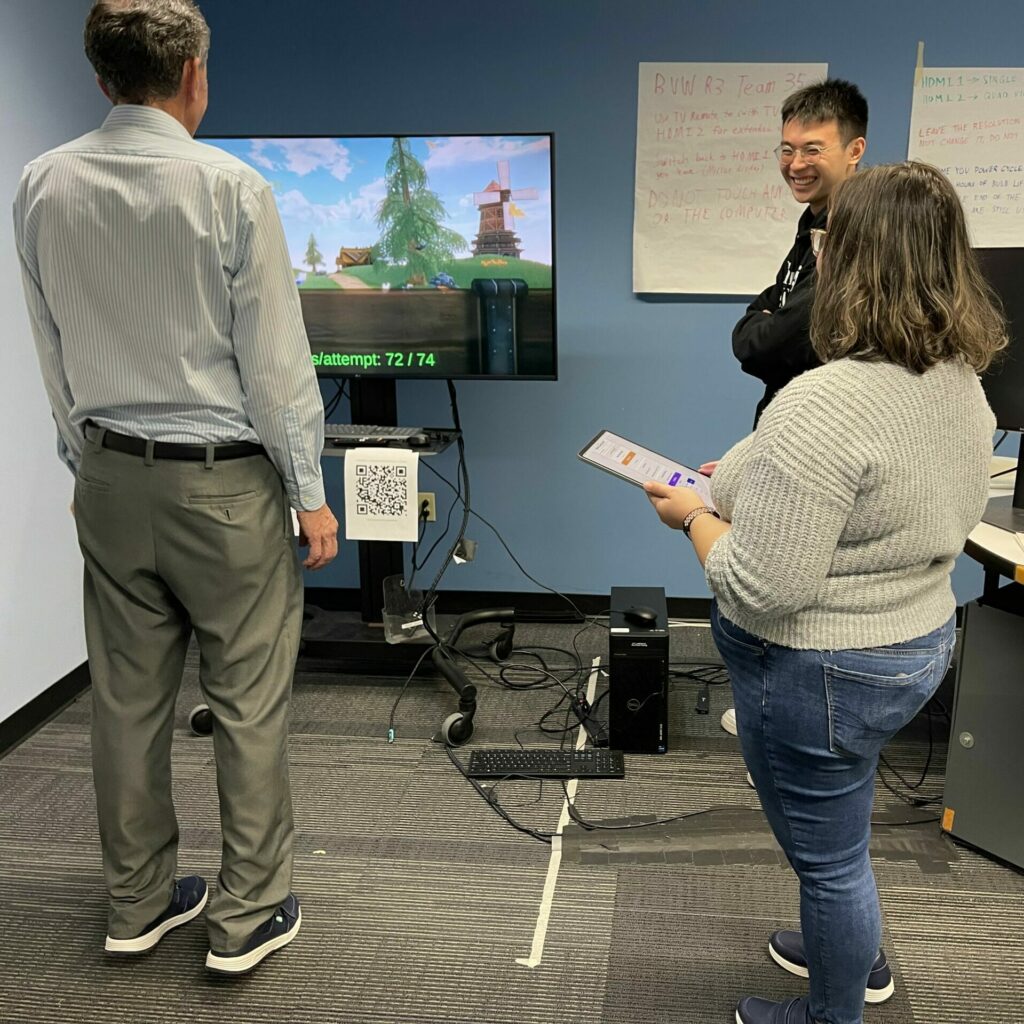
Playtesters enjoying their time.
Looking Ahead
Going into Week 11, our goals are to:
- Further stabilize shoe connectivity and right-foot tracking
- Refine the PT interface presets and visuals
- Build out the mini-golf abstraction prototype for the new third mini-game
- Prepare updated builds for follow-up testing with therapists
Week 10 was a turning point: we not only improved what we already had, but also clarified how ReNUSHU should balance real PT movement, hardware constraints, and playful abstraction.
Comments are closed