


In Week 8, Team ReNUSHU focused on refining gameplay logic and responding to faculty feedback. We improved the Heel Raise game’s visual clarity and cognitive depth, explored new directions for our third mini-game, and prepared multiple builds for an upcoming clinical playtest.
Refining Design Through Feedback
Following our Halves presentation, this week was dedicated to iterating on our existing prototypes and addressing valuable feedback from both ETC faculty and our collaborators at Magnes AG and AHN. The faculty praised the strong integration between the smart shoes and the PT interface, noting the system’s solid technical foundation. However, they also raised key questions about how our game mechanics connect with physical actions, how players receive feedback when performing movements incorrectly, and how our visuals appeal to our target demographic.
These insights encouraged us to reflect on how therapeutic movement can feel purposeful and engaging—not just functional.
Iterating on Heel Raise Gameplay
The Heel Raise (Butterfly Watching) game was central to this week’s iteration. Many felt that the original “counting butterflies” concept, while visually calm, risked becoming repetitive and cognitively shallow. In response, the team decided to:
- Improve visual clarity – making the butterflies larger and more distinct to ensure accessibility for older users.
- Experiment with an alternative “find-and-spot” gameplay – a more exploratory variation where players lift their heels to reveal hidden details in the scene, encouraging visual scanning and memory.
These updates aim to preserve the game’s relaxing tone while giving the exercise clearer cognitive purpose and better visual readability.
Art & Visual Development
In parallel with gameplay iteration, our art team made significant progress on asset production and environment design. The visual tone continues to evolve toward a warm, nature-inspired aesthetic, reflecting our goal of creating a setting that feels peaceful, inviting, and therapeutic.
Below are some early visual explorations for the Butterfly Watching scene and environment props:
Early visual exploration for the mini game selection.
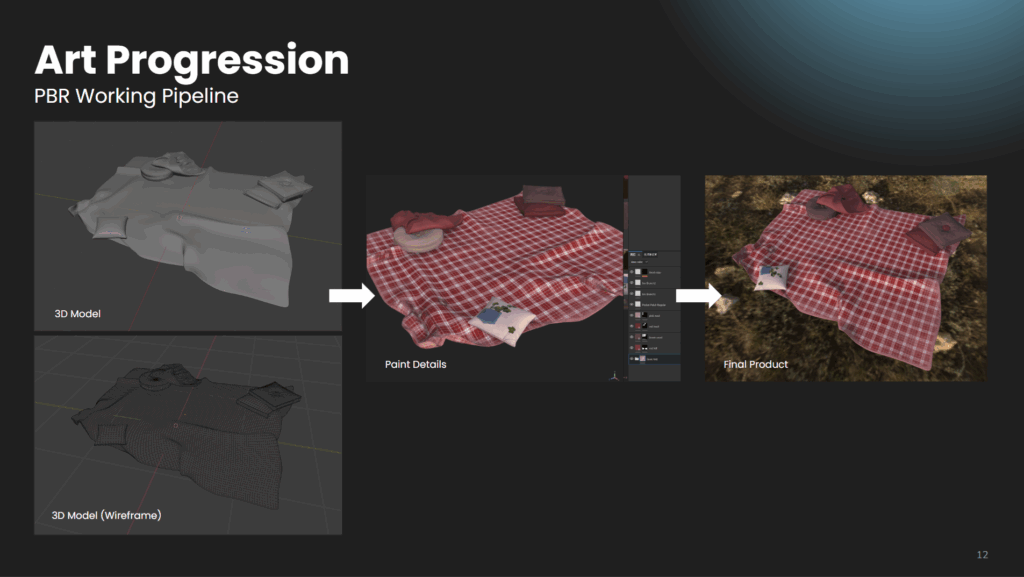
Campground environment prototypes developed for the “Animal Picnic Raid” game.
These assets establish the visual foundation for the cohesive “outdoor recovery” theme that connects all of ReNUSHU’s mini-games.
Deepening Collaboration with Magnes AG
In our latest meeting, Conrad and his team at Magnes AG shared their excitement about the project’s direction and provided critical guidance on gameplay scalability and hardware integration. Together, we examined how physical therapists may prefer varying levels of supervision—some exercises designed for independent use, others requiring close monitoring.
For Heel Raises, Conrad recommended focusing on repetition- and duration-based tasks, where longer holds or sustained sets can be tied to meaningful in-game reactions. He also encouraged us to explore memory-based cognitive challenges, such as spotting differences between scenes after several repetitions, or identifying subtle visual changes to train focus and recall.
From a technical perspective, we learned that the NuShu shoes do not currently maintain a world coordinate system, which makes precise positional tracking for “reactive stepping” gameplay complex. Our programming team has begun investigating potential solutions—such as recalibrating using step states or simplifying the game’s spatial logic—to make the “animal picnic raid” experience function reliably within Unity.
Exploring the Third Gameplay Direction
Alongside ongoing work on Heel Raises and Reactive Stepping, the team revisited the concept for our third mini-game, originally inspired by tandem walking. After extended discussion, we concluded that the “log bridge” design contained inherent gameplay limitations and did not effectively encourage the desired movement patterns. Two promising alternative ideas emerged:
- A Subway Surfer–like experience focusing on lateral movement and agility.
- An Alpine Coaster concept where players use heel pressure as a brake, connecting lower-limb control to a fun, momentum-based challenge.
Both directions show potential for balancing therapeutic training with engaging play, and will be further explored in the coming weeks.
Milestone: Our First PT Playtester
This week, we officially connected with our first physical therapist playtester, Shani, who will help us evaluate gameplay clarity, comfort, and engagement.
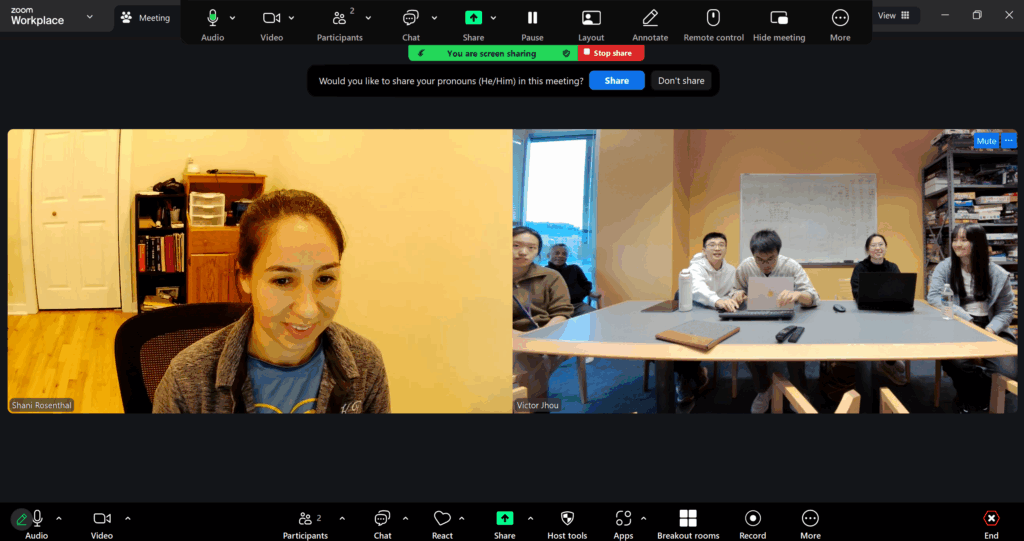
Team ReNUSHU meeting with Shani, our first PT playtester.
We scheduled our first playtest session for October 29, aiming to test three versions of our current games:
- The updated Butterfly Watching heel-raise game.
- The new Find-and-Spot variation.
- A playable build of the Reactive Stepping (Animal Picnic Raid) game.
This collaboration marks an important step forward in validating our designs with real clinical insight.
Preparing for Upcoming Playtests
We also confirmed a playtest session with physical therapist Shani scheduled for October 29 (Wednesday). Our goal for the coming week is to finalize three playable builds for this session:
- The improved Butterfly Watching version of the Heel Raise game.
- The new “Find-and-Spot” variation of the Heel Raise game.
- A playtestable version of the Reactive Stepping (Animal Picnic Raid) game.
This playtest will help us evaluate comfort, clarity, and engagement from a clinical perspective and guide how ReNUSHU continues bridging therapeutic value with playful design.
Looking Ahead
Week 8 reaffirmed our commitment to designing games that are medically grounded yet emotionally resonant. As we refine visual clarity, cognitive structure, and motion feedback, we continue to move toward our vision of making rehabilitation intuitive, motivating, and joyful—
From Rehab to Play, From Play to Progress.
Comments are closed