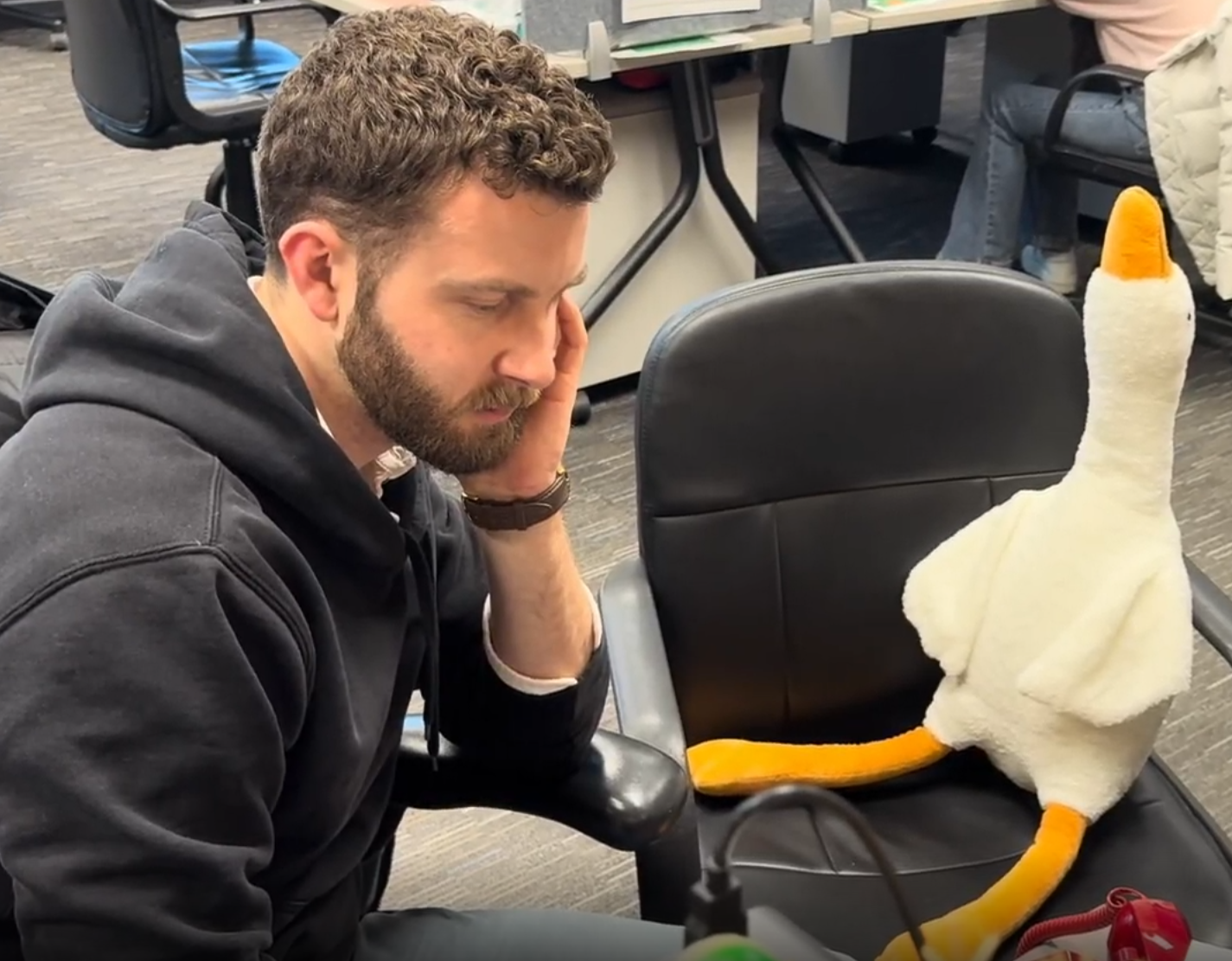
At the start of week four, we were excited to share a new narrative direction with our instructors. Our concept centered on a performer waiting at a bus stop beside a stuffed goose. The two engage in a conversation about waiting for a phone call, with the goose’s responses generated by a uniquely constrained AI.
At this stage, our primary interest was exploring what kinds of constraints can be reliably applied to an AI system—specifically ChatGPT Voice mode—while still maintaining flexibility and functionality. Our early tests led us to question:
- How personality can be effectively embedded into an AI
- Whether the AI should be aware that it is participating in a performance
- Which types of prompts and constraints lead to compelling human–machine interactions for an audience
- What tools or platforms we might be overlooking that are better suited to integrating AI into live theatre and improvisation without it feeling like a gimmick
After discussing our initial narrative with our instructors, we were encouraged to lean into ambiguity rather than resolve it too quickly. We were also prompted to consider questions such as:
- Could the goose have a distinct personality?
- Would assigning gender change the interaction?
- What assumptions do audiences bring regarding age or gender?
- Does the bus stop remain the setting, or does the waiting move somewhere else—perhaps a more abstract or unexpected location?
Later in the week, we successfully implemented our API integration. However, a major challenge emerged: session-level instructions were not behaving as expected. To continue testing, we conducted playtests using OpenAI’s Realtime Voice Playground as well as our standalone WebRTC implementation without the intended constraints. In parallel, we began compiling an initial set of prompts aimed at shaping the AI’s personality more consistently.
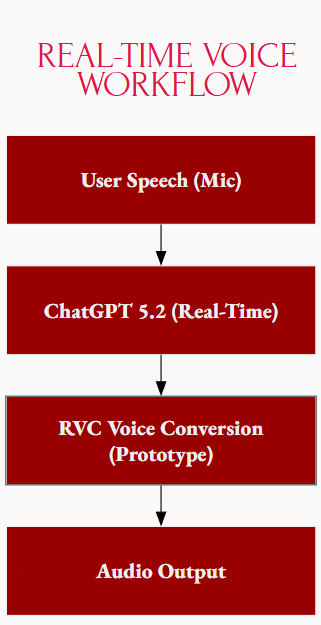
We produced an early version of our poster and updated the project website. Finally, We also developed a revised workflow for our API-based approach. While RVC was not implemented at this stage, it was discussed as a potential tool for future prototyping.