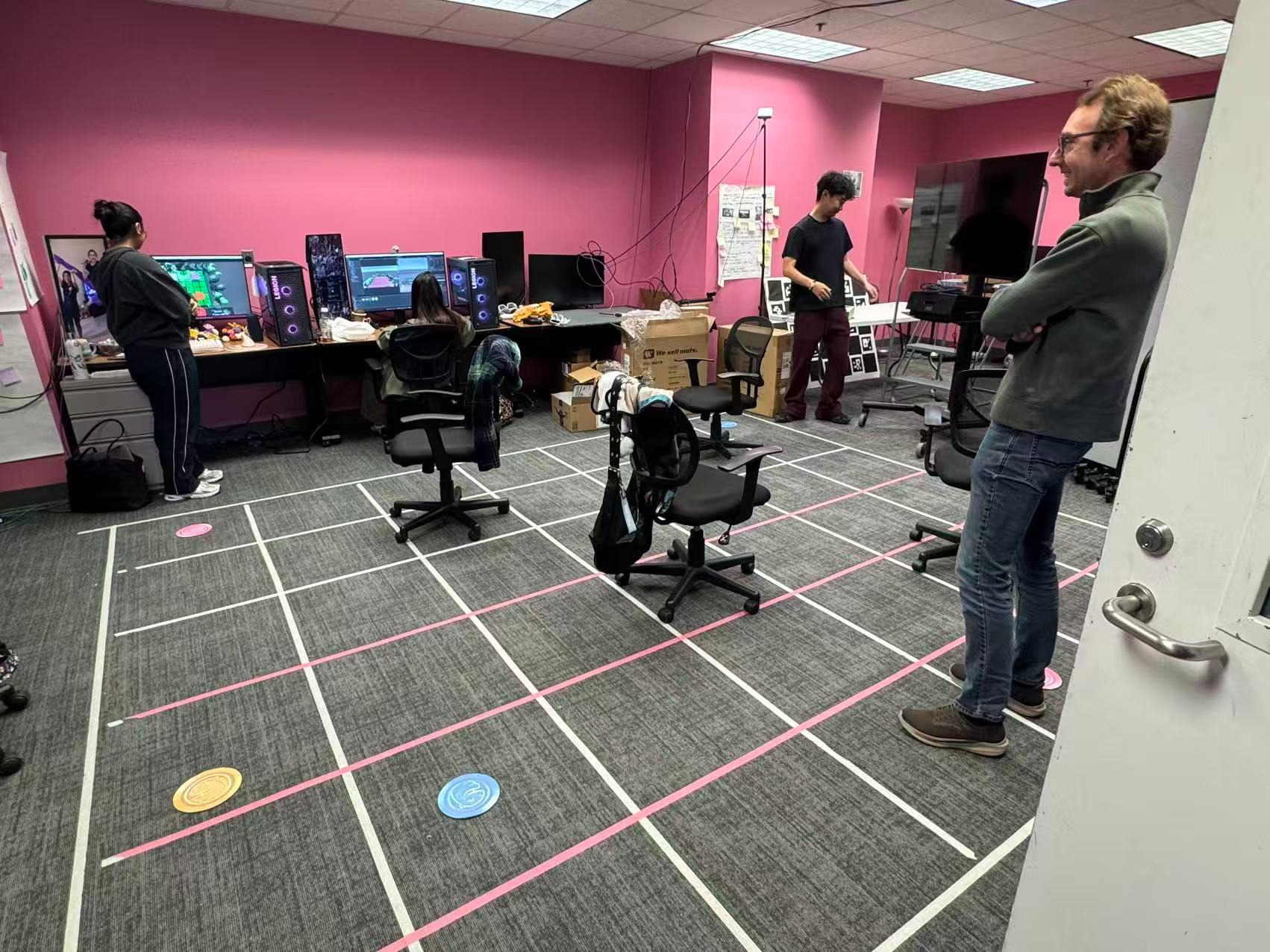
This week, our team continued refining our mini-games and preparing for Playtest Day. Through discussions with Jonathan, Dave, and our instructors, we explored how to improve feedback, give room players more agency, and create more meaningful interactions between the physical room and Tilt Five players.
Exploring New Ways to Provide Feedback
One of our biggest challenges has been providing clear feedback to room players. While we can track their movements, the physical space has limited ways to communicate what is happening in the virtual game.
We decided to experiment with a second screen that displays information specifically for room players. Rather than showing the same view as Tilt Five, we can control what each side sees and explore different levels of information asymmetry.
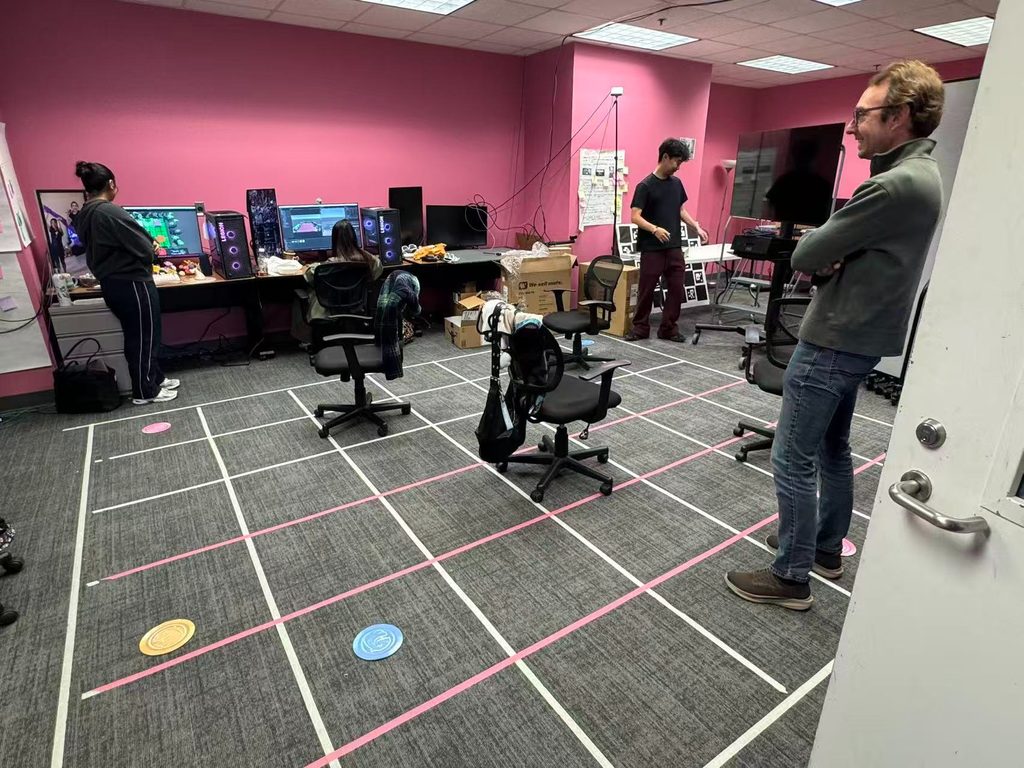
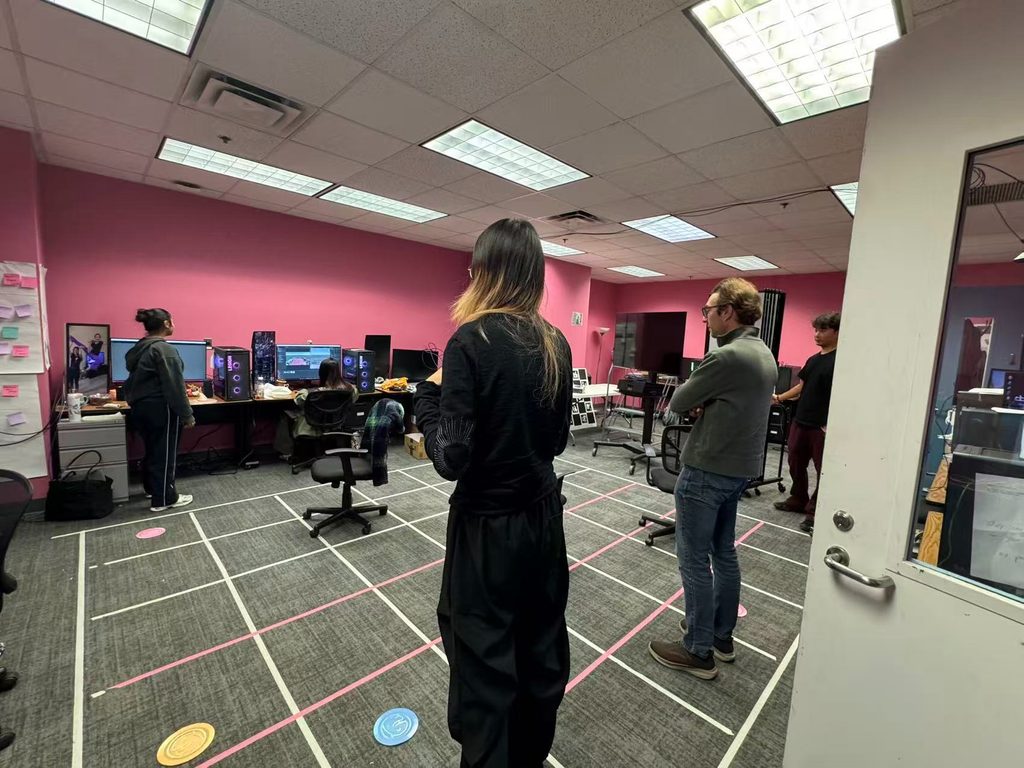
During our meeting, Dave encouraged us to treat the screen as a prototyping tool rather than a permanent solution. It allows us to experiment with different feedback systems without immediately committing to additional hardware, such as lighting or projection.
However, we also need to be careful that providing more information does not make the Tilt Five player unnecessary. Our goal is to find a balance between clear feedback and meaningful communication.
Iterating on Balancing and Hiding
For Balancing, we are exploring a new role for the Tilt Five player. Instead of directing room players to specific locations, they would actively drop weighted objects onto the platform. Similar to Tetris, they must place incoming objects while minimizing their negative impact on the balance. Room players would then adjust their positions to compensate.
We are also considering a competitive version in which the Tilt Five player deliberately tries to sabotage the room players. We hope to test both cooperative and competitive approaches to understand how they affect communication and engagement.
During a playthrough with Dave, we identified several issues with the current Balancing prototype. The platform’s response to player movement was difficult to perceive, the top-down view made small changes in tilt hard to read, and players did not feel that they could reliably stabilize the platform. These observations reinforced the importance of improving visual feedback and responsiveness.
For Hiding, Dave’s playthrough revealed a different challenge: the disconnect between physical and virtual interactions. Our collectible coins were confusing because players naturally expected to pick them up, while the virtual system treated collection differently. The relationship between collecting coins, avoiding danger, and achieving the overall objective was also unclear.
We discussed possible alternatives, such as giving players a specific destination for collected objects or introducing mechanics that require players to help one another. These ideas could make movement and cooperation more purposeful, rather than having players independently collect points while following the Tilt Five player’s instructions.
Developing Growing Magical Flowers
We also continued discussing our third mini-game, Growing Magical Flowers, which aims to reverse the information structure of our previous games by giving room players more responsibility.
Based on instructor feedback, we are considering replacing abstract runes with symbols and patterns that make more sense within the flower-growing theme. Finding the correct tiles could become a small puzzle rather than a straightforward matching task.
Another important consideration is keeping the Tilt Five player actively involved while room players are solving the puzzle. We want both sides to contribute throughout the experience instead of taking turns waiting for instructions or interactions.
Preparing for Playtest Day
Alongside gameplay iteration, we are preparing the overall guest experience, including the introduction, game transitions, technical setup, and room organization.
We plan to distribute playtesting opportunities across our mini-games so that we can collect more balanced feedback. We are also preparing a structured question sheet and considering guidelines for younger participants to play alongside their guardians.
Our main priorities for Playtest Day are to evaluate how well the second screen supports room players, compare cooperative and competitive interactions in Balancing, and identify whether Hiding’s objectives and physical interactions are intuitive.
One important takeaway from our discussions is that asymmetric gameplay should involve more than one player giving instructions while others follow them. Both sides need distinct roles that contribute meaningfully to the experience.
As we move toward Fall Festival, we will use these playtests to determine which mechanics and feedback systems are worth developing further.