Rethinking the Experience
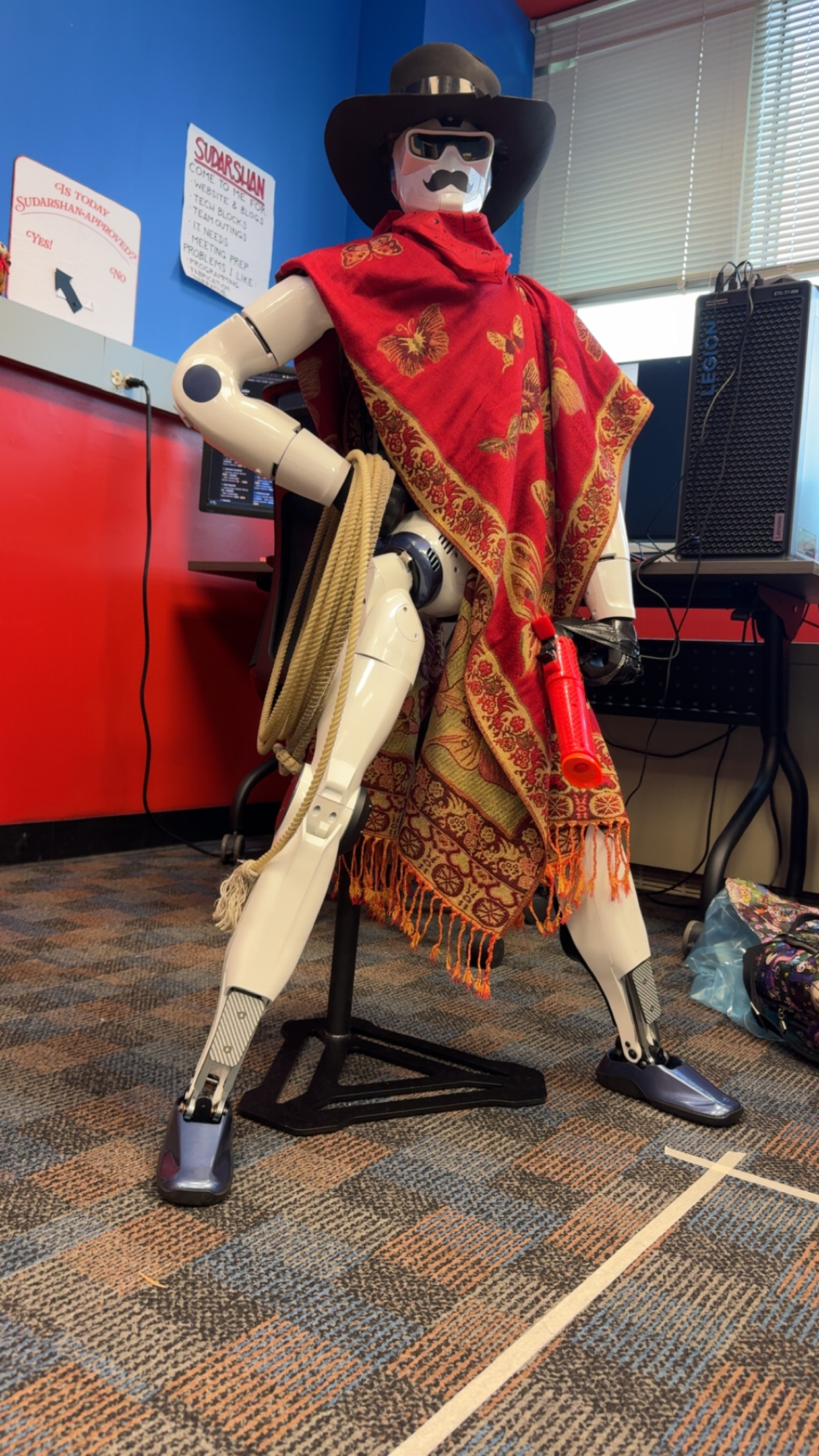
What a week it was! Even though this was our first short week of the semester, it felt a little longer because we had so much going on with the project. We met with several SMEs, our project advisors, had our Quarters Presentation, and also had our first design production review.
To start the week, we met with Roch Nakajima on Monday evening around 6:30 PM. Roch works at Noitom Robotics and has been a great resource as we learn more about humanoid robots and how we can use them in our project. We learned about a possible pipeline for motion capture using tools such as Xsens. The idea is to capture human movement, stream that movement into a model, and then transfer the movement to a robot. We also discussed MuJoCo for simulation and some of the challenges of taking simulated movements and making them work safely on a real robot.
Roch also introduced us to companies and systems working in this area, including Westlake and PND Robotics. Westlake’s models can support different types of human movement, including one-hand, five-finger, and full-body movement. We also talked about how newer models may be able to prevent a robot from copying unsafe human movements, such as falling when a person falls, while still allowing movements such as jumping with two legs. There was also a discussion about an expensive AI model that could help connect policy-based control with teleoperation.
Another important part of the meeting was embodiment in storytelling. We were encouraged to think about what the robot’s physical body communicates and which movements are actually needed for our experience. For example, having legs can add technical and safety challenges, but they may not always be necessary depending on the experience. We also discussed XR and Meta’s approach of using simple but spatially accurate movements.
We talked about the Unitree R1 and G1 and their differences in size and possible uses. The R1 was also discussed in the context of early-education robotics. One important takeaway was that much of the technology we need already exists. The challenge is figuring out how to use these tools effectively in our experience. We also learned that IROS could be a good place to meet robotics researchers and practitioners and learn more about the technology.
On Tuesday around 3 PM, we met with another SME, Francisco Souki. This meeting helped us rethink both the story and the role of the robot. We were encouraged to question whether betrayal is really necessary for our experience, especially with the limited amount of time we have. We also need to clearly define what we want guests to take away from the experience.
Another important point was understanding the robot’s capabilities in detail. We should identify its strongest abilities and design around them. At the same time, we need to make sure the robot itself feels important to the experience instead of depending too much on puppetry or pre-recorded actions.
Francisco also talked about keeping the scope small. We should build the smallest version possible, test our ideas early, carefully time the experience, and avoid adding too many variations. Onboarding should be quick, and guests should have a clear path through the experience. For each playtest, we should know exactly what we are testing and what questions we want answered. These could include timing, story beats, space, setting, theme, and the overall flow. We were also reminded to make decisions early instead of waiting for everything to be perfect. By around Week 13, the experience should be mostly complete, with clear documentation of what we explored, what we chose, what we rejected, and what research helped us make those decisions.
On Wednesday, we had our Quarters Presentation from 3:30 PM to 5:00 PM. Overall, the feedback was very positive, and most faculty members were excited to see our ideas and how much work the team has already done.
The main feedback focused on space, character, and story clarity. Since our room is small, we should avoid heavy set pieces and look at lighter options such as three walls, pipes and connectors, tapestries, and a few simple foreground elements. We also need to rethink whether the saloon and robbery story make sense and clearly define the roles of the character and guest. Most importantly, we need to decide what emotion we want the guest to leave with.
We also talked about making the character feel isolated and surprising through the theming, even if the physical environment stays simple. Another major topic was the robot’s capabilities. We need to find out what the robot can realistically do and design around those strengths instead of waiting for the technology to be ready. This includes looking at available animations, 3D and animation files, and animatronic-style interactions. We also discussed references such as Cowboy Jo, The Wizard of Oz, and The Mandalorian.
We should also start improvising and playtesting the interaction now. Timing the different beats will help us understand whether the experience can actually fit within the time we have. Overall, we need to make the Western world, character, guest interaction, and technology feel like they belong together.
On Thursday morning from 9 AM to 10 AM, we had our weekly advisors meeting with Shirley and Vivian. This meeting focused on safety, character development, guest experience, and designing around the robot’s capabilities.
For safety, we discussed adding safety measurements into the experience and keeping teleoperation as a possible approach because of our small room. For the character, we were encouraged to build a stronger “Quasi Bible” that covers their personality, appearance, tone, name, and backstory.
We also revisited the guest experience and questioned whether betrayal is really necessary, how it would be built up, and whether we should limit the experience to a three-minute festival experience. Instead, we were encouraged to focus on creating a meaningful experience and understanding what makes the experience specifically about the robot.
A major takeaway was to identify the robot’s affordances, or what it can and cannot do with guests. This could include things like following someone or showing emotions. We can then use these abilities to create interaction and cooperative gameplay.
We discussed switching to the G1 if we cannot get R1 teleoperation working. We also need to make sure we start prototyping with the actual robot next week. Finally, we will follow up with Tom Corbett about our room situation and the possibility of using the robot room for our final experience.
Later that morning, from 11 AM to 12 PM, we met with our SME Axel. The main focus was understanding how much work we still have, identifying major milestones, and creating a flexible schedule that gives us enough time to keep testing and improving the experience.
We know that the schedule will change, so the goal is to create an “illusion of order” that keeps the team focused without making the schedule too restrictive. We were also reminded that no work is really lost, but we need to make sure we use our notes and feedback properly.
Our planning should include risks, ways to reduce those risks, research timelines, and clear responsibilities using a responsible, informed, and consulted framework. We should also work on one concept at a time and use an organization system that works with our team’s enthusiasm without letting us get stuck in endless iteration. For the narrative, only the narrative designer should directly edit the script.
On Friday, we had our First Design Production Review Session with Charles. We shared our ideas for the poster, half-sheet, logo, color palette, typography, website template, team photo, and individual portrait ideas. The fifteen-minute session was short but helpful, and we received some useful feedback that we can use as we continue developing our visual identity.
Week 3 gave us a lot to think about. We now have more information about the robot, clearer questions about the story and guest experience, and a better understanding of the work that still needs to be done. At the same time, we have several things that we need to start testing instead of only discussing.
Going into Week 4, our main focus should be getting the robot involved, testing the core interaction, narrowing down the story, and making clear decisions about our space and character. We also need to keep our scope under control and start working toward our next major milestones. The goal for the coming week is to move from talking about what the experience could be to actually testing what works.