Upon taking the first step they they thought,
“Well! That was easier than I expected!”
But the path still ascends skyward,
into the fog and snow…
When I got out of improv class on Wednesday morning, I took the elevator up to the third floor, where our project room is. Before I made it, I was stopped in the hallway by Frank, who said to me,
“They did it! Do you want to see?”
Now, if you remember from last week, our first major challenge was to make our multi-perspective rendering technique work in the first place, so that we could begin to test it. Henry and Jason were put on that task, and based during the last progress update there were still a lot of unknowns about how to do it. The first thing they were going to try was the version that already existed in the CAVERN: A single headtracked player, circling around an object projected into its center. Based on the number of unknowns about the multi-perspective version, I had been mentally budgeting our time this semester to spend about 5 weeks simply getting everything set up. So when Frank asked me if I wanted to see what Henry and Jason had been doing, I assumed that they had got the CAVERN set up, and the single perspective version working.
But as you may be able to guess by this point, they had made the multi-perspective version work! So, that puts us much further ahead of schedule! Which I shouldn’t need to tell you is fantastic. The other good thing about this is that Quarters is next week. So now we don’t have to just explain what we are doing, we can show it. Which I usually prefer whenever we can manage it.
Let’s go over how it works!
Splitting the Apple
As I wrote last week, the CAVERN uses stereoscopic 3D projection with shutter glasses to project a different image to the left and right eye. This creates a 3D effect that can make objects appear as if they are deeper into the screen, or projected out into the circular inner space. The unfortunate side effect of this is that images taken of the CAVERN, without these special glasses, not only lack the 3D effect, but appear doubled. So for most of these examples, you’re going to have to use your imagination, or come by and try it out for yourself!
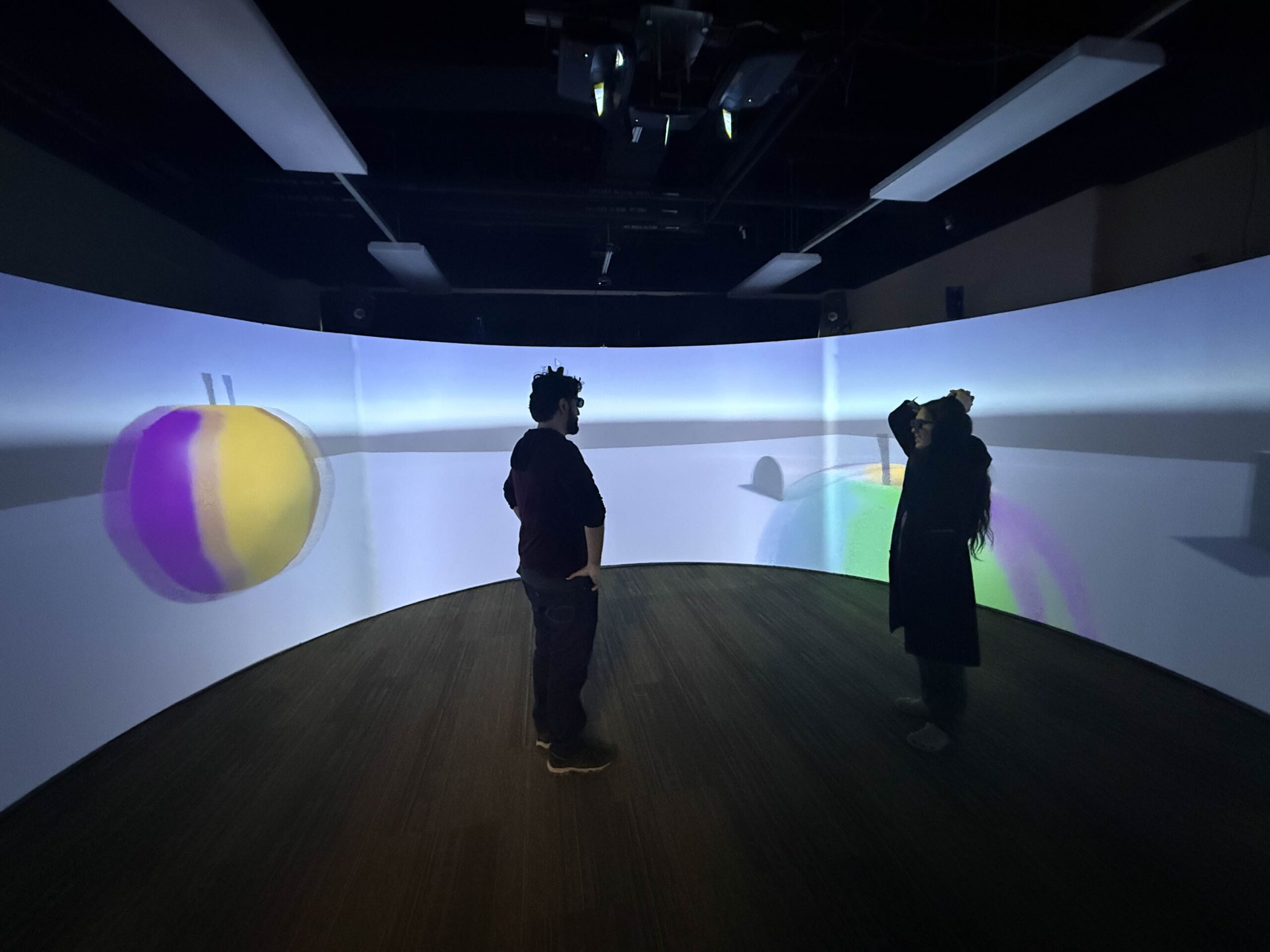
As you can see in this video, there are two apples. In engine however, there is only one apple, floating in the air in the center of the room. This apple is our test object, and was created by Ivy.
Both José and I are balancing a tracker on our heads, and when the apple is rendered, it is projected to the wall of the CAVERN opposite us. So José has an apple across from him, and I have one across from me. With the shutter glasses on, the 3D effect makes the apple appear as if it is floating in the correct spot in the center. Because José and I are both getting a version of the apple that is based on our individual locations, we both see the apple floating in the same position in the room.
Jason tells me that this version of the technique, while working, is very unrefined. It duplicates a lot of rendering processes that it really doesn’t need to, so he is going to continue optimizing it. In the meantime however, this version provides us with a great way to try out different arrangements of objects to figure out what we might be working with!
The First Of Our Problems
Also shown in that video of me trying the demo is the first of the problems we had anticipated. By simply turning around, José is no longer looking at “his” apple. He’s looking at mine, which appears to be in the wrong place to him. We knew going into this that this would be a problem we would have to primarily address through our design, so getting to look at how it feels to have these duplicates is important. One notable thing is that the duplicate apples don’t appear particularly distorted to the “wrong” player. They just appear to be “in the wrong place”.
We also encountered the “blocking” problem. Where one player is able to block another’s view of an object that should be in between the two of them.
And also, due to the CAVERN’s height and lack of floor projection, objects can’t be too close to the players unless they are perfectly at eye level, or else they quickly leave the borders of the screen.
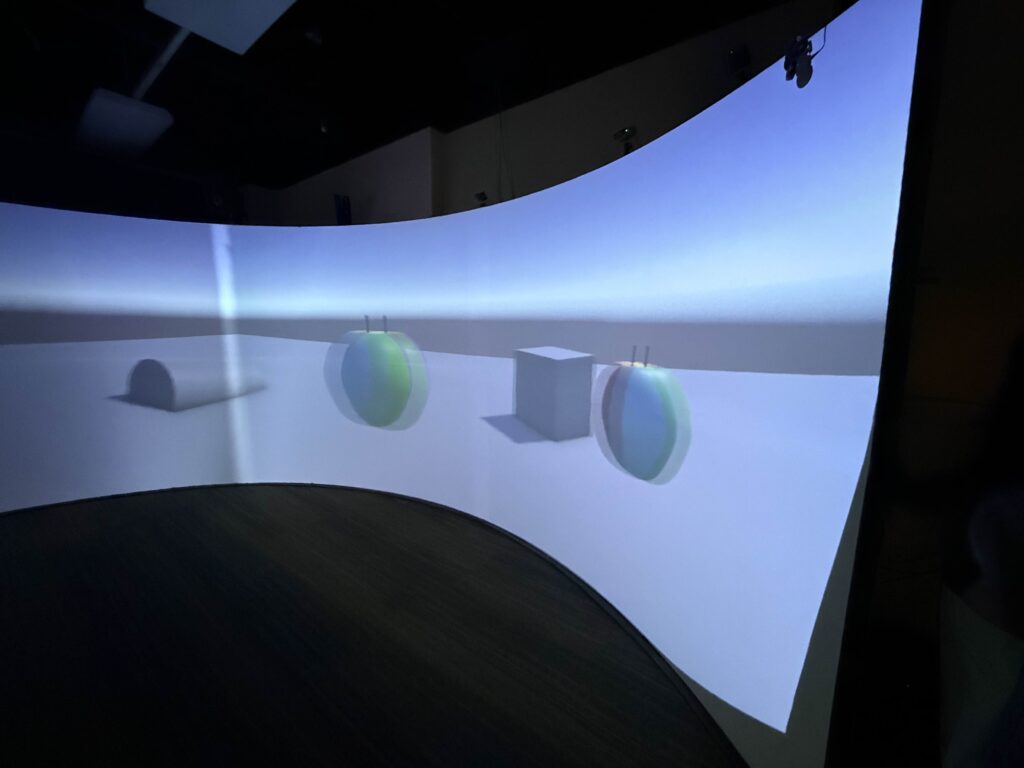
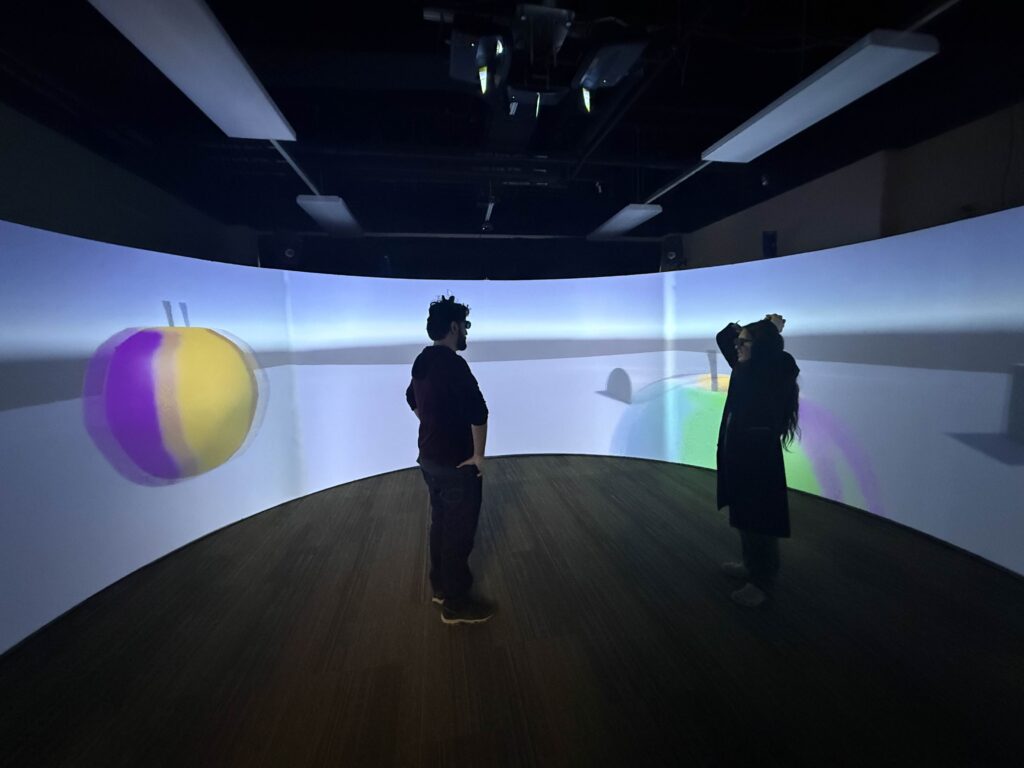
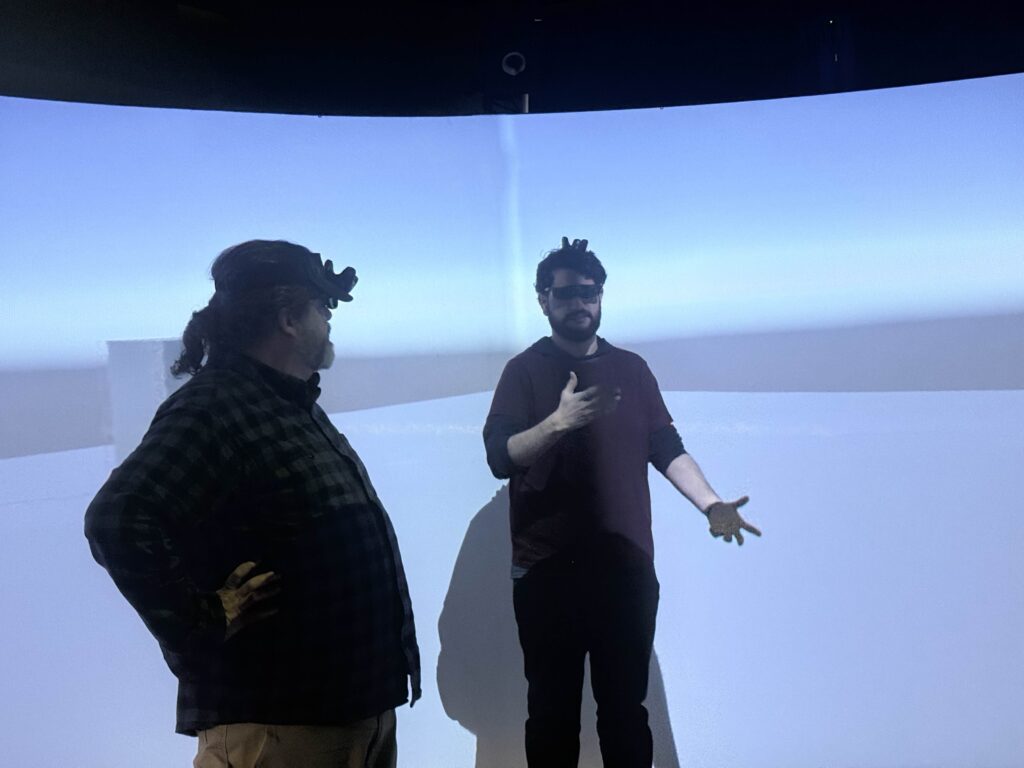
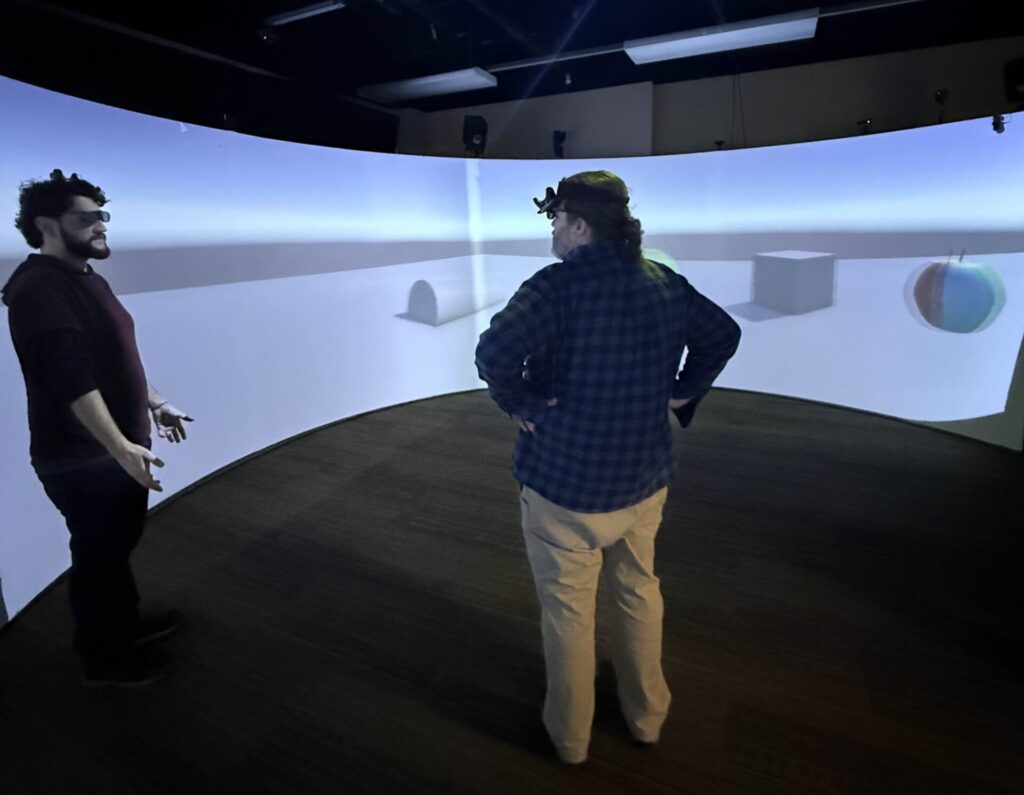
But being able to experience these problems in person, and not just theoretically, is very helpful for us to begin thinking of ways to get around them, or mitigate their effects.
We also tried a version of this demo where the apple is bouncing around the space, and let me tell you, that was disorienting with the doubling.
We did a little brainstorming for potential ideas that could maximize the techniques potential, without leaning into its limitations:
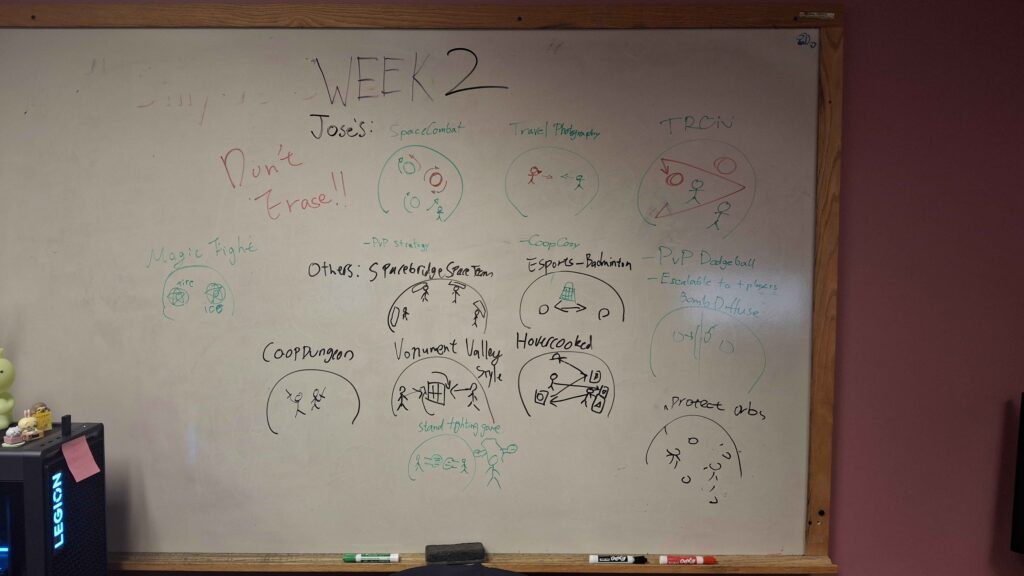
With the system working enough to try it out and show it off, we move into Quarters next week, were we’ll have to demo it for ETC faculty!
Over the next couple of weeks, our goals are now to continue refining the system, and figure out how exactly we plan to make a game out of it!

We got Popeye’s to celebrate our progress