Over the weekend, some team members read through Understanding Comics by Scott McCloud, and realized how in fact, finding the “idioms” for our form, is the crucial step to creation for our artform / medium.
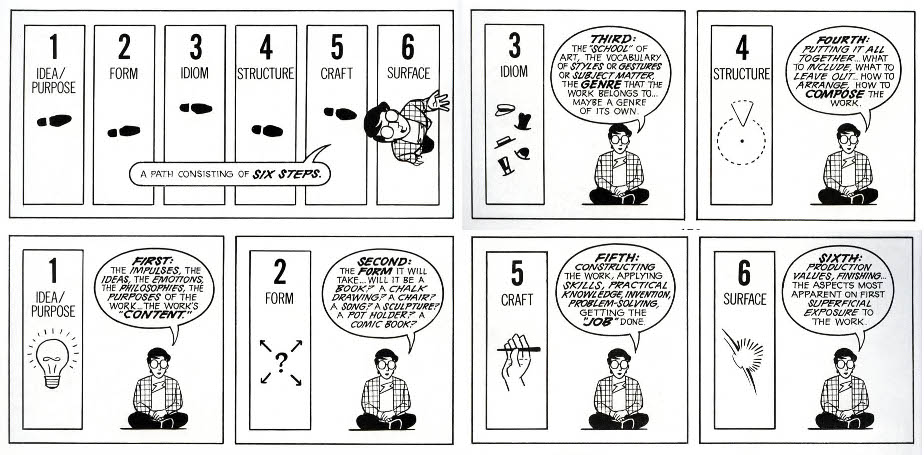
For us, we have been stuck defining the form, which was why our idioms does not ground us. In fact, after reading this comic, we made a bold decision
WE NEED TO GET OUR FORM DOWN IN ORDER TO FIND OUR IDIOM TO SHOWCASE OUR CRAFT AND TELL THE STORY OF OUR PURPOSE
Each chapter of Understanding Comics actually serve as inspirations for different functions for the team.
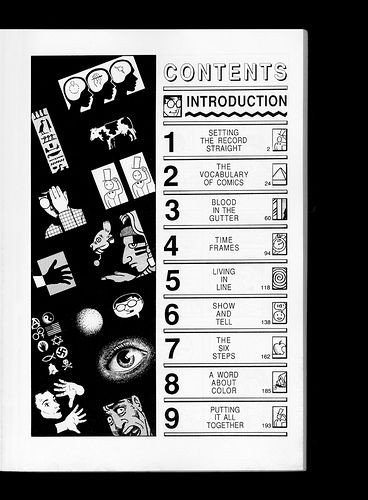
- Chapter 3-4 are for visual puzzle design.
- Chapter 7 is for production direction of how a medium evolves.
Puzzle Design
Having been inspired by Understanding Comics about how to evolve our understanding for this medium, continuing from last week knowing that puzzles are our hamburger meat to be encapsulated by narrative components expressed through repositioning, our hamburger buns, it was time to find the main complex puzzle from our proposed linear script!!
Different people designed different puzzles, but mainly the golden triangle of script + comic art + puzzle mechanic started working on the first moment on the script: the solar wind introduction.
4 distinct settings from the script was confirmed, and they will be slowly translated to our final experience:
- outer space with spaceship
- inside of spaceship
- marooned planet
- marooned planet’s past
Script
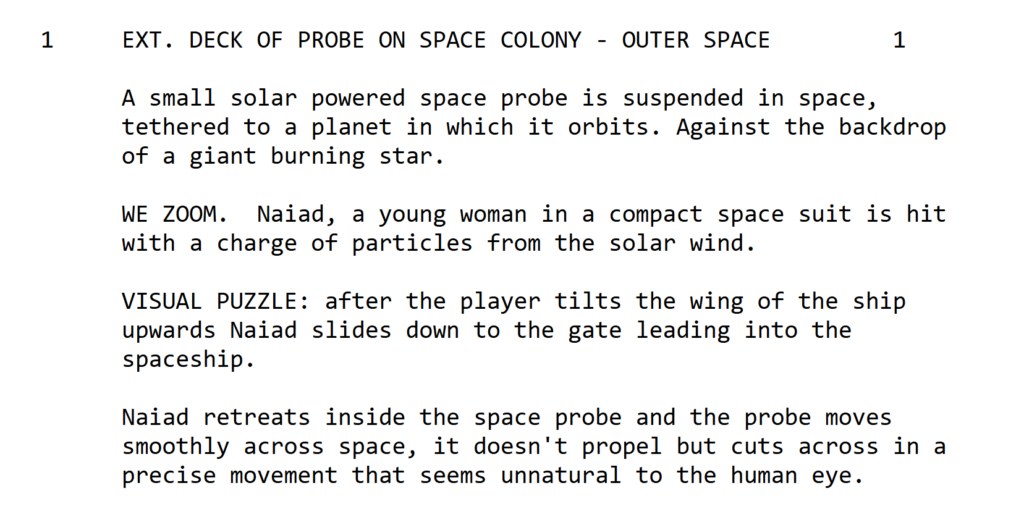
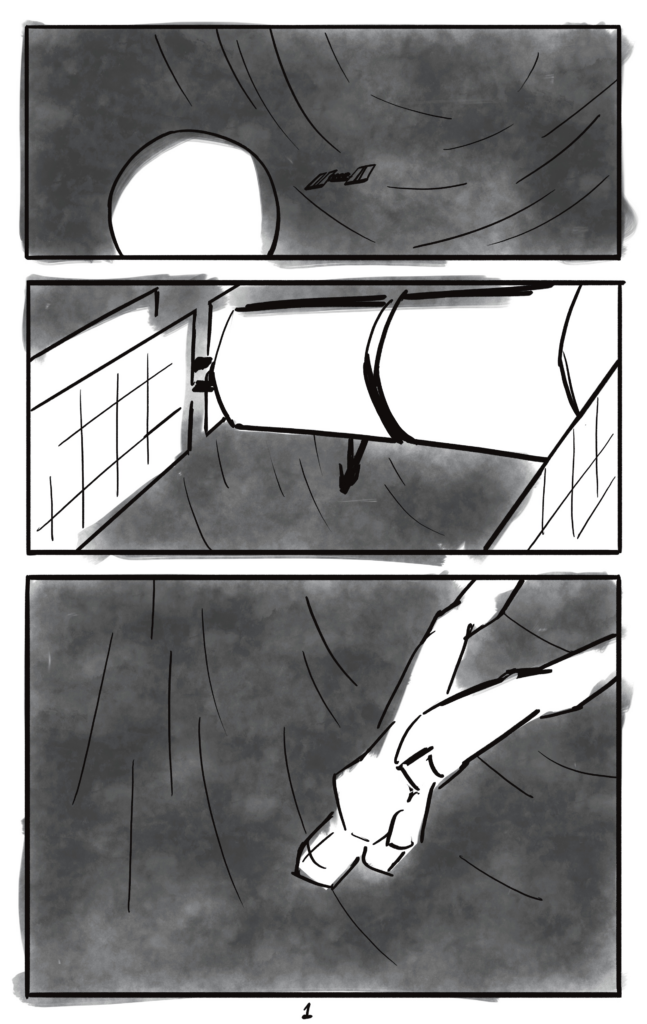
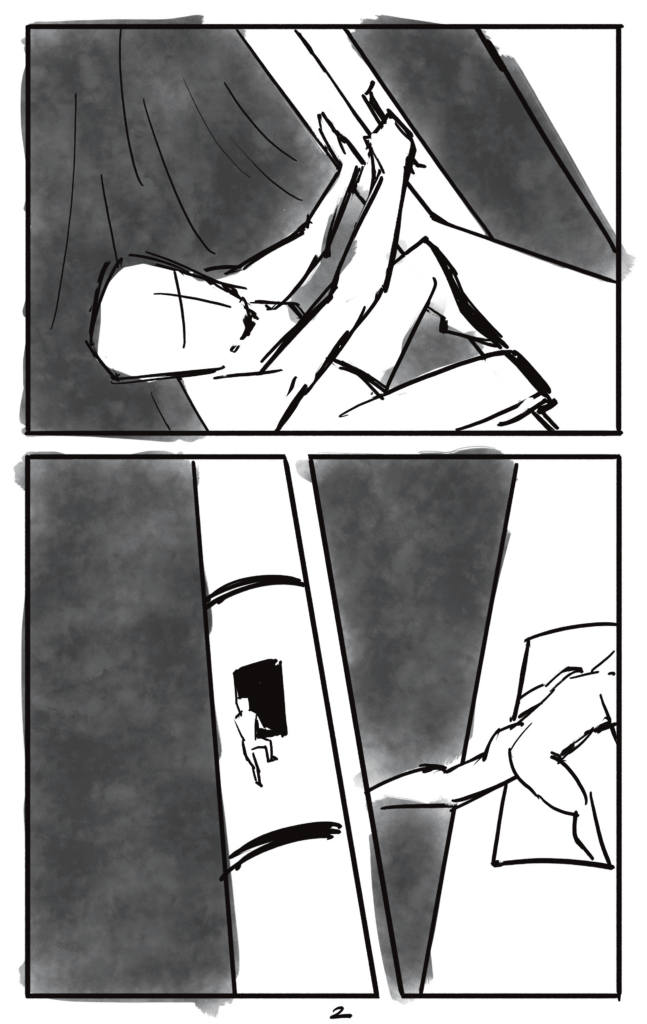
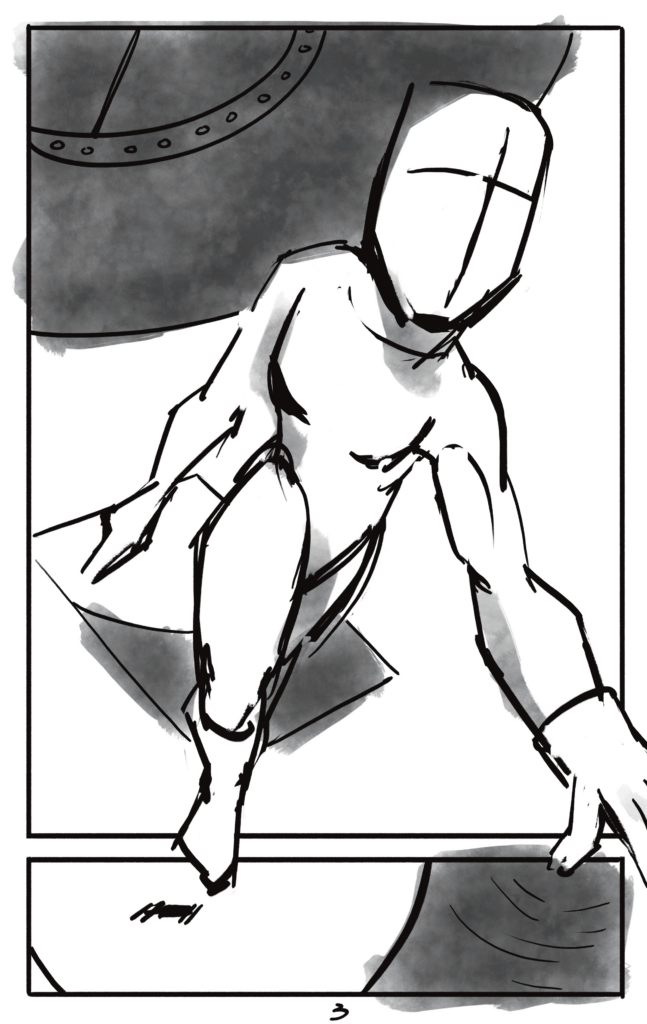
An insight came that in fact, since comic art encompasses the objects the script informs, and puzzles require keyword objects to work with, the pipeline goes: script -> comic art translation -> puzzle mechanic informed by the art.
Comic strip translation
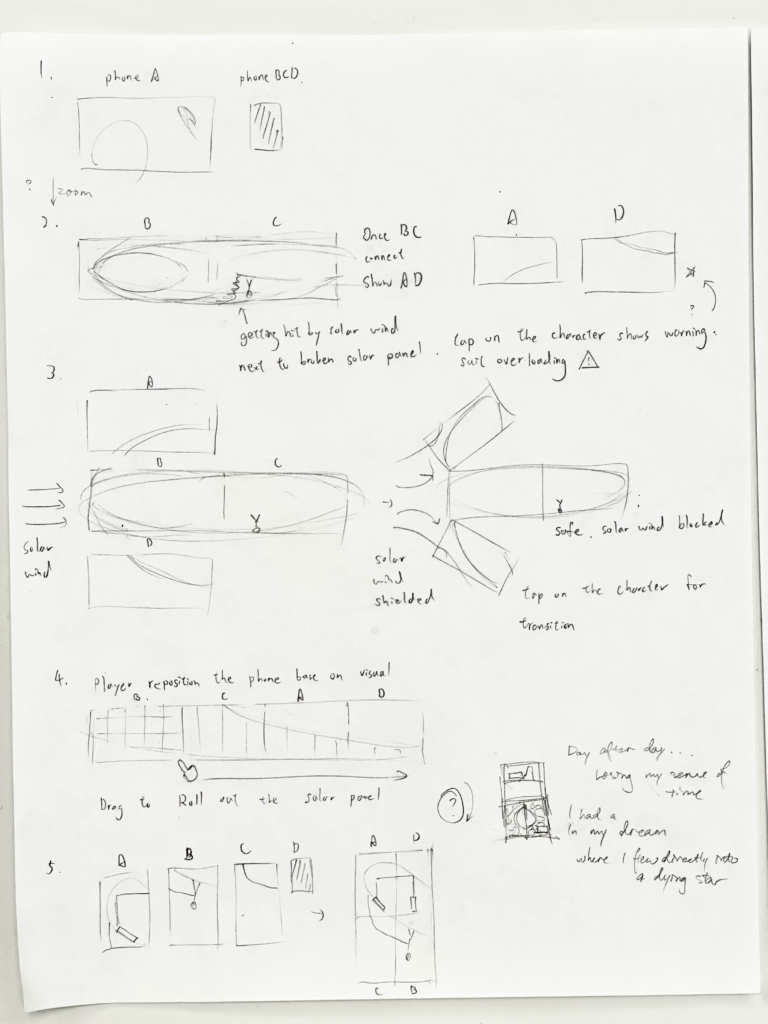
Puzzle idea
The power of the golden triangle of script, comic art, and puzzle mechanics come form: when one of these functions come up with an idea, the other can yes, and to the idea, and co-develop the next step. In this case, the comic visualization gave rise to how the phones move (the repositioning), and that informs how content is communicated across frames for narrative to design.
Comic to repositioning translation
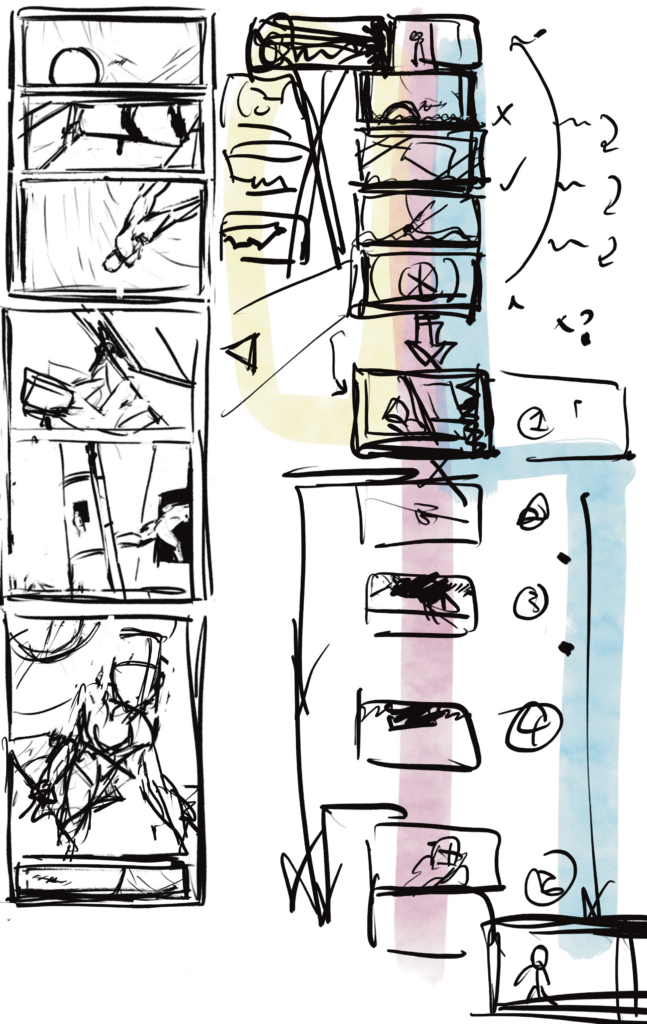
Puzzle from the repositioning ideation: a space ship that opens its wings!
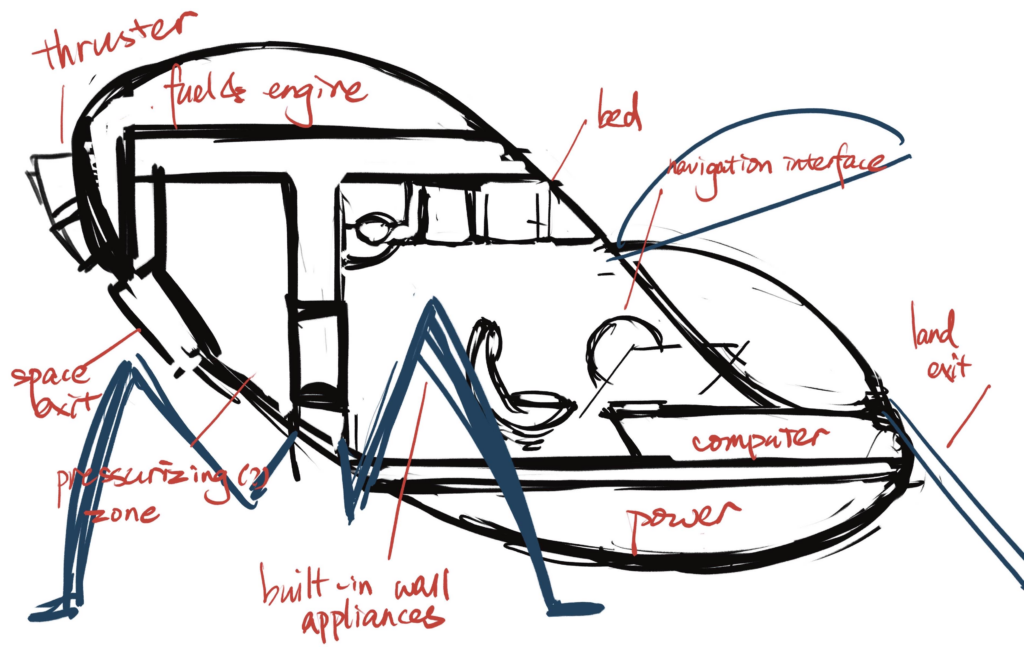
And with the synergy between a spaceship opening wings puzzle idea came the design of what the spaceship should look like visually.
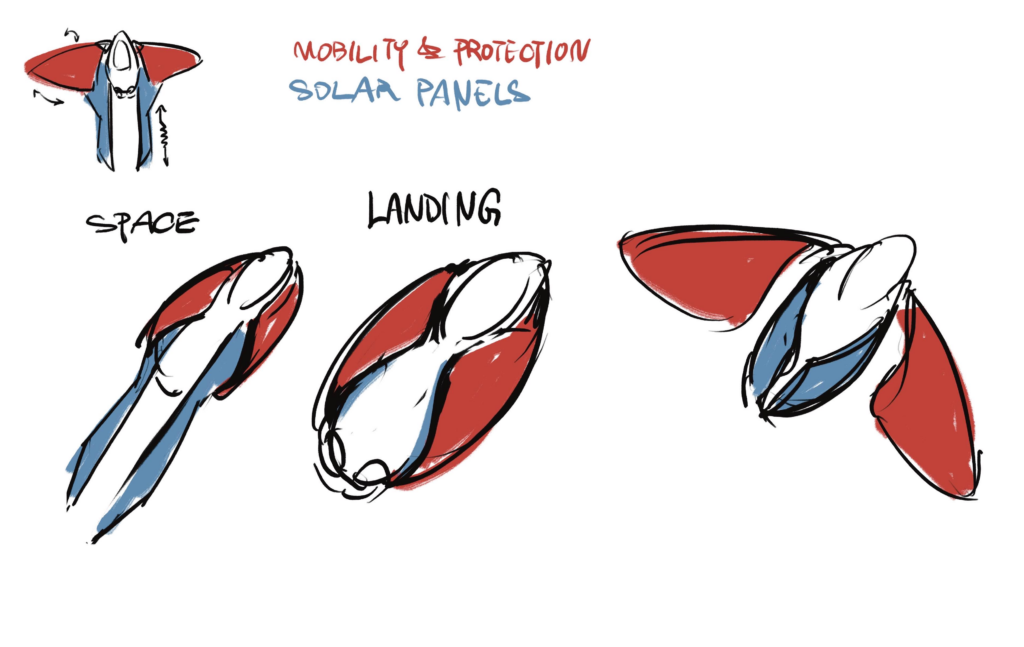
And these formalized into the puzzle moment where, if the player opens the wings of the spaceship, it will block the solar wind that is making the ship unsafe to move. Once the wings are open, our main character Naiad can enter her ship, and the story progresses.
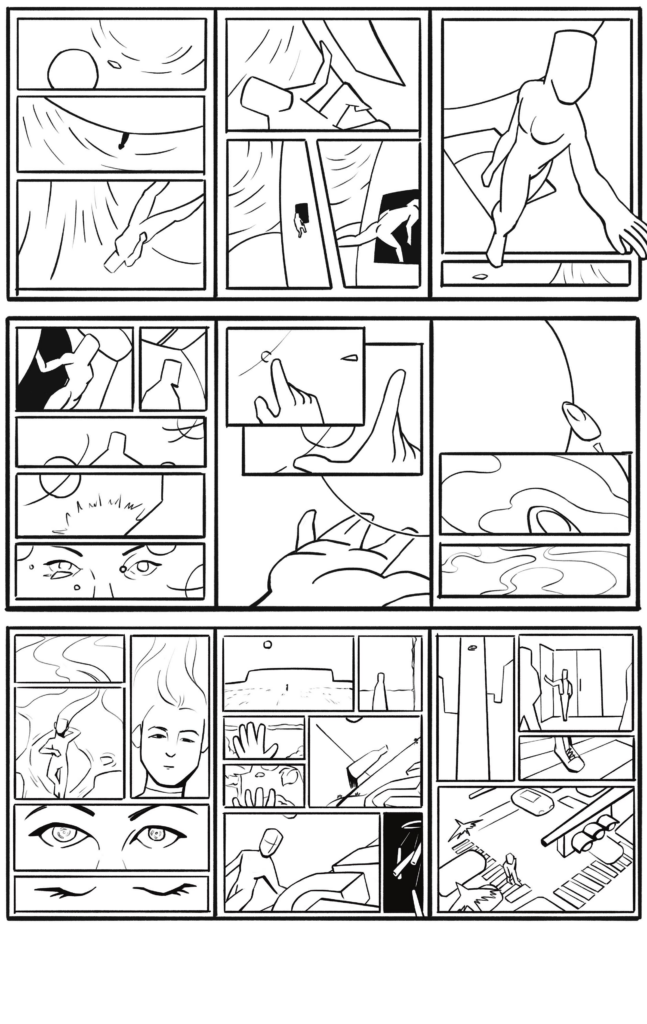
Further on, because of how helpful this comic translation process was, the visual development function decided to visualize the entire script from start to finish, shown below.
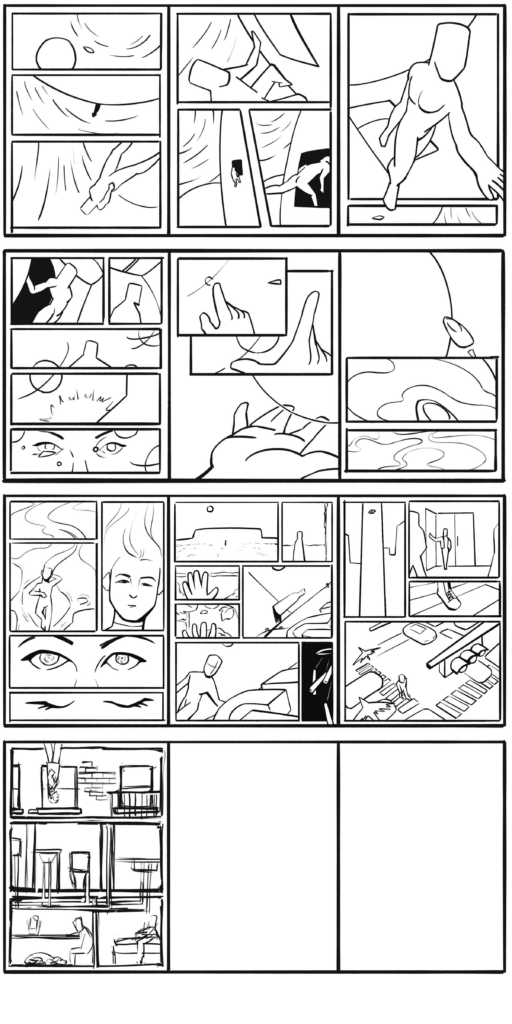
Other explorations beyond the golden triangle puzzle design
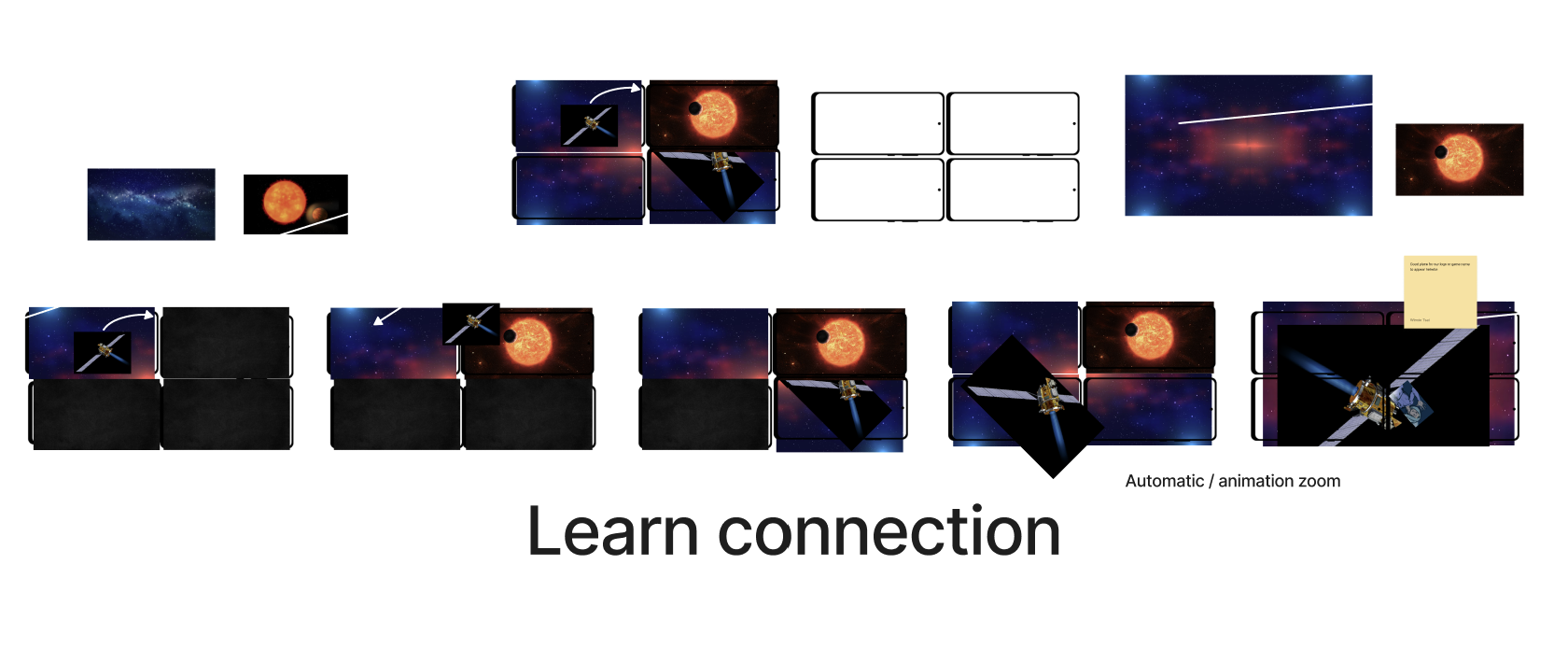
Outside of the script -> comic -> puzzle translation, there were attempts in the onboarding side, trying to answer the question of how players learn the main mechanic of connecting phones together. In fact, this clarified to the team how narrative works with puzzle design. It is the showcase of the spaceship going across the screen, like how a long take (a cinematic language for scene movements that doesn’t cut) always introduces new content regardless if the camera moves. In order for us to utilize our medium well, and have profound story for the narrative, the newly introduced frames always have to include a narrative component.
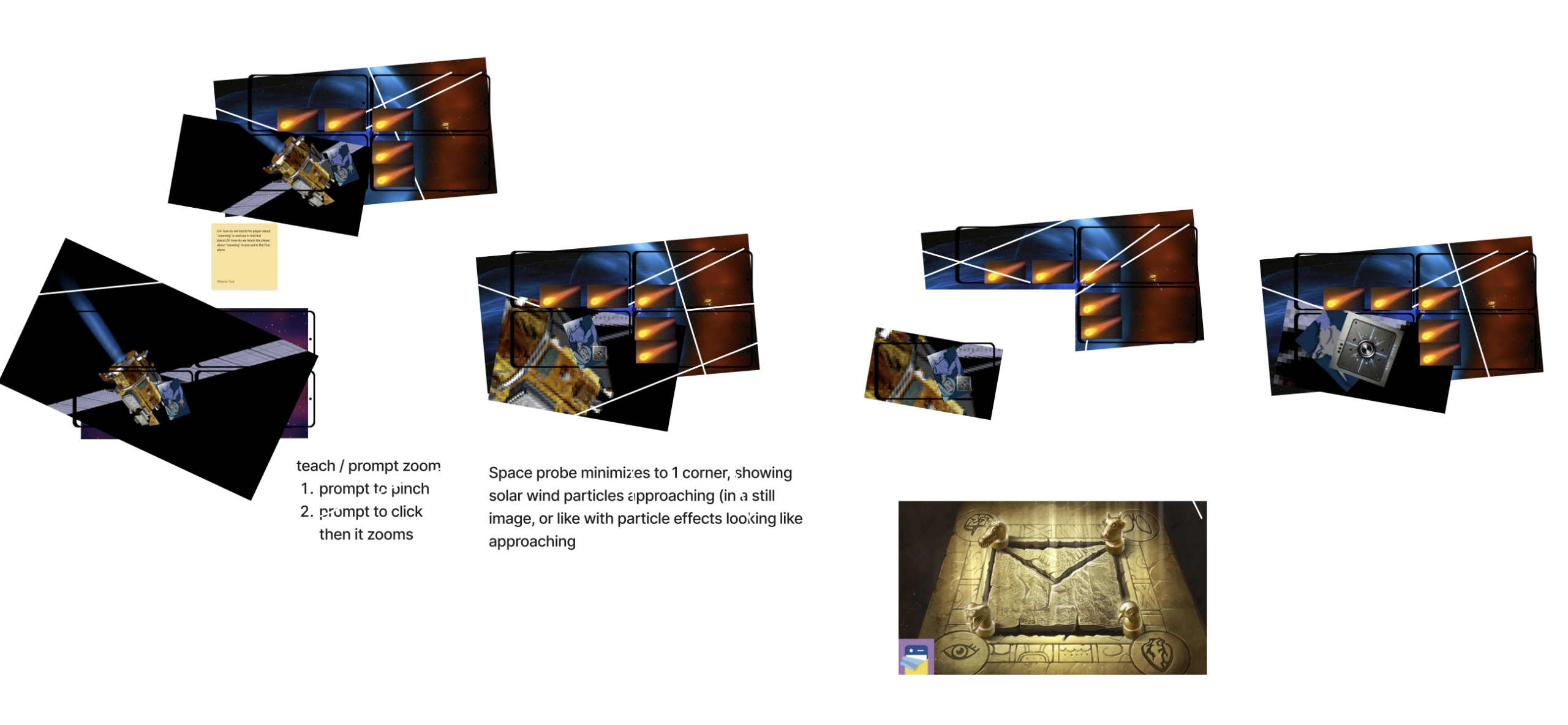
There was also another attempt for the solar wind puzzle moments from the direction of tutorials: if zooming in and out of a scene has to be introduced to the players, a possible puzzle is having the solar wind lines being activation method for a spaceship entrance lock. It is through matching of the lines metaphorically, making connections between a line in the game world, to a puzzle input, that the players learn about visual matching and a sequence of zoom in, zoom out, match actions. However, this did not further development at that time as tutorial sequence has to be rethought about AFTER the design in set. It was still a good exploration!
More Tech prototypes
Sometime between last week and this week, our system programmer refined the architecture of a moments-based game, where instead of a phone connection functionality component being added to game objects one by one, it now changed to an event structure, where a connection event would be broadcasted to the scene, and listener objects who are involved would answer. This helps with separation of concerns for our “moments-based” game structure, so that an object hat has changed connection type during different moments, would not have to dynamically add and take away components themselves, but only do so when prompted by a central commander.
In addition, preparing for our first playtest next week, a system for registering swipe as connection activation entry, and a “pick-up” motion detection mechanism for players to get feedback on when the phone disconnects, is created.
Other than that, we played with other possibilities the phone has:
Drag prototype
What if you can drag one thing to another screen. Sounds cool right! And it utilizes our cross-screen interactions well! However, we decided to focus our on-screen interactions to only pinch. Regardless, look at this beautiful prototype.
Satellite prototype
The team has been very excited about having one phone as a controller to change the contents of the other phones, which we have been calling satellite. This on the other hand, turned out to be a base proof-of-concept of our phone-changes-each-other puzzle design philosophy.
Gyroscope prototype
How good can the phones detect movement? Gyroscope is a phone feature we have been thinking of utilizing, but haven’t tested. Turns out, the phones know exactly how much this phone has been rotated, on any axis that we specify. This will be the basis for the solar wind beetle wing puzzle.
2D in 3D test
Because of our 3D artist’s beautiful finding 2D symbols in 3D scenes idea, we also sought to prototype this. It was more difficult than we imagined, and the matching of textures did not feel intuitive enough. Still, it was a great attempt.
Miscellaneous
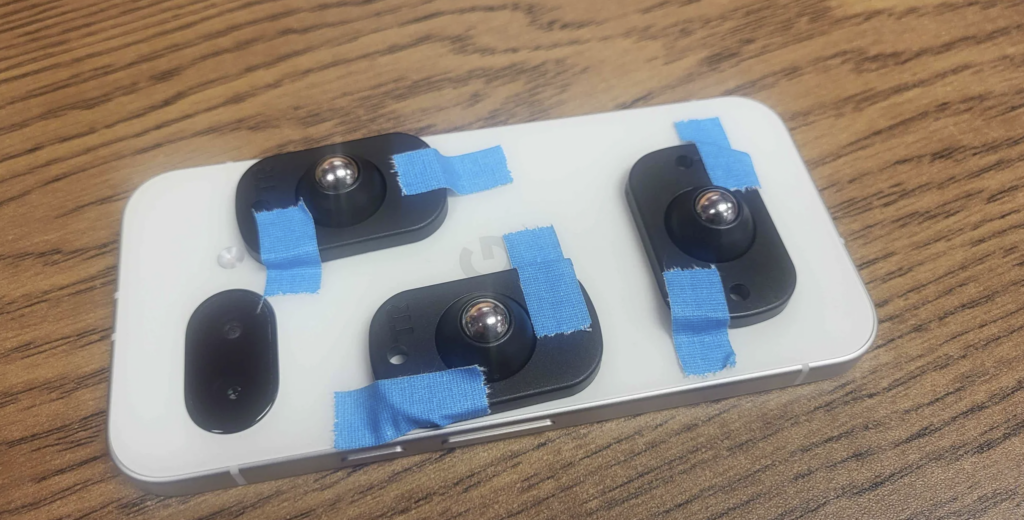
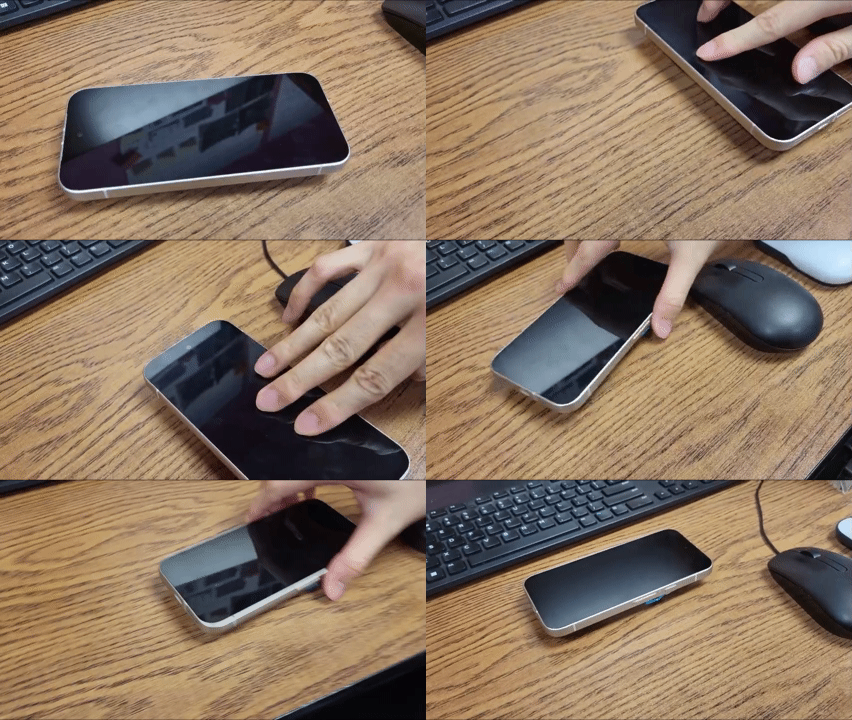
Concerned about harming the camera when sliding the phones on the table, this week, in addition to receiving the phones, we also tested with using casters to see if they would make moving them smoother. We decided not to use it though, as it made the phones too clunky, and the camera scratching is not as pronounced as we imagined.
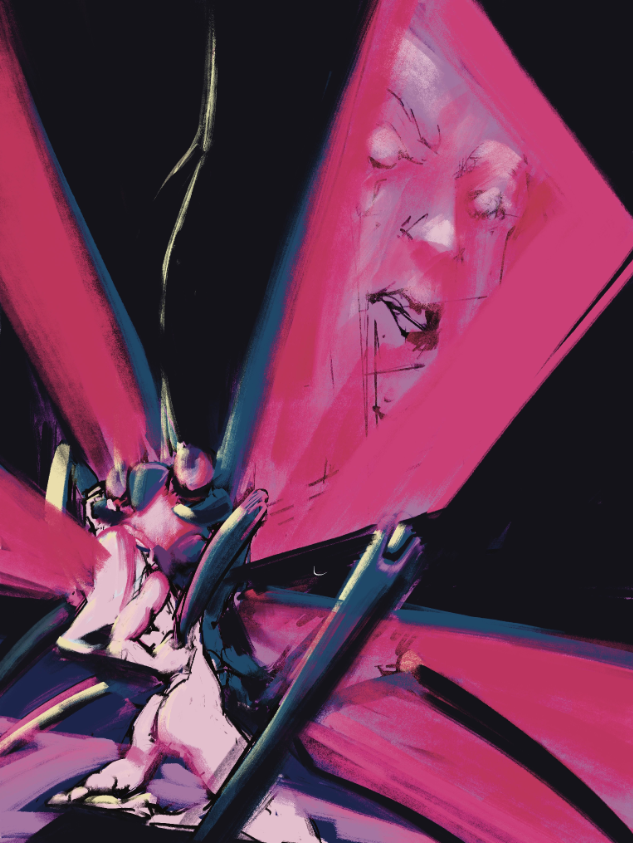
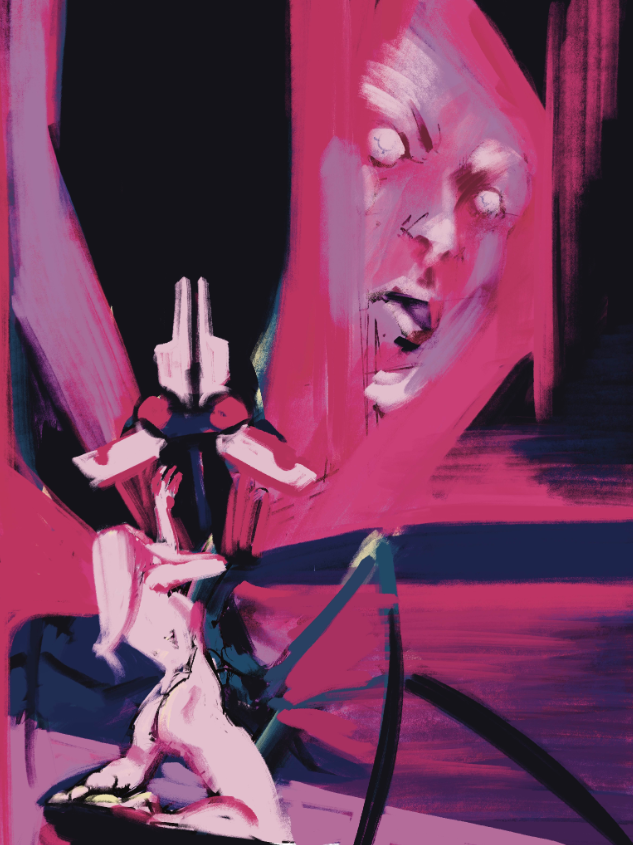
Our poster underwent different iterations, and while this specific theme was not chosen, it is so pretty, so I’ll put it here!
Next steps
So you see, week 4 is filled with puzzle design, tech foundation, and content exploration. There is one thing missing: the player perspective, so next week is playtest night, the first time we’d bring our ideas to actual users. Please look forward to our discoveries.