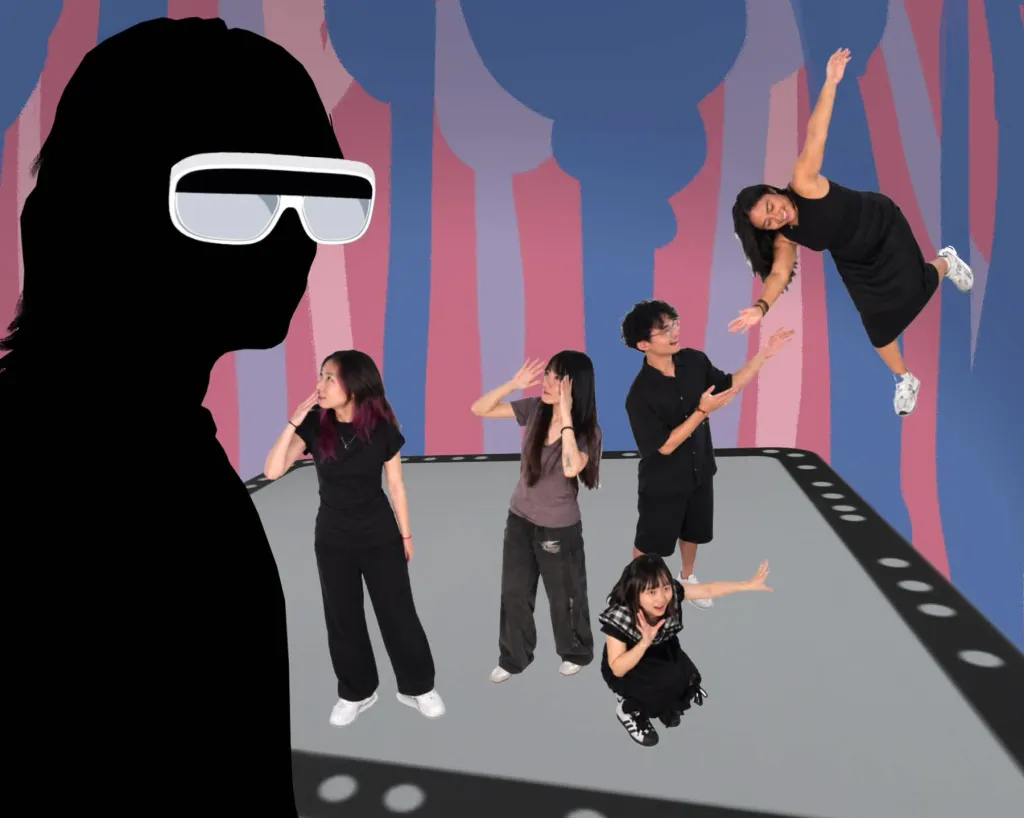
This week, we finalized our team photo:
During meeting we discussed:
- Party game ideas
- Tech
- Concept art
- 1-sentence project description
For design, we did physical playtests on three games: passing a ball, ghost hunting, and bomb defusal.
Even without tech, we hope to use a simple 2D camera, a screen, and paper to playtest some prototypes. These are the puzzle ideas we selected to do playtests.
Following the feedback from Quarters, we made the T5 player the main information sharer in these games. The basic format became: the T5 player tells the room players what to do, and the room players follow the instructions. However, this made the room players feel bored and aimless. They could only learn a limited amount of background information without being spoiled, so they mostly had to wait for instructions from the T5 player.
As a result, the current dynamic feels more like the T5 player is the “real” player with most of the information, while the room players function more like characters being controlled by the T5 player. This makes the experience less engaging for the room players.
Problems We Observed
- Instructions are understood too quickly. When communication is clear, room players can quickly understand what they are supposed to do and then become bored.
- The games feel too similar. Although the games have different themes, the room players are mostly doing the same thing: moving to specific positions based on the T5 player’s instructions. They often do not understand why they are doing it.
- There is little feedback. Room players do not receive enough feedback or information from their actions, so their actions do not feel meaningful.
- There is limited physical interaction. In the current prototypes, room players rarely interact with the physical environment in meaningful ways.
New Direction
Instead of making the T5 player the main source of information, we want to give room players more information and create an information gap between the two sides. The goal is to use this information asymmetry to encourage communication, rather than relying on increasingly complex interactions to engage both sides.
We want room players to have a clearer goal: finding information in the physical space, and sharing that information to make progress. We still believe puzzle-based games are a good fit for this direction because they naturally create opportunities for players to observe, communicate, interpret information, and make decisions together.
For now, we do not plan to change the overall experience structure. We will still have three separate, parallel party games, but we may redesign two of them to focus more strongly on information-based puzzles and asymmetric information.
In terms of theming, we are still using birds and magical forests, because magic can explain a lot of mechanics naturally.
For tech, we are now working with the sync ups, trying to use multiple cameras for the body tracking.
Finalized description for website and half-sheet:
Birdie’s Chirp is a series of asymmetric co-op games where players in a room work with a Tilt5 player in a separate room, sharing information to solve challenges.
The project explores cross-platform communication through different perspectives of the same space, a magical forest setting. The room players’ movements are tracked through synced Orbbec 3D cameras and reflected in the Tilt5’s virtual bird’s-eye view, allowing the Tilt5 player to see and cooperate with the players from a different perspective.
The magical forest setting and cute character emphasize the Warmth of Cooperation and Vivid Interactivity at the heart of the experience.