September 7 – 11, 2026
I tried testing motion tracking there for the first time but it did not work too well when it came to detecting movement left to right. Motion tracking is also very finicky and glitches quite often, would most likely need to create a smoothing algorithm if we were to display body tracking.
We also watched past ETC projects like flow, Meridia, and remnants, to better understand what worked well and what didn’t.
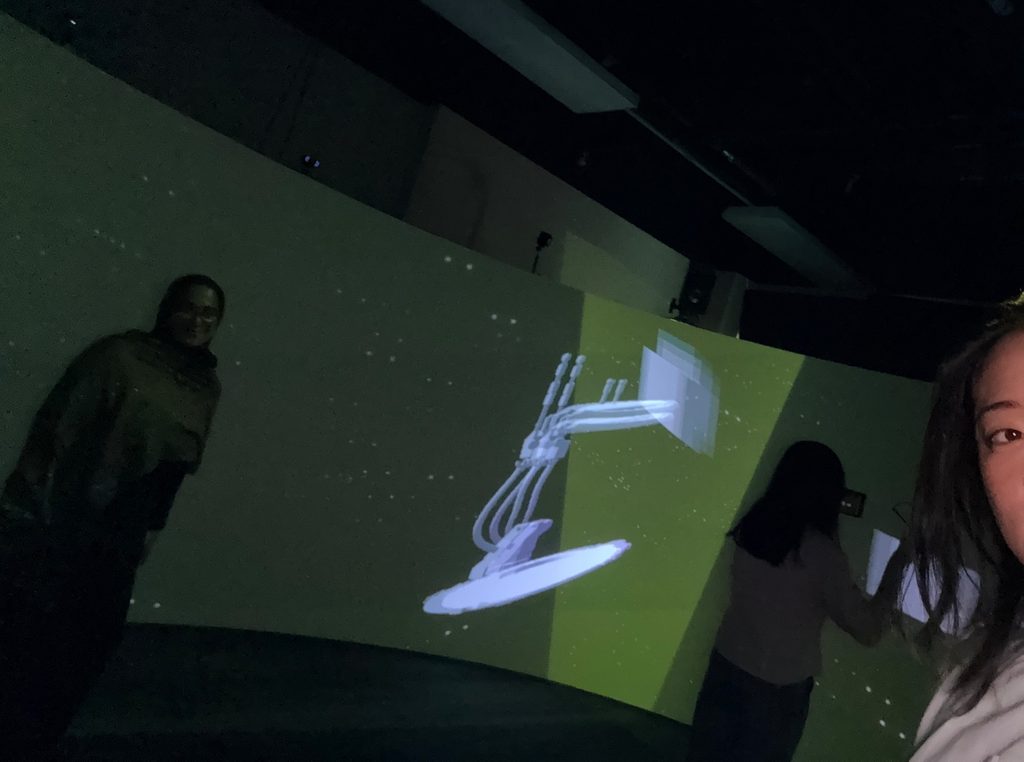
We also tested some 3D as per Steve Audia’s suggestion in order to maximize the CAVERN space as otherwise it would not be a cave and would just be a space with large projectors, good for a cinematic or film project but does not utilize the cave to its full potential.
Lot’s of good ideas but need to dial down on a mechanism to prototype and test a full experience with a feedback loop.
Nightray and Gamma shared their initial design ideas that span a variety of styles. If I had to put them into categories, they’d be:
- Freeform: the digital world changes based on your actions
- Fantasy: wellness becomes the mechanism to accomplish something
- Body: pays attention to physical states, like heart rate, breathing, or level of anxiety
- Cooperation: emphasizes a multi-player experience, where people need to work together or be in sync
When talking to our Subject Matter Expert Tim Davis, an ETC alum with experience in the wellness space as well as game design, we asked him: should we hone the idea first, or try to reverse engineer the idea based on available technology? He said that we should think about both, but not just think – prototype ideas and different tech as we go.
One place I found helpful to start first is the website of past Cavern projects. During a team meeting this week, we watched 4 past projects and discussed what we liked and didn’t like about them. Later, we ran two of those projects in the Cavern to experience the interactivity and the 3D visuals firsthand. The CAVERN project built an awe-inspiring underwater experience. It’s as if you can see miles into the ocean in front, and I imagine if submarines had 270-degree windows, it’d be just like this, except here, fish can swim right up to your face.
The Flow project is legendary at the ETC. Their video is probably the one that people watched before they applied to the ETC. The art is really well done, the interaction draws you into the experience, and you feel a sense of community with whoever is in the room, syncing their arm waves to yours.
Steve Audia, the Director of Information Technology at the ETC, is the lead builder of the Cavern. He said that when the CAVERN project happened in the spring of 2023, the 270-degree screen was meant to be a temporary installation. The project just worked so well that they decided to keep the Cavern and make it into a permanent tool that future ETC students can use. And because of this almost serendipitous origin of the Cavern, the whole setup only cost $20,000. Two high schools in the greater Pittsburgh area have built a Cavern room of their own because the ETC Cavern proved its affordability.
There are a few other past projects that we haven’t looked at yet, but it feels necessary to keep learning about what’s been done. It’s a special feeling to join the Cavern family.
As a team developing for a wellness experience, it’s important to experience various forms of wellness, and interact with people who are also interested in similar forms of wellness.
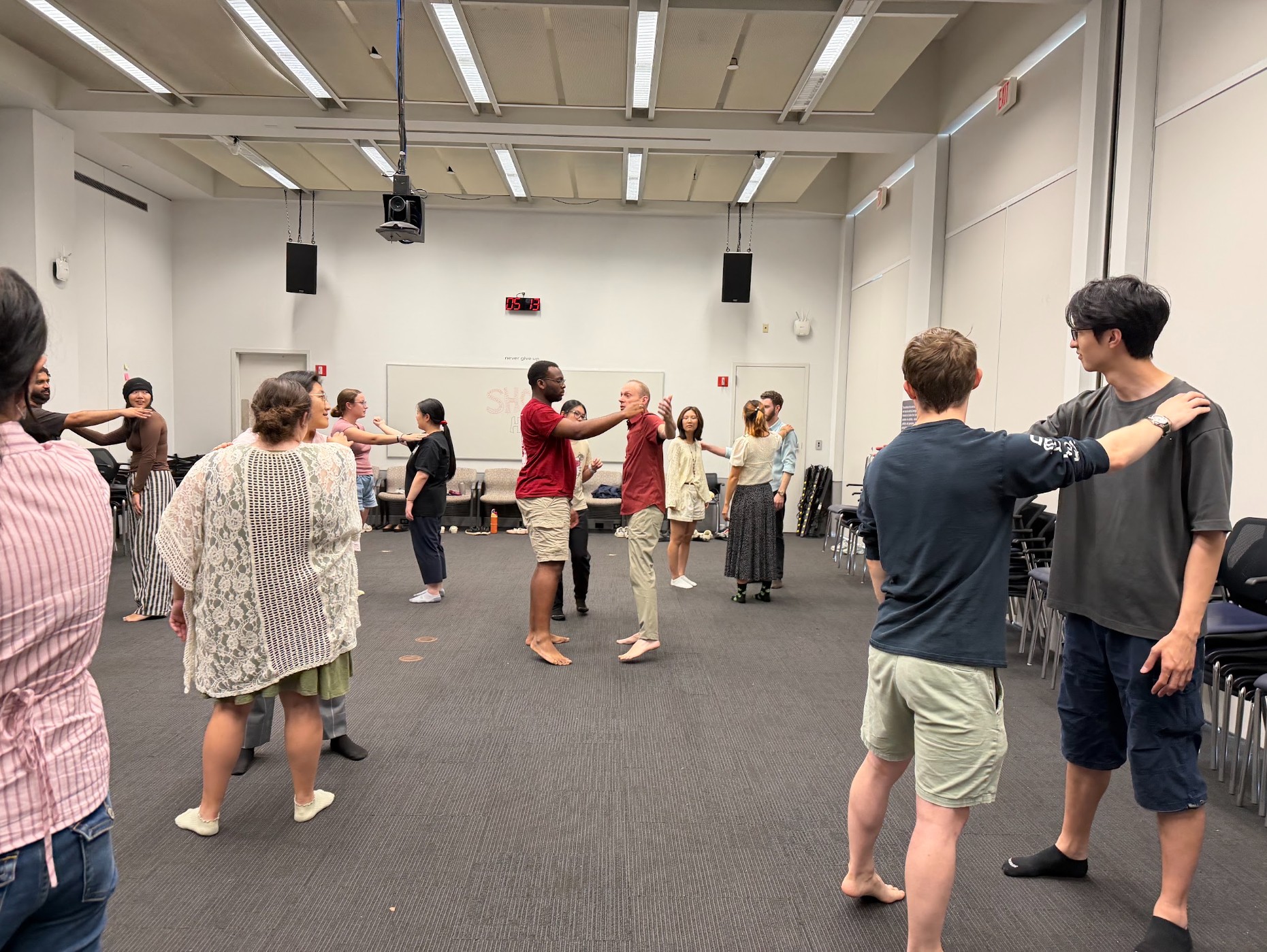
Our Faculty Advisor, Heather Kelley, organized a “Music Experience” led by Dr. Stephen Neely (CMU School of Music). A few members of our team participated in it. If the experience could be summed up in one sentence, it would be “people enjoy being in sync with each other.”
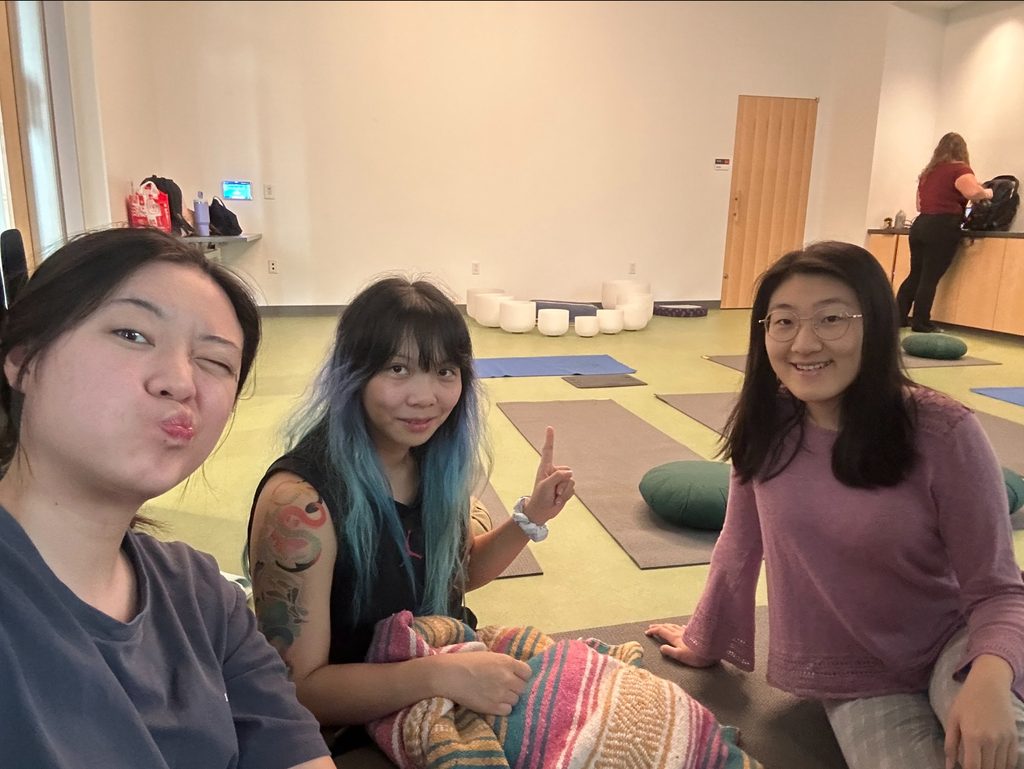
Three of us also went to a Sound Bath on main campus. Hopefully, we can bring a Sound Bath to the ETC very soon, so more people will have an opportunity to try it. It’s just one of those experiences that everyone should try at least once.