October 5 – 9, 2026
Innerverse: Halfway Through the Semester
This week, we reached a major milestone: our Halves Presentation!
At Carnegie Mellon’s Entertainment Technology Center (ETC), Halves is essentially the midterm presentation for project teams. Rather than taking an exam, we share what we’ve accomplished so far, what we’ve learned along the way, and how we plan to move forward during the second half of the semester.
For us, Halves was more than an opportunity to showcase our progress. It was also a chance to share some of the explorations and discoveries that have shaped our thinking.
Revisiting Our Vision
Nightray kicked off the presentation by sharing the inspiration behind Innerverse. We initially envisioned a social wellness playground — an experience where well-being emerges naturally through movement, play, and social interaction, rather than feeling like something players have to actively work toward.
That vision continues to guide our design, even as we’ve refined the experience to fit our technical capabilities and the unique possibilities of the Cavern, ETC’s immersive, 270-degree curved-screen environment.
Learning from the Experts
Next, Christina walked the audience through our conversations with subject matter experts (SMEs). Although we were assigned two experts in wellness and game design, we also proactively reached out to professionals with experience in interactive installations, computer vision, and CAVE systems.
These conversations helped us better understand the technical possibilities and limitations of our setup, giving us a clearer sense of what was achievable within the scope of the project. More importantly, they helped us identify the trade-offs we would need to make.
One particularly important discovery concerned the limitations of computer vision in our existing space. This directly influenced our design direction, pushing us to reconsider our original multiplayer concept and explore a more manageable player count. It was a good reminder that designing an immersive experience isn’t just about imagining what’s possible; it’s also about finding creative ways to work within real-world constraints.
Building an Emotional Journey
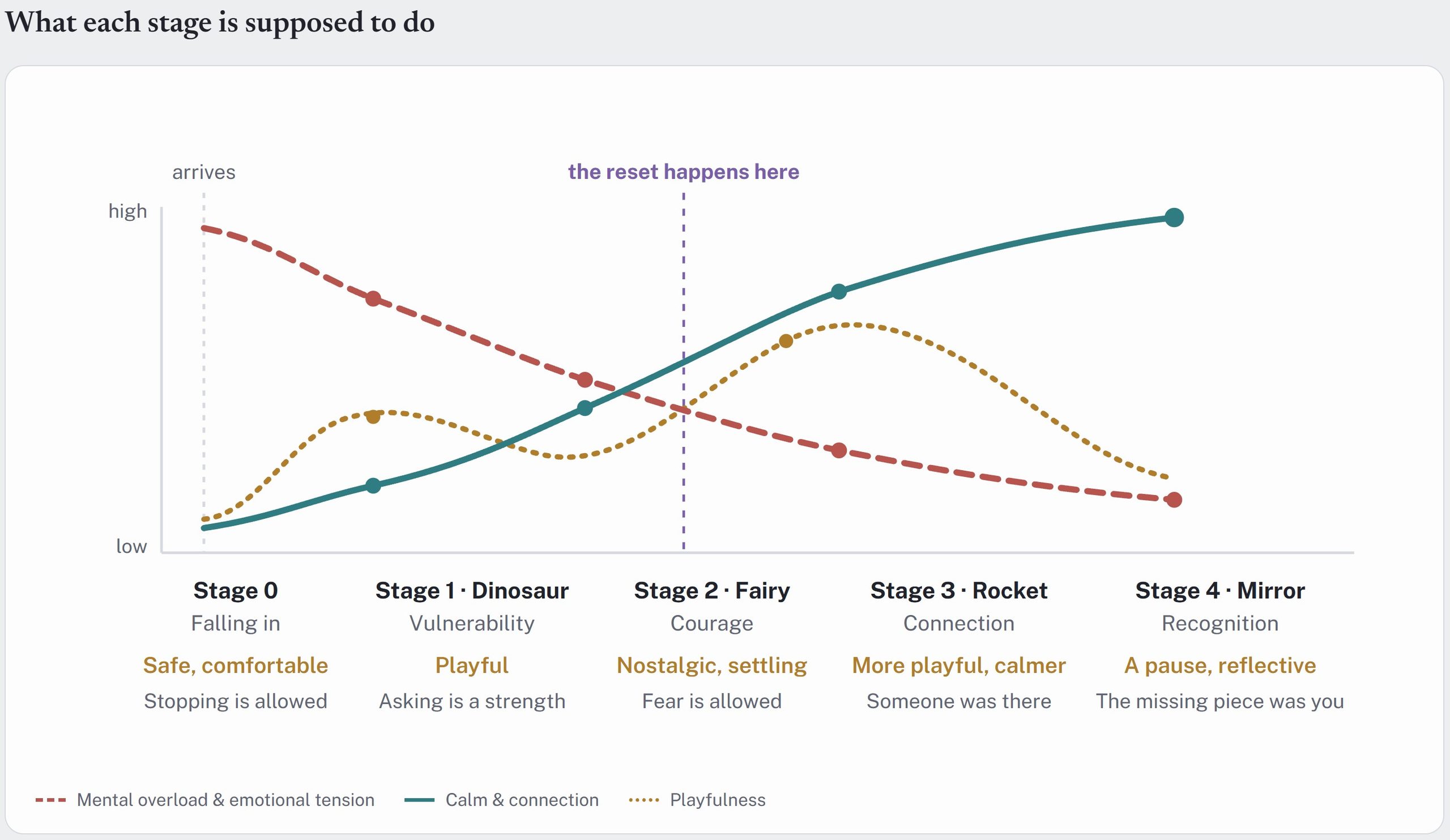
Gamma then introduced the doodle-inspired visual world she envisions for Innerverse. At its core, our goal is to give players an emotional reset: a chance to step away from the outside world, engage with something playful, and leave feeling a little different from when they arrived.
The diagram below illustrates the emotional journey we hope to create throughout the experience, from sparking curiosity to guiding players through a more meaningful emotional arc.
After sharing screenshots from our digital prototype, we shifted our focus to the work of bringing Innerverse into the physical space of the Cavern.
Bringing Innerverse into the Cavern
Aya walked us through the technical development process, including our use of a custom Unity toolkit and the work she’s been doing to improve its body-tracking capabilities. She also explained one of our important technical decisions: using monoscopic rendering. In simpler terms, it just means that the players don’t need 3D glasses. This choice helps us avoid forcing cumbersome wearables onto players.
Aiden showcased our current art assets, including a custom 3D-to-2D shader he developed. The shader gives our three-dimensional models a distinctive, illustrated look, helping bridge the gap between the depth of 3D environments and the charm of our doodle-inspired art direction.
Ethan then offered a sneak peek into the sound effects he’s creating. Sound is an important part of how we want players to experience Innerverse, and we’re excited to see how these audio elements will work together with the visuals and narration to shape the overall atmosphere.
Turning Playtests into Insights
To wrap up, Aya and Gamma shared how we’ve been approaching playtesting and iteration.
We’ve developed an internal playtesting tool inspired by the playtesting framework of Jesse Schell, an ETC professor and game designer. The tool allows us to feed playtest transcripts into an AI system and generate suggestions for future iterations. Rather than relying solely on memory or informal discussions, we’re exploring ways to turn player feedback into a more structured and repeatable part of our design process.
So far, we’ve conducted 9 playtests with 18 players, all using our digital prototype. The results have been encouraging. Players responded well to the music, understood the key messages conveyed through the narration, and were generally able to complete the experience without much outside guidance.
These findings suggest that the core experience is coming together: the narrative is communicating what we intend, the audio is resonating with players, and the gameplay is intuitive enough for people to navigate on their own.
Of course, there’s still a big step ahead. So far, we’ve only tested the digital prototype rather than the full experience in the Cavern. Our next challenge is to bring everything together in the actual Cavern environment and see how the experience holds up.
Below is our presentation deck.
Below is a recording of our presentation.
This semester is the first time where a faculty playthrough happens right after the Halves presentations. This process was implemented in the hopes of helping teams get real feedback on our current build.
We are super thankful that this happened because we got 6 playthroughs done with 12 faculties/staffs/guests, and the concentrated, back-to-back playthroughs gave us a good impression of what is missing from the experience. For instance, if one part confused the players almost every time, then that part deserves our attention the most.
The team is going to let the feedback sink in over fall break. After we return to school, we are planning to discuss as a team and come up with revised goals and a changelist of things that should be improved.